The strongest work I’ve been part of at Arke hasn’t started with a prescribed deliverable. It started with a deeper, early, conversation. Usually one where a brand is still working out what actually needs to change and why it matters commercially, before anyone has committed to a channel, a budget or a timeline.
That shared thinking stage is where a lot of the value sits. And it’s the part that gets squeezed and rushed most often.
The way brands and agencies work together has shifted a lot in the last few years. Marketing teams are under more pressure to move quickly, prove more and make budgets work harder. There are more channels, more platforms, more data sources and more tools than most teams can realistically stay on top of.
So it’s completely understandable that brands often come to agencies looking for pace, clarity and delivery, and that agencies, wanting to be useful, lean into that.
But somewhere in that pace, an important part of the relationship can get lost.
Quite often, by the time the agency is properly in the room, the shape of the answer is already decided. The channel has been chosen. The budget agreed. The timeline set. The expected output is clear. The agency is being asked to deliver against that well, which matters. But it hasn’t had the chance to help shape whether that work is the best route to the result the brand actually needs.
That isn’t a criticism of how brands work. The clients we partner with know their businesses, customers and internal pressures better than any agency ever will. But internal knowledge and external perspective do different jobs. The strongest partnerships happen when those two things meet early enough to influence the plan, not just execute it.
A good agency should be able to answer the brief.
The relationship gets more valuable when the agency is also helping shape the question.
Biggest mistakes when briefing a marketing agency
One of the easiest traps in marketing is starting with the format.
- “We need a paid social campaign.”
- “We need more leads.”
- “We need a new landing page.”
- “We need to reduce acquisition costs.”
-
“We need more content.”
Any of those might be right. But they’re rarely the actual problem, and treating them as the answer before testing the question is how time and budget end up working hard in the wrong direction. A paid social campaign won’t fix weak conversion. More leads won’t help if the issue is lead quality. A new landing page won’t solve unclear positioning. A lower acquisition cost looks good in a dashboard, but if those enquiries don’t convert into meaningful sales, the business hasn’t actually moved.
This is where the relationship earns its place: not by an agency being difficult, but by both sides pressure-testing the route together before time, budget and expectation are wrapped around it.
The patterns are usually familiar. A brand asks for more media spend when the bigger issue is what happens after the click. The campaign then gets judged on sales or leads, even though the real friction sits further down the journey. Or a business wants to reduce acquisition cost, and the proposed route is almost entirely bottom-of-funnel, which might move short-term numbers, but doesn’t answer whether enough of the right people know, trust or understand the brand in the first place. Or reporting creates a false sense of control.
The dashboard is full, but if the right questions weren’t asked at the start, it ends up measuring activity rather than progress. Everyone can see what happened. Nobody is quite sure whether it was the right thing to do.
None of this comes from bad intent. It comes from pressure. Teams are busy. Decisions need to be made. Stakeholders want a plan. Momentum matters.
But when the thinking stage gets compressed, marketing can become very busy without becoming more effective, and that’s a harder problem to spot from the inside, because everything looks like it’s moving.
This is where accountability and access need to line up.
What a good marketing agency should be accountable for
If an agency is asked to deliver a campaign, manage a budget, build a website or produce assets, it should be judged on the delivery. Was it on time? On budget? Was the quality there? Did the team communicate well? Were the basics handled properly? That’s fair. That’s delivery accountability, and we welcome it.
But when the conversation is about growth, revenue, lead quality, acquisition or long-term efficiency, the agency needs more than a brief. It needs to understand what success actually means to the business. Without that, an agency can still do a good job, but it may be doing a good job inside a plan that was already limited before it arrived. And neither side really wins from that.
Why the best agency relationships start before delivery
This is the part we try to get right from the start at Arke. Before we get to channels or deliverables, we want to understand the context around the work. What is the business actually trying to change? Where’s the pressure coming from? What’s been tried already, and what was learned? What’s known, and what’s assumed? What does success look like as a business outcome, not just a marketing one?
From there, the route gets clearer. Sometimes that means challenging the channel choice before the plan is locked. Sometimes it means reframing the brief around the real customer barrier. Sometimes it means flagging that the website, the sales journey or the measurement setup needs attention before more budget goes into acquisition. Often, it means confirming the original brief was exactly right and getting on with it. Occasionally, it means saying the brief isn’t quite the right brief yet, which isn’t a blocker. It’s a better starting point.
A good relationship should feel supportive. It shouldn’t feel passive. If an agency only ever agrees, the brand probably isn’t getting the full value of the partnership. There are times when the most useful thing to say is: that channel might not be the problem. That target’s achievable, but not on that timeline. This campaign will drive traffic, but not the right kind of demand. You may not need more spend yet: you may need to fix the journey first.
That kind of challenge only lands when it comes from the right place. Not ego. Not making a point. Just a shared commitment to getting to the strongest answer, because both sides are accountable to the same outcome.
So if you’re shaping a brief, reviewing your agency setup, planning a launch, or quietly wondering whether your marketing activity is solving the right problem, it’s worth having that conversation before the plan is locked. Not to slow things down. To make the route sharper, clearer and more commercially useful before time and budget are committed.
The best agency relationships don’t start with a list of deliverables.
They start with a better question. Let’s start the conversation.
2026 has reinforced the need for businesses to balance visionary leadership with strategic execution.
AI has dramatically lowered the barrier to producing content, campaigns and creative assets. Execution is cheaper and faster than ever before.
But when every business has access to the same tools, differentiation no longer comes from output volume alone. It comes from strategic alignment, commercial understanding and the ability to connect brand positioning with measurable growth outcomes.
In this article, Steph, Arke’s Founder, explains the state of play in 2026.
It’s all about the disconnection
The problem is not that brand and performance require different specialist skills, they absolutely do. It is that many agencies still build entirely separate strategies, reporting structures and success metrics around them.
Where is the integration? We’ve seen brand teams optimising for awareness, performance teams optimising for acquisition and CRM teams optimise for retention…
…Meanwhile, leadership teams are left trying to piece together what is actually driving growth.
What’s happening?
This year, we’ve seen businesses shift their focus from pure cost reduction towards generating greater commercial value and sustainable profit.
For a performance marketing agency this means analysing past performance, goal setting, strategic planning and specialist execution to gain competitive advantage. The difference this time it’s across marketing tactics and operations.
What we’re doing at Arke
More than ever before we are working with CFO’s, boards and directors alongside the marketing team. They are no longer asking, “How many leads did we generate?”
They’re asking:
- Which campaigns (not channels) drive the most profitable customers?
- What is the true cost of acquisition over time?
- How does brand investment reduce future acquisition costs?
- Where are we losing customer value after conversion?
These are not siloed marketing questions, they are business growth questions.
Collaboration and alignment are becoming business priorities rather than marketing preferences. The questions above rely on far more than the marketing team alone.
True accountability becomes difficult when execution sits across fragmented teams with disconnected objectives. Even more so when individuals do not understand the wider commercial impact of the work happening around them.
Often, training, investment and experience, leads agencies to hone in on one or the other, but since we at Arke brought this all under one roof and within one team we’ve seen, measured and built upon, the short, mid and long term impact campaigns actually have.
Not to mention the hidden costs of separation from duplicated spend to missed opportunities.
Why does this matter?
This is because modern growth strategies require businesses to look beyond immediate conversions. Short-term attribution models still matter. CPA, ROAS and conversion rates remain critical performance indicators, but sustainable growth comes from understanding what happens after acquisition:
- Customer lifetime value
- Retention behaviour
- Repeat purchase patterns
- Churn indicators
- Brand affinity over time
This is where integrated brand and performance strategies outperform siloed campaigns.
Success does not fall to marketing agencies that simply produce more content, run more ads or automate more processes. It belongs to agencies capable of aligning brand, performance, CRM, data and commercial strategy into a single growth engine.
Integration and collaboration are key, building and resourcing integrated teams is an investment.
AI supports process streamlining, however, you can’t take your AI agent into the board room and hold them to account or as equally as important, to understand the next strategic priority, the context and widening factors to achieve the next milestone.
Why do most agencies separate brand and performance?
Because that’s what the industry is used to.
Business growth isn’t only a marketing job. It’s a job across product, operations, finance, compliance, IT, the list goes on. Listen, learn, share insight and crucially adapt.
We need to remember businesses do not experience growth in marketing silos, and customers do not experience brands in silos either.
Brand creates demand, performance captures it and the businesses growing fastest in 2026 are no longer treating those as separate functions, they integrate.
And the agencies creating the most value are doing the same.
Curious about it? Let’s have a chat and discuss what an integrated marketing strategy could do for your business.
With the clock ticking until Black Friday, the Arkenauts have put together a checklist for the main things you need to consider and can still action on time for a successful marketing strategy during BFCM.
Whilst we at Arke can support your overall strategy, we recognise that pricing, inventory planning, web development, and logistics optimisations may not be too flexible by now, but your BFCM marketing campaign can still be a success by following our tips.
10 steps to succeed this Black Friday.
1. Define how long you will take part for
What started several years ago as a one-day shopping frenzy has been diluted by multiple approaches, with retailers offering their Black Friday discounts for several days or even weeks. Analyse what impact this will take on your brand, bottomline, and your customers’ perception if you participate in Black Friday over an extended period.
2. What will you offer?
BFCM can be a great opportunity to reduce inventory levels and clear collections. Site-wide discounts can be communicated more easily to customers, but going granular can also increase your customers’ perception of hitting the jackpot if you’re able to offer irresistible discounts.
3. Have a look at your results from last year
Don’t forget to check the performance of your online store last year. Were there any pain points that need to be communicated (such as an extended period for deliveries?). Were there any collections that didn’t perform as expected or others that surpassed your objectives and that may offer a chance to increase your margins?
4. Set up your BFCM page
If you haven’t got a BFCM landing page from previous years, it’s never too late to create one where your promotions are shown with exclusive content for the duration of the campaign. This page will also be a great testing ground to where you can direct your paid campaigns.

5. Design your multi-channel communications strategy
Losing sales by communicating too late or receiving complaints from customers who purchased before the campaign goes live is a common scenario. Clearly communicate your returns policies during BFCM and any price-matching strategies you’re able to put in place. Decide well in advance when you will start communicating your Black Friday marketing campaign.
6. Target your paid campaigns accurately
Use advanced segmentation based on your customers’ profiles and retargeting for those who visited your site before your BFCM campaign goes live.
With competition and demand increasing considerably during the run-up to BFCM, it’s always crucial to direct your budget to those most likely to convert, whilst also trying to reach new audiences.
Consider launching data-capture competitions and give-aways four weeks before Black Friday to build up your email list and retargeting campaigns.
At Arke we can help you devise a correct bidding strategy to win the day, optimising towards target ROAS and maximising value to boost your marketing ROI.
7. Can you offer a sustainable spin to your customers?
The consumerism spirit of the discounting campaign could pose a contradiction to your brand values. In response to this, creative initiatives have gained prominence over the years so you can have a sustainable Black Friday campaign. At Arke we don’t take a one-size-fits-all approach and specialise in tailoring creative strategies for each of our clients. Interested? Just hit that contact button and tell us about your unique needs.
8. Prepare your teams
The most successful marketing campaigns cannot be detrimental to your customers’ experience. Consider any additional support your teams will need for increased demand over BFCM and the run-up to the holidays, so your customers get your products on time and their questions answered swiftly.
9. Plan for loyalty and retention
BFCM is not just about discounts. Take it as an opportunity to scale LTV, showcasing your values and the quality of your products.
Make sure your reviews are clearly shown not just on your website but also across your multi-channel communications, and have a plan in place to reward loyal customers who act as referrals and ambassadors of your brand.
10. Check your tracking!
Having inaccurate data is one of the biggest issues retailers face to understand the performance of their marketing campaigns. Server-side tracking combined with Consent Mode V2 are required to stay privacy-compliant and enhance accuracy.
Download Arke’s Black Friday Marketing Checklist
Let’s talk about your eCommerce strategy
Our expertise across multiple industries is constantly recognised as refreshing by our clients as we bring fresh perspectives and learnings gained over the years.
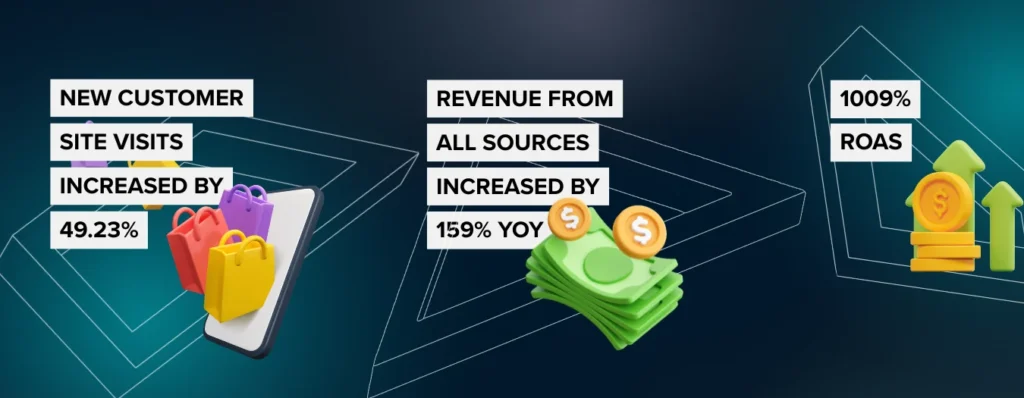
Our Black Friday campaign for Shay & Blue won the Best Paid Social Campaign at the UK Paid Media Awards, bringing record ROAS, revenue and engagement among younger audiences. These are some of the stats we achieved with them:
Let’s have a chat and tell us about your unique needs or book an intro call directly.
How is SEO changing with the introduction of AI Mode?
Simply put, Google is rebuilding Search around AI chat. More than 100 million people are already using AI Mode, and the ad switch is flipping just in time for the holiday rush. That means our single-word keywords are giving way to full-blown conversations with AI.
What’s changed? Context. Everything the user has asked so far is going to become the new targeting goldmine.
Key Timelines
Google’s AI Mode Ads Roll-out in the UK vs US:
| Milestone | United States | United Kingdom |
| Public launch of AI Mode | 20 May 2025 | 28 Jul 2025 |
| Ads inside AI Mode | Live tests since May; broad roll-out “before Q4” 2025 | Still offline as of August; expected once US data lands in Q4, late 2025 |
| Regulatory climate | DOJ antitrust trial hangs over search | CMA decision on “Strategic Market Status” due 22 Oct 2025 |
This means that now is the perfect time to experiment with organic content and how search queries affect AI Mode results. Anything you can learn now, will vastly improve your ability to effectively deploy ads once paid inventory finally opens towards the end of 2025.
What Are Google AI Mode Ads?
Google’s AI Mode is a full-screen chat interface baked into Search. Instead of typing a short query and scanning blue links on the SERPs, people hold a back-and-forth conversation with the AI to find accurate, informative answers.
Until now, that chat has been ad-free. However, Google is looking to change that in Q4 2025 by weaving AI Mode Ads directly into the dialogue. Here’s how it will look and feel:
-
- Native placement, not banners. Ads appear as extra messages inside the chat clearly labelled, but part of the flow so users don’t leave the conversation.
-
- Context over keywords. The system reads the entire chat history, then surfaces an ad that fits the moment.
-
- Familiar formats, new trigger. Text and product-listing styles stay the same; but what’s new is the timing and relevance. Existing Performance Max campaigns will be automatically eligible for placement within AI Mode.
-
- Measured in sessions, not clicks. Because users may act later bookmarking, revisiting, or buying after another chat Google will push “value-per-session” metrics alongside traditional click-through rates.
Think of it as Google’s answer to ChatGPT-style shopping advice. Keeping visitors inside the Google ecosystem, serving them helpful ads at the right conversational beat, and collecting richer intent data along the way.
Why Is Google Fast-Tracking the Deployment of New Ads Inventory?
Google’s sales still hugely depend on search ads, but a range of factors are beginning to squeeze that income and Google needs to work quickly to keep revenue flowing in:
-
- People are clicking fewer links
When SERPs already shows a direct answer to queries around weather, sports scores, and now an AI summaries are provided, users are far less likely to leave Google. However, fewer clicks mean fewer chances to show classic ads. Therefore, putting paid messages inside the AI chat keeps those advertising dollars flowing without sending users elsewhere.
- People are clicking fewer links
-
- Rivals are teaching us to search differently
ChatGPT, Microsoft’s Copilot in Bing, and even Amazon’s voice tools are training people to ask questions in plain language, producing conversational replies. If Google lets that habit form on a competitor’s platform, it risks losing both users and ad budgets. Moving quickly makes Google the place where those new habits are likely to root first.
- Rivals are teaching us to search differently
-
- Q4 is the retail sector’s “World Cup”
November and December account for up to 30% of many retailers’ annual sales. If Google can prove that conversation-based ads boost holiday performance, it will win early case studies and increase the likelihood of retaining advertiser adoption. With the aim of setting themselves up for a flood of budgets ahead of 2026.
- Q4 is the retail sector’s “World Cup”
- Increased usage of AI means better training data for Google
Each AI reply will help Google understand how people’s searches and questions are changing. Launching ads alongside the AI Mode product will give Google another string to their bow: new revenue streams today and richer data to improve tomorrow’s model.
Put simply, Google is racing to protect its main income stream, stay ahead of new competitors, and lock in user habits before the biggest shopping season of the year in Q4. That urgency explains why AI Mode is rolling out now rather than waiting for every policy and product detail to be perfect.
Priority Checklist
How UK Brands Should Prepare for Google AI Mode Ads:
| Priority | Why It Matters | What To Action in 2025 | Category |
| Clean Data Feeds | AI search tools (Google’s SGE and Bing Copilot) pull information directly from your product or service feed. If this data is incomplete, messy, or out of date, users may see incorrect or unattractive results. | Audit and clean all structured data feeds. Ensure titles are clear, no typos, and all fields are complete. Add helpful extras like delivery times, sustainability tags, and service availability. | SEO |
| Write Content for Conversations | AI-driven search and advertising is now triggered based on the topics and intent of the user, not just keywords. That means your content and ads need to anticipate user questions and the intent behind them. | Rewrite ad copy and landing pages to answer natural follow-up questions. Such as “Is this right for me?” or “How does it compare?” Use short FAQs, comparison tables, or visual explainers to help with legibility. | Content / Paid Media |
| Track Chat Journeys | AI search experiences often skip your site entirely, or delay conversions so traditional tracking misses key touchpoints. | Set up server-side tracking to better attribute conversions (this can be actioned through SGTM). Consider modelling multi-step user journeys that span multiple sessions and channels. | Analytics / Attribution |
| Flexible Budgeting | AI-generated ad placements and formats are still evolving, and performance can vary. You need budget room to test without risking core campaigns. | At Arke we would recommend ringfencing 10-15% of your paid search budget for AI-based formats (e.g. Search Generative Experience ads). Monitor weekly and reallocate funds based on ROI. | Paid Media / Budgeting |
Potential Risks for Google AI Mode and What to Watch Out For
Regulatory brakes
The UK Competition and Markets Authority could soon label Google “strategically significant,” unlocking powers to demand clearer ad labels or even pause new formats. A decision like that could push back or delay the UK launch, so we’d suggest building wiggle room into your Q4 timeline.
Publisher push-back
When Google’s chat answers a query outright, news sites and blogs lose clicks and they will understandably lobby hard for changes. Google has adjusted its page layouts before under similar pressure, so your ad real estate could shrink or shift with little notice. Keep creative and budget plans flexible.
Difficult measurement
Chat users rarely follow a neat click-and-buy path, making sales attribution difficult. Teams with solid first-party data pipelines will see the real performance faster; those relying solely on Google’s reporting will be stuck guessing. Shore up your data where you’re able to now, to avoid flying blind during the rollout.
What We’re Telling Clients Right Now
We’ve got roughly twelve weeks before Q4 kicks off for 2025. Here’s how Arke are approaching it and what we recommend:
-
- Experiment early while bids are cheap.
-
- Treat AI Mode as upper and mid-funnel. Optimise for engagement assists, not just last-click wins.
-
- Fight for creative resources. Narrative-led assets outperform price-led blurbs inside chat.
-
- Keep your clients up to date with changes and manage expectations.
Keyword bidding still matters, but the search game is getting much bigger and increasing in complexity. Conversation-led journeys are opening fresh lanes for creativity and growth for advertisers and brands alike, and the first adopters that test, learn, and adapt will set the pace for everyone else.
Do get in touch with us if you want to talk more about AI Mode Ads, we’ll be happy to help!
What It Means for Marketers and Why the Future Isn’t All Doom and Gloom
Recent news on the antitrust rulings against Google in the United States, alongside ongoing investigations in the UK and EU, have cast a wider spotlight on Google’s dominance in the ad tech ecosystem. With 38.9% of surveyed audiences in the UK discovering new brands through search, and 88.4% of them primarily using Google to do so (data from GWI), marketers have long understood the importance of integrating Google within our strategies. As the US continues pushing for Google to break up their AdTech assets, the concern for how these proposed consequences may impact our industry can seem daunting. However, they open up room for a conversation on the future of digital marketing and opportunities for diversification, innovation, and enhanced transparency.
Are Google Selling AdX and DFP?
In April 2025, the U.S. federal court determined that Google had unlawfully monopolised the digital advertising market, particularly through its Ad Exchange (AdX) and DoubleClick for Publishers (DFP) platforms. The Department of Justice (DOJ) has since proposed a structural remedy: requiring Google to sell these parts of its AdTech infrastructure. This move aims to dismantle what the DOJ perceives as an entrenched monopoly that stifles competition and innovation.
Naturally, Google contests these findings, arguing that such a breakup would be technically complex and detrimental to the digital advertising ecosystem. Instead, the company has proposed behavioural remedies, including increased transparency in ad auctions and equal access to bidding tools for competitors.
Meanwhile, in the UK, the Competition and Markets Authority (CMA) has provisionally found that Google abused its dominant position by favouring its own ad tech services, harming competition and disadvantaging publishers and advertisers. Similarly, last year, the European Commission rejected Google’s offer to sell part of its ad tech business, deeming it insufficient to address competition concerns
There’s also another antitrust case occurring alongside, where the DOJ (and now FTC) have found Google holds a monopoly on search, so don’t get the headlines mixed up when you look through the news!
Implications for Transparency and Data Access
One of the central criticisms against Google centres around the lack of transparency within its ad auction processes. The DOJ’s proposed remedies include requiring Google to release auction code under an open-source license and to share auction data with competitors. Such measures could democratise access to valuable data, enabling advertisers and agencies to make more informed decisions and fostering a more competitive environment.
For those of us in marketing, this shift would mean enhanced visibility into ad performance metrics, facilitating more strategic campaign planning and optimisation (which I’m sure we’d all love to get our hands on!).
Opportunities for Diversification
The potential restructuring of Google’s ad business underscores the importance of diversification in digital marketing strategies. Relying heavily on a single platform poses risks, especially while future ad tech regulation remains uncertain.
Marketers should consider exploring alternative advertising channels, such as programmatic advertising platforms, social media networks, and the emergence of ad placements within AI models and platforms. These avenues not only mitigate dependency risks but also offer access to diverse audiences and innovative engagement formats.
Strategic Takeaways for Marketers
-
- Stay Informed: Keep up to date on regulatory developments in key markets, including the US, UK, and EU, to anticipate changes that may impact advertising strategies. Decisions in one market are likely to impact global strategy, so plan accordingly.
-
- Diversify Channels: Explore and invest in a mix of advertising platforms to reduce reliance on any single provider and to reach broader audiences. Embrace opportunities to find where your niche lives so you can ensure you’re reaching them there.
-
- Embrace Transparency: Utilise increased access to data and transparent auction processes to optimise campaign performance and ROI.
-
- Keep Innovating: Adopt emerging technologies to enhance targeting, efficiency, and adaptability in marketing efforts.
As we wait for the next hearing on September 22nd, the antitrust proceedings against Google may be a period of uncertainty. However, they also open the door to a more competitive and transparent digital advertising landscape. For marketers, this is the moment to reassess strategies, embrace diversification, and leverage technological advancements. By staying informed and adaptable, marketing professionals can navigate these changes effectively, turning potential challenges into avenues for growth and innovation.
Looking for an innovative agency to work with on reassessing your strategies? Check out our marketing consultancy services and contact us today.
Google Tag Manager (GTM) is an essential tool for marketers and analysts, offering a streamlined way to manage website tracking without needing constant developer support. However, while GTM simplifies tag management, implementing it effectively requires a strategic approach. A poorly structured GTM setup can lead to inaccurate tracking, data discrepancies, and slow website performance.
To help you maximise the power of GTM, James Seddon, our Digital Strategy Lead at Arke, shares his top six best practices for a cleaner, more efficient tracking setup.
What are Google Tag Manager (GTM) Best Practices?
1. Give yourself a stable foundation
A well-organised GTM container is key to keeping your tracking clean and manageable. Clearly naming your tags, triggers, and variables makes troubleshooting and future updates far easier. Instead of generic names like ‘Tag 1’ or ‘Conversion Event,’ use descriptive and standardised naming conventions such as ‘Arke – GA4 – Form Submission – Contact Page’ or ‘Arke – Facebook – Purchase Event.’ This ensures clarity, consistency, and ease of maintenance, especially when multiple team members or agencies are involved.
A structured approach also involves categorising tags based on their function and separating analytics tags from marketing pixels and third-party tracking scripts. This helps maintain an organised environment and avoids confusion when making updates. The easiest way to do this is through GTM’s built-in folders function.
2. Utilise the Data Layer
The data layer is your best friend when it comes to accurate tracking. Rather than scraping elements from the Document Object Model (DOM), which can break with website updates, a structured data layer ensures data integrity and stability. It acts as a centralised hub for data collection, feeding relevant information to GTM, which then sends it to the various destinations you require.
For example, instead of extracting transaction values from the webpage using CSS selectors, push them into the data layer like this:
dataLayer.push({
‘event’: ‘purchase’,
‘ecommerce’: {
‘transaction_id’: ‘12345’,
‘value’: 99.99
}
});
By doing this, you create a more reliable and flexible tracking setup that won’t break when minor changes are made to the website’s front end.
3. Avoid Tag Bloat
Adding too many tags can slow down site performance and create unnecessary complexity. Each tag added increases the risk of conflicting scripts, longer page load times, and potential errors.
To prevent tag bloat:
-
- Regularly audit your GTM container and remove redundant or outdated tags.
-
- Consolidate multiple tracking tags where possible. For instance, instead of having separate event tags for different buttons, use a single tag with dynamic triggers.
-
- Leverage GTM’s built-in functions instead of adding excessive custom JavaScript.
-
- Use lookup tables and regex to manage multiple tracking IDs efficiently.
4. Test Before You Publish
GTM’s Preview Mode exists for a reason – use it! Testing before publishing ensures that your tags fire correctly and that data is being sent to the right platforms. Before making changes live, run tests to verify:
-
- Are the correct tags firing at the right time?
-
- Is the data being captured accurately?
-
- Are there any errors in the GTM container that could disrupt performance?
Additionally, integrating tools like Google Tag Assistant, Chrome DevTools, and TagDebugger can help diagnose any issues and provide deeper insights into how your tracking setup is functioning.
5. Manage User Access Wisely
Not everyone needs full control over GTM. Granting unrestricted access to all users can lead to accidental misconfigurations, data loss, and untracked conversions.
A quick summary of the different access levels can be found below.
-
- Read-Only – Allows users to review tags but not make changes.
-
- Edit – Enables users to configure and edit tags but not publish.
-
- Approve – Requires changes to be reviewed before being published.
-
- Publish – Full control over implementing changes live.
6. Document Everything
Tracking implementations can become complex, especially over time. Keeping a detailed record of what’s been implemented, why, and by whom is essential for maintaining a robust tracking setup.
-
- Use GTM’s ‘Versions’ feature to monitor changes and roll back if necessary.
-
- Maintain an external Measurement Framework that documents tags, triggers, and variables used, along with their purpose.
-
- If you’re working with an agency or multiple teams, a shared knowledge base can prevent duplicate efforts and miscommunication.
How Arke Can Help
At Arke, we don’t just implement GTM, we optimise it for long-term success. Whether you’re setting up GTM for the first time, improving your tracking capabilities, or refining an existing container, we ensure best practices are followed so your tracking is reliable, scalable, and aligned with business objectives.
Here’s how we can support your GTM implementation:
-
- Strategic Setup & Tagging Structure – We ensure your GTM is well-organised, with clear naming conventions and logical categorisation, making future updates seamless.
-
- Advanced Tracking Solutions – From enhanced eCommerce tracking to detailed scroll depth monitoring and custom event tracking, we implement tailored solutions that go beyond basic setups.
-
- Data Layer Implementation – We ensure your website is structured with a robust data layer, improving the accuracy and reliability of your tracking.
-
- Tag Audits & Optimisation – Our team conducts in-depth audits of your GTM container to identify inefficiencies, reduce tag bloat, and enhance performance.
-
- Error Debugging & Troubleshooting – We identify and resolve tag firing issues, ensuring smooth data flow to platforms like Google Analytics, Meta Ads, and LinkedIn.
-
- Training & Support – We offer hands-on training sessions to help your team understand GTM, making them self-sufficient in managing and troubleshooting tracking setups.
Whether you need a fresh GTM setup or a fine-tuned solution, Arke is here to help. Get in touch today to ensure your tag management is working seamlessly for your business and driving the insights you need.
The Evolution of the Hashtag Social Media Strategy
Once upon a time, hashtags were the backbone of social media discovery. A simple #ThrowbackThursday could skyrocket engagement, and brands relied on a hashtag social media strategy to track campaigns and trends. But as social media platforms evolve, their algorithm changes and AI-driven content recommendations raise a crucial question: Are hashtags still relevant, or are they officially #dead?
How Hashtags Have Changed Over Time
Hashtags first gained popularity on Twitter (now X) in 2007, helping users categorise conversations. Soon, they became a staple on Instagram, Facebook, LinkedIn, and even TikTok. However, their effectiveness has fluctuated as platforms prioritise keyword-based search, AI-driven feeds, and personalised recommendations over traditional hashtag discovery; even
So, should we still use them? Let’s weigh the pros and cons.
Why Should You Use Hashtags in Your Social Media Strategy?
Discoverability
Hashtags still help users find content, especially on platforms like Instagram and TikTok. They help posts appear in topic-specific searches and suggested feeds (although the usefulness of hashtags on Instagram is up for debate, but more on that later).
Community Building
Niche hashtags foster online communities. Think #BookTok for book lovers or #VanLife for digital nomads. Users engage with others who share their interests, boosting interaction.
Brand Awareness
Branded hashtags like #ShareACoke (Coca-Cola) and #LikeAGirl (Always) help brands spread their message and encourage user-generated content.
Campaign Tracking
Businesses and marketers can use hashtags to track engagement and campaign performance, making it easier to measure ROI.
The Issues with Hashtags
Overuse and Misuse
Some posts are buried under irrelevant or excessive hashtags. Examples such as #Love #Happy #InstaDaily, are generic hashtags that rarely add value.
Relevancy to Content
Algorithms favour contextually relevant content over hashtag stuffing. Using #MondayMotivation on a random Tuesday post won’t help, so make sure you tailor your hashtag strategy to the platform you’re on.
Platform-Specific Behaviour
Hashtags work differently across platforms. While Instagram allows up to 30 hashtags, LinkedIn and Facebook users engage less with hashtag-heavy posts. Meanwhile, both Threads and Bluesky added hashtags after launching the platforms, and Threads limits hashtag usage (called tags on Threads) to only one per post!
Different platforms will also prioritise hashtags in their algorithms differently and these are ever-evolving, so ensure you’re keeping an eye on your metrics and the latest news.
Are Hashtags Still Relevant on Instagram?
Since 2022, Adam Mosseri (Head of Instagram) has said several times that hashtags do not have an impact on various metrics such as views or reach. Despite this, hashtags continue to be used on the platform. Audiences have grown used to seeing them, and some marketers still report seeing improvement in their metrics. Ultimately when deciding whether to use hashtags in your posts, pay attention to platform updates and announcements, but track your own metrics and test where you can.
Key Strategies for Hashtag Strategy Success
Hashtags aren’t dead, but they require smart usage. Here’s how to make them work:
-
- Quality over quantity – Stick to a few highly relevant hashtags rather than spamming 30.
-
- Research & test – Use platform analytics to see which hashtags drive engagement.
-
- Branded hashtags – Create unique hashtags for campaigns to encourage user participation.
-
- Monitor trends & platform updates – Social media is ever-changing, so adapt accordingly.
What Could Replace Hashtags?
-
- Keyword-Based Algorithms – Search and discovery are now driven by keywords and captions rather than hashtags.
-
- AI-Powered Content Recommendations – TikTok and Instagram suggest posts based on user behaviour, reducing reliance on hashtags.
-
- Social Listening Tools – Brands use tools to track conversations without needing hashtags.
-
- Niche Communities & Forums – Platforms like Reddit and Discord create highly engaged communities without hashtag dependency.
Conclusion
Hashtags Are Not Obsolete
While hashtags are not as powerful as they once were, they are far from obsolete. They still help with discovery, branding, and engagement but strategy matters. The future of social media lies in contextual content, AI-driven recommendations, and community-driven conversations.
So, are hashtags #dead? No, but they’ve evolved (and so should your social media strategy)!
Meta has a long history with EU data regulations, most notably its record-setting €1.2 billion fine in 2023 for breaking GDPR regulations. Meta was found to have been transferring European user data to the United States and was ordered to cease this, in addition to the fine.
In November of 2023, Meta launched an ad-free subscription service exclusively for users in the EU to provide an alternative method to using their services, compared to their standard advertising model. This was in direct response to the EU ruling, and the Digital Markets Act (DMA) coming into full force since its introduction in 2022.
However, in July of this year, the European Commission found that this new model was still in breach of their laws due to the service’s “Pay or Consent” nature. Regulators saw the DMA requires non-paying users to still have access to services without having to either pay a subscription fee or consent to their personal data being used for targeted advertisements.
What we know
As of November 12, 2024, Meta has announced that they’re rolling out two new updates to their advertising model in the EU: reducing the cost of their ad-free subscription service by 40%, and launching the option to opt out of personalised ads for EU users. These come off the back of the European Commission DMA rulings, which puts Meta at risk of being fined up to 10% of their global revenue.
Whilst Meta are making changes to appease the European Commission, their own pro-personalisation stance mean the changes are very limited in geographical range. Meta also claims that European businesses earn €107 billion in revenue from personalised ads on their platforms each year and that for every €1 spent on Meta ads, €3.79 is earned in advertiser revenues in Europe.
How will the new “Less Personalised Ads” work?
Meta will use less personalised data to decide which ads to show users, relying instead on session context (what the user is seeing during that particular Facebook or Instagram browsing session), and broad data points such as age, location, gender, and ad engagement.
However, Meta is also rolling out the introduction of “ad breaks” within this new mode. This will allow advertisers to purchase unskippable ad breaks lasting a few seconds, which will allow Meta to ensure they’re still providing value to advertisers within the EU, whilst hopefully complying with EU regulations.
Which countries is this being rolled out to?
All European Union countries, in addition to the EEA and Switzerland. The UK is not affected by these new changes.
Why is Meta implementing these changes?
The European Commission has been cracking down on large tech companies, and Meta is no exception. Meta themselves wish to continue advocating for personalised advertising: “We will continue to advocate for regulations that support the responsible use of personalized advertising.”
How this may affect the UK
As the UK doesn’t fall under the geographical bubble for these features, they’re unlikely to directly affect users and businesses here. However, with the new “ad breaks” feature, we may see an eventual rollout of this across a wider range of services based on the response of the less personalised ads service users.
Additionally, if you’re marketing outside of the UK to the wider continent, make sure you’re keeping in mind that EU users may be paying for an ad-free experience or opting out of targeted advertising. We’ve yet to see figures that show how many users are opting out of personalised ads (one way or another), but in the meantime, here are a few ideas for how you can maximise your less targeted ads:
-
- Test, test, and test some more!
-
- A|B testing is a great way to find out if your ads are working for you, and how you should optimise your campaign to get the best results.
-
- Test, test, and test some more!
-
- Focus on the creatives
-
- Ensuring you have eye-catching, excellent visuals is even more important when you can’t guarantee your ads are in front of your specific target audience.
-
- Focus on the creatives
-
- Embrace and adapt to any changes
-
- Digital marketing is still relatively new, so don’t be afraid to embrace receiving fewer demographic data points and optimise as you go to figure out the most effective campaign for your audience.
-
- Embrace and adapt to any changes
All in all, these new updates are unlikely to directly affect us here in the UK, but understanding Meta’s responses to increased pressure from the European Commission allows us to stay ahead of upcoming changes and industry shifts. In the meantime, we’ll be keeping a close eye on responses to the new ad-breaks feature!
Have you tuned in to catch the Paris 2024 Olympics? Well, you’re not alone.
The 2024 Paris Olympics are set to be the most watched and digitally interactive Games in history, breaking new ground in digital engagement and connectivity. With 200 million unique users expected on the Olympic website and app, alongside 7.3 billion engagements across social media, these statistics underscore the monumental shift towards digital experiences.
Taking it back to Tokyo
After a delay due to the COVID-19 pandemic, the Tokyo 2020 Olympics finally got underway in 2021, proving to be record-breaking in more than one way. That year, the Olympic Games were watched by more than 3 billion people, and changed the media landscape by becoming the most watched Olympic Games ever on digital platforms. Using new innovative technology allowed more fans to interact with the games than ever before, making Tokyo 2020 the most engaged Olympic games ever.
Four years later, the Paris 2024 Olympics are taking the digital centre stage.
Paris 2024: A Digital Revolution
Learning from the success of the Tokyo 2024 Olympics, the Paris Olympic Games are fully leaning into the digital age. The Games are leveraging advanced technologies like augmented reality (AR) and virtual reality (VR) to enhance fan experiences, allowing viewers to immerse themselves in the action like never before. This includes interactive fan zones, live chats, and virtual meet-and-greets with athletes, making the Games accessible to a global audience in unprecedented ways.

The Games will feature an unprecedented 5,000 hours of live-streaming content. This digital revolution offers brands unparalleled opportunities to connect with audiences worldwide.
Brands that are that are striking gold
Brands are fully engaging in the hype and excitement around the Olympics. Here are some of our favourites:
Samsung Galaxy Z Flip6 Smartphone
You’ve surely seen the foldable flip phone athletes are using when snapping selfies with their medals. It’s not a coincidence that you’re seeing these all over the Games – each of the 17,000 athletes got this phone in their welcome pack at the games. This is part of a partnership Samsung has with the Paris Olympics and Paralympics to promote their new flip phone – and it’s working. The company is saying that the Galaxy Z Fold6 has jumped in popularity by 15% and that they are seeing a continued drive for foldables, with Samsung UK taking the top spot for Galaxy Z Series sales in Europe.

Samsung is capturing viewers’ curiosity and capitalising on the reach and exposure of local heroes using their tech.
Fenty Beauty

The make-up and beauty brand created by singer and businesswoman Rhianna has announced its partnership with the Olympics and Paralympics. And while athletes and influencers have saturated the branding market in Paris, Rhianna has found an area of the Olympics that hasn’t yet been capitalised on – the volunteers.
Six hundred volunteers, ranging in ages from 18 to 21, who are giving out medals, have received Fenty Beauty kits, with which they will be creating their unique, “designated” look. There are also make-up artists on hand to help the lucky volunteers get a flawless look.
Fenty Beauty is using everyday men and women who have a big role at the games to share their products, relating to their audience and getting mega exposure.
Snapchat – AR Partnership
Snapchat has announced its partnership with the Paris 2024 Olympics and Paralympics, and they are making a splash using AR filters. Snap’s AR Camera Kit technology is available on the official Paris 2024 Olympic app, as well as Snapchat. Features highlight the 100-year anniversary of the last time that the Olympics were held in Paris, as well as including filters that users can snap and share.


Snapchat is capturing and keeping users’ attention near and far by utilising content creators and UGC across various social media platforms to keep the content coming.
Nike – Winning Isn’t for Everyone
Nike’s new advertisement is making headlines, but not everyone is on board. The controversial ad pushes boundaries by showcasing Olympic athletes and other sports superstars while asking, ‘Am I a bad person for never being satisfied? For having no remorse and wanting to end others’ dreams?’” According to Nike, the mission of the ad is to remind the world that there is nothing wrong with wanting to win, and doing whatever it takes to do so. However, many are not happy with the direct and seemingly un-empathetic nature of the ad.

Regardless of whether viewers agree or disagree with the message of the ad, it has helped the ad go viral, bringing to mind the old phrase ‘any publicity is good publicity’.
How Brands Can Get Involved and To Get the Gold
Given this digital landscape, brands have a plethora of opportunities to engage with the Olympic audience. Here’s how they can “get the gold” in terms of marketing success:
Leverage Social Media Influencers and Athletes
The success of the Paris Olympics 2024 digital engagement is said to be rooted in the athletes and influencers – they add the human aspect that keeps the viewers engaged. Brands can collaborate with these personalities to create authentic and engaging content. For instance, partnering with athletes for “day-in-the-life” videos or sponsored posts can significantly increase a brand’s visibility.
Lean into the Olympics hype
But not everyone has the ability to get a partnership with a mega athlete. We get it. With billions of viewers tuning in online, digital advertising during the Olympics offers a prime opportunity for exposure, so utilise Olympic themes to create and curate your digital ads. By using targeted ads on social media and streaming platforms to reach specific demographics. Dynamic ad placements that adapt in real-time based on the event’s progress can also capture viewers’ attention more effectively.
Embrace moment-based marketing
Athletes can be serious characters, and when record-breaking results are being created, there’s always something to talk about. Stay in the loop with the latest results, memes, and reactions, as these will become trending topics. Curate your ads using these moments that are seen by millions of people. It will help you with reach and engagement while showing your audience that you’re in the loop with the latest.
Explore stories beyond the podium
Some of the most compelling sides of the Olympics are the human stories behind the events, and this extends beyond the winners. Look for opportunities to share stories of people less recognised in the Olympics, similar to what Fenty Beauty did. Does your brand resonate more with the families behind the athletes or those on the ground helping the Olympics run day-to-day? Put them into the spotlight.
Engage in Social Responsibility Campaigns
The Paris Olympics has a strong emphasis on sustainability and social responsibility. Align your messaging with these values can participate in eco-friendly initiatives or social campaigns. For example, sponsor a zero-waste initiative or support local communities during the Games to show your brand’s efforts. These efforts can enhance brand image and appeal to socially-conscious consumers.
Final thoughts
The 2024 Paris Olympics are not just a global sporting event; they are a digital phenomenon. With unprecedented access and engagement opportunities, they offer a unique platform for brands to connect with a worldwide audience. By leveraging digital tools and platforms, embracing innovative technologies, and aligning with the values of the Games, your brand can achieve significant marketing success.
As we continue to navigate this digital age, the Paris Olympics provide a blueprint for how brands can effectively engage in large-scale global events and resonate with diverse audiences. The race for digital gold is on—are you ready?
So, you’re running some great ads as part of your campaign – text-based search on Google and some visual HTML5 ads on Google Discovery, as well as a few videos on Meta. They might be officially the best ads ever made – but, you’re losing those all-important leads as soon as your audience clicks through to your landing page. So, what’s going on?
Here at Arke, we’re all about our clients getting the best possible bang for their buck when it comes to online advertising. And it doesn’t just stop with said online advertising. Thinking about your potential customers’ journeys leads us to the landing page that you’re directing them toward. How effective is it? Are people abandoning your proposition after excitedly clicking on your ads?
Here are 10 factors to consider when putting your landing page together for your next campaign.
Beginning Your Landing Page:
Ensure that all of the important visuals, copy, forms and buttons appear above the fold (the visible part of the webpage before the user scrolls down), so that people don’t have to scroll down to get to the action. A key part of landing page design is making everything as easy as possible for your potential customers – reducing friction by making it a smooth customer journey. So if you have time-poor customers, keep it short, and have everything important above the fold, reducing the need to scroll down a complex page is one way to make it easier for your potential customers.
Be clear with your message
Your offering should be part of a big headline ideally, so there is no ambiguity about what this page is all about. Whatever you’re hoping your potential customer to do, whether it be to:
-
- download a resource,
-
- enter a competition,
-
- buy a product
-
- sign up for a service
… you need to be clear about what your proposal is. As well as that headline, make sure that all the key information is also present, accompanying your form or call to action button.
Picture this
On the subject of being clear, make sure your landing page includes a visual to entice the audience – what will they get if they click on the button? What are they signing up for if they give their details? You might want to be more literal, rather than conceptual, depending on the nature of your business.
All one big happy family
Your landing page should look in line with your ads – working as part of the same campaign, so that users feel they are in the right, intended place, and importantly don’t feel they’ve been misled, which could cause users to ‘bounce’ straight off the page! The ad that has led the user here will need to match with the landing page – they should be ‘of a piece’. If it were solely text, then the copy should be in the same tone of voice. If it were a visual, then the same brand look-and-feel should be present, so the landing page is a continuation of the same campaign.
No distractions
Keep top navigation and distracting links to a minimum. You probably have a great website, with a huge range of information and offerings, but you want to keep your users captivated with the offering at hand, rather than tempting them to click away to read a funny blog post. You want to be showcasing this one particular aspect of your business – this landing page’s key offering – not leading the potential customer to get lost in other parts of your site.
Small is beautiful
Ensure it is mobile-friendly and will work as well on a mobile device – so that you’re not neglecting a proportion of your audience. Everything needs to work for the visitors using their phones, so test your landing page to check it behaves as expected when using a tablet or smartphone.
4 out of 5 dentists
Numbers are always good 🙂 – do you have a snappy stat that proves how great your service is? Get it up there on the landing page. Furthermore – do you use TrustPilot or something similar? Perhaps include some of the best reviews – make sure you adhere to policies regarding transparency, and linking to ALL reviews for parity!
Testing, testing 1 2 testing
Could you be testing several headlines, or several visuals to see which performs best? There are plenty of services that offer Dynamic optimisation – could you employ something similar, to make sure that the best-performing elements of your landing page are used more frequently?
The devil’s in the details
If you’ve got forms, keep them short, and perhaps user dropdowns rather than free text fields to speed up a potential customer submitting their information. Also, think about what these forms do – if they are to book a call, do users submit and then have to wait for you to get in touch? Why not make this even easier for the user by including a link directly to an online booking system to book the call in at a time and date to suit them best?
Please and thank-yous 🙂
Do you need a page saying thank you to someone having submitted their details, ensuring that the potential customer knows that you’ve got their vital statistics? The message could include the next steps you’ll take, keeping them in the loop. Importantly, this page might be a vital part of you recording your audience’s interactions with your site – affecting your all-important metrics! (Roll on bonus!)
To Summarise:
-
- Make sure your key content is appearing above the fold
-
- Be super clear with your messaging
-
- Back up your messaging with clear imagery of your offering
-
- Ensure your ads and landing page match visually
-
- Keep menus, navigation and links to a minimum to avoid distractions
-
- Keep different screen sizes (like mobiles) in mind when designing (heck – you might even want to design the page mobile first if your audience is likely to all be using smartphones!)
-
- Back up your messaging with stats and reviews if possible
-
- Meaningful testing is only going to help improve your landing page’s performance
-
- Try to keep forms short (a tough balance when everyone wants EVERY crumb of information they can ever get, but use your judgement!)
-
- Let your users know when they’ve completed the intended interaction successfully! And a thank-you doesn’t hurt!
The eCommerce landscape is changing faster than ever before. There has been more development in the world of online shopping in the past few years than in the last 10. In this ever-evolving landscape of ecommerce, staying ahead of the curve is essential for businesses striving to remain competitive and innovative.
That’s precisely why the Arkenauts recently set sail for the eCommerce Expo event in London. This two for one event saw both eCommerce experts and vendors seamlessly sit alongside those from the Technology for Marketing world.
After a two day event of insightful talks on everything from strategies to boost sales, to Web 3 and what role AI will have in online retail, we are primed and ready to fill you in on everything you need to know and explore what the future holds for the world of online retail.
1. Customer-Centricity Rules Supreme
While this isn’t news to us, as the way customers shop online develops so does the way in which we put customers in the centre of our strategies. In a digital age marked by endless options, personalisation is the compass that guides customers toward your brand. With more competition than ever before, hyper-personalisation of the customer’s online shopping experience is no longer a luxury but a necessity.
As the experts throughout the day provided unique insights into personalisation strategies, we picked up on three key aspects of this trend:
- Data-Driven Personalisation: Businesses must harness the power of data analytics to gain insights into customer behaviour and preferences. Understanding the ‘why’ behind customer actions can lead to more meaningful interactions and, ultimately, conversions.
- AI-Powered Customer Service: Chatbots and AI-driven customer service solutions are transforming the way businesses engage with their audience. These technologies offer real-time assistance and address customer queries promptly, enhancing the overall shopping experience – and in turn attaining those allustive returning buyers.
- Omnichannel Excellence: Seamless integration across various sales channels is vital. Consumers expect a consistent experience whether they’re shopping online, on mobile devices, or in physical stores. Achieving this harmony can be a game-changer for businesses.
2. Sustainability is Not a Buzzword – It’s a Priority
The second core insight that gleaned from the event was the growing importance of sustainability in ecommerce. Today’s consumers are not just looking for quality products at competitive prices; they’re also seeking eco-friendly and socially responsible brands. In fact 77% of consumers buy from brands that share the same values as they do. Sustainability is not only good for the planet but also for your brand’s reputation and customer loyalty.
The three key things we learned about sustainability:
- Green Packaging Initiatives: Reducing waste through sustainable packaging is not only environmentally friendly but also cost-effective. Brands that prioritise eco-conscious packaging can stand out and win the favour of their fellow eco-conscious consumers.
- Transparency and Ethical Sourcing: Consumers want to know the story behind their products. Brands that emphasise transparent supply chains and ethical sourcing practices are more likely to build trust with their audience.
- Circular Economy Practices: Embracing a circular economy model, where products are designed to be reused or recycled, can reduce the environmental impact of ecommerce businesses and contribute to a more sustainable future – and win the hearts of consumers.
3. The Evolution of Mobile Commerce
Mobile commerce (m-commerce) has been on the rise for some time, but the eCommerce Expo highlighted the rapid evolution of this trend. Social media, in-app shopping and virality has fundamentally changed how consumers shop online, making it imperative for businesses to adapt.
So, what were the key insights we learned about the future of m-commerce?
- Progressive Web Apps (PWAs): PWAs offer a hybrid between a website and a mobile app, providing a seamless shopping experience. They load faster, work offline, and can be added to a user’s home screen, enhancing convenience for mobile shoppers.
- Mobile-First Design: Designing websites and apps with mobile users in mind is crucial. A responsive and intuitive mobile interface can significantly boost conversion rates.
- Voice Commerce and AI: Voice assistants like Siri and Alexa are becoming shopping companions. Businesses should explore voice commerce integration to make shopping even more effortless for customers.
If there’s one takeaway from the eCommerce and Technology for Marketing Expo above all, it’s this: eCommerce is booming and the future of online shopping is bright. With more technology on the market than ever before to level up your eCommerce website and customer journey seamlessly, now is the time to incorporate the key insights into your site.
As Arkenauts, we are committed to applying these learnings to our strategies, ensuring that our clients stay at the forefront of the dynamic ecommerce landscape. With a customer-first mindset, sustainability in our hearts, and mobile commerce at our fingertips, we’re poised to navigate the ever-changing tides of the ecommerce world.
It has been a whirlwind of a month since the launch of Google Analytics 4 (GA4), the latest and most advanced iteration of the analytics platform. For businesses everywhere, GA4 presents a significant opportunity to gain valuable insights into their online presence and customer journeys – but what if many brands are finding out it’s not working as the powerhouse platform it should be?
With new updates come new challenges, and we’ve been keeping a track of reactions in response to the new analytics system. So how can we solve these and utilise GA4 for the ultimate tracking platform it was created to be?
We’re going to review the top three challenges we’ve seen for businesses and reveal our solution to not only getting your data back on track, but creating the ultimate dashboard to bring more ROMI than ever before…
So what are we waiting for?
We’re getting started with a few reactions to Search Engine Land’s ‘GA4 readiness’ poll, with some extracts from the top 10 things users hate about GA4.
The user interface is the biggest issue
GA4’s user interface has been a prominent issue highlighted by respondents, and they didn’t hold back in terms of expressing their frustrations. Adjectives like “slow” and other less publishable terms were used to describe the UI.
Navigating through segments and dimensions in GA4 is a bit more lengthy compared to the simplicity of Universal Analytics. In GA4, the process involves opening customisation or adding comparison, clicking “add filter,” selecting a dimension from a beefy dropdown, followed by selecting a dimension value from another dropdown, and finally applying the filter. This process seems to have become frustrating for users when analysing multiple patterns on a daily basis, especially for those who may have been familiar with a faster workflow.
How to tackle this
Utilising custom dimensions is an essential component for maximising the benefits of Google Analytics 4. While there are a variety of predefined and auto-tracked events available, these predefined events might not offer the specific data you require. With custom dimensions and event parameters, you can track everything that’s relevant to your business including user based data, event based data and purchase data. There is even a handy guide to set these up on Google’s website.
It’s proving to be pretty hard to use
Numerous marketers from diverse backgrounds have expressed their concerns regarding the usability of GA4. Even experienced advertisers are encountering difficulties while trying to familiarise themselves with the intricacies of the new platform.
There have been quite a few changes, including the introduction of new and improved data streams. Data streams are a key feature of GA4 and allow you to separate the data that enters your GA4 property for example from your web and app.
If you didn’t add all your streams and additional figuration before the big switch, your UA data could have disappeared.
How to tackle this
Make sure you’re updating your tracking code and reporting dashboards. Each data stream has a different measurement ID and you’ll need to use this where appropriate when setting up tracking across your website. Doing so will give you access to incredible tracking abilities. GA4 now tracks a user’s session longer than the previous UA parameters, e.g cutting off after midnight as well as also having the capability for cross device and channel reporting, meaning there is more data available to help inform your strategy.
There isn’t a basic option
Advertisers have emphasised that marketing strategies cannot be confined to a “one size fits all” approach. While certain intricate settings may be suitable for specific users, such as advanced marketers, others, like bloggers, simply want access to fundamental tools within GA4.
For them, navigating through complex features they don’t require becomes a time-consuming process. But even advanced marketers are finding it difficult too. We’d recommend employing help from a marketing agency that knows their stuff to optimise your tracking capabilities.
We happen to know a good one if you need one…
How to tackle this
GA4 can be a little daunting to explore, so training your team on how to use it efficiently is a must. If you’re looking for expert training in GA4, we’ve got you covered. Our Google-partnered team is ready to help you transfer, set up and train your team in everything GA4. So make sure you get in touch with us now.
But why is utilising GA4 important?
Google Analytics 4 comes with a host of innovative features that offer a more comprehensive view of user interactions. With the focus shifting from sessions to events, businesses can now track individual actions taken by users, such as clicks, video views, and downloads, providing deeper insights into user behaviour – making strategies more data informed than ever before.
You can even read more on the benefits of GA4.
But what if we told you there was the possibility to integrate GA4 into your existing data touchpoints? To have a perfectly seamless data visualisation dashboard that you could use to inform your strategies and unify all your data in one place.
You’d probably jump at the chance right?
Well start jumping.
Do you know at which points your customers are dropping off and where you need to be advertising to re-engage them?
We can bring all your information touchpoints together and with all data working in unison, you will have the ability to create a seamless predictive model to use in your consumer mapping to enhance ROI and ROAS all year long. Tracking your customers’ level of engagement and planning early for interventions, you will always be one step ahead of the curve.
At Arke, we can paint a picture of your entire ecosystem of consumer touch points to allow you to make real, actionable data driven decisions – and take away the challenges of the new GA4 platform.
For example, for educational institutions, we can collate all the various ID’s assigned to students from CRM’s like Microsoft Dynamic or Hubspot and GA4 into one ID and in one place – making tracking easier than ever before.
If you are ready to level up your tracking, get in touch with an Arkenaut and we can begin your journey to your own seamless data dashboard, taking your marketing strategies to new heights.
The past three weeks we’ve been on a mission to find out if AI can be a dependent tool in the marketing world and whether or not it’s really worth utilising.
To do this, we set out with a series of challenges for our in-house creative team and online AI robots. We briefed them on creating logos, writing engaging taglines and illustration. We then showcased the designs to our followers on Linkedin, letting them decide what they thought to be the human approach.
So, is AI worth using in your content strategy? We hope you are ready as the results are in…
Logo Design
Our first challenge for our followers was to recognise which of four logos was created by our Head of Creative at Arke, hidden in a mix of designs generated by AI.
We can now confirm that 55% of our audience voted for the logo made by our Head of Creative with the love reaction, so a close split in opinions.
With sites like Canva and Design.ai offering image generated content through artificial intelligence, the rise of AI content is at an all time high. Now whilst it does speed up the design, it can sometimes take the concept a bit too literally, producing content that may lack creativity.
However, sometimes that could be a great thing for marketers. For example, Google has recently released Product Studio, a system that allows shop owners to easily create unique and tailored product imagery for free.
With products on Google earning a 76% increase in impressions and a 32% increase in clicks when having more than one image, this tool could really help those with small budgets hoping to boost their product image catalogue.
And whilst that is still a pretty cool feature, we know AI can’t always provide the creativity, critical thinking, and problem-solving skills that designers bring to their work. Take for example how we generated a 1009% ROAS for Shay and Blue through pairing custom messaging frameworks with tailored creatives and paid media activity, generating record-breaking revenue during Black Friday.
Copywriting
Next up was our Copy and Content Executive Jacob, alongside AI for the most engaging tagline for Arke.
AI seems to be a well established thinker here, convincing 50% of our audience that it was our in-house Copywriter.
Scheduling platforms have recently launched generative AI to their users. HubSpot’s AI content assistant utilises OpenAI’s GPT model to help anyone on your team ideate, create, and share content in a flash.
Again it’s about being that extra support in the marketing process. Tools like this can help the everyday marketer create content plans, reactive posts and generate ideas for blogs – which lets admit, can be very helpful when you’re on tight deadlines.
However, Sitecare did a similar experiment to us and found that AI underperformed humans in all areas of copywriting. Human-generated content had a lower bounce rate than AI, with Google ranking it higher as readers stayed on the page longer. This is because humans understand the behavioural, unspoken nuances that a machine would have to be told…and if you’re spending so much time briefing this into ChatGPT, its going to be taking you far more time than its worth.
AI can find information on the internet and construct a blog on all it finds, but it tends to lack the creativity and research that goes into making writing that extra bit special – so if you’re writing about a very in depth topic, we recommend sticking to pen and paper for now.
But don’t get us wrong, AI is a very handful tool for all ideation and content planning needs.
Illustration
Lastly, Matt took to the sketchbook to create an illustration which we paired against three AI generated images.
Tasked with finding the illustration representing ‘people using the internet’ that was created by our talented Head of Creative, 71% of our followers got it right and chose the support reaction image.
Now AI may not have you fooled this time, but it is doing some pretty cool things in the Adobe world. With users creating about 200 million AI-generated images using Adobe’s in-house text-to-image model Firefly since it launched in March, the platform is now planning to launch to 12,000 enterprise customers.
With AI now having the ability to action repetitive and mundane tasks, designers can now focus more on creative and strategic aspects of their work. Tasks such as generating design variations, resizing images, or formatting layouts can be accelerated and streamlined using AI algorithms. This efficiency enables designers to work faster and allocate more time to the creative process.
In conclusion, AI is a pretty handy support tool, and offers a realm of opportunities for content creators and designers alike. With the aspect of saving time, helping with ideation and new platforms like Firefly introducing a range of generative tools with endless possibilities, it’s definitely a feature worth utilising. But if you’re looking for something powered with behavioural science, research and audience analysis, it’s a human team of experts you should look to.
Blog written by ChapGPT (only joking).
The way we search could potentially be changing forever. AI is switching up the way Google will present results with a whole new generative search experience, a game changer for advertisers.
In a bid to make the search experience tailored and custom to the users query, the future of search is now in the hands of AI. What could this mean for SEO and the way we use keywords? And what does this mean for advertisers?
Ready to enter the new era of surfing the web? Here’s what you need to know.
So, what is the new Google ‘generative search experience’?
Google has long been known for its powerful search algorithms, but the generative search experience takes things to a whole new level. With this new feature, users can enter a search query and receive not only relevant results but also an AI generated paragraph of text summarising the key points of the search.
Created using Google’s state-of-the-art natural language processing technology, Google analyses the search results and generates a coherent, concise summary. This means that users no longer have to sift through pages of search results to find the information they need – it’s all right there in the summary – meaning the user never has to leave Googles loving arms.
The feature is available to preview on Search Labs, where you will have access to SGE in the coming weeks.
What will the new Google Search look like?
Whilst still in the testing stage, the new AI generated responses could appear above the standard search listings that we’re used to seeing. AI will generate an answer to your query based on the search results, saving you browsing through web pages to find what you’re looking for…helpful, right?
And for customers who love a bit of online shopping, the AI responses will present a range of products and reviews right before your eyes. Google even states that every hour, more than 1.8 billion listings are refreshed in the Shopping Graph to give people fresh, reliable results.
You can check it out in action below
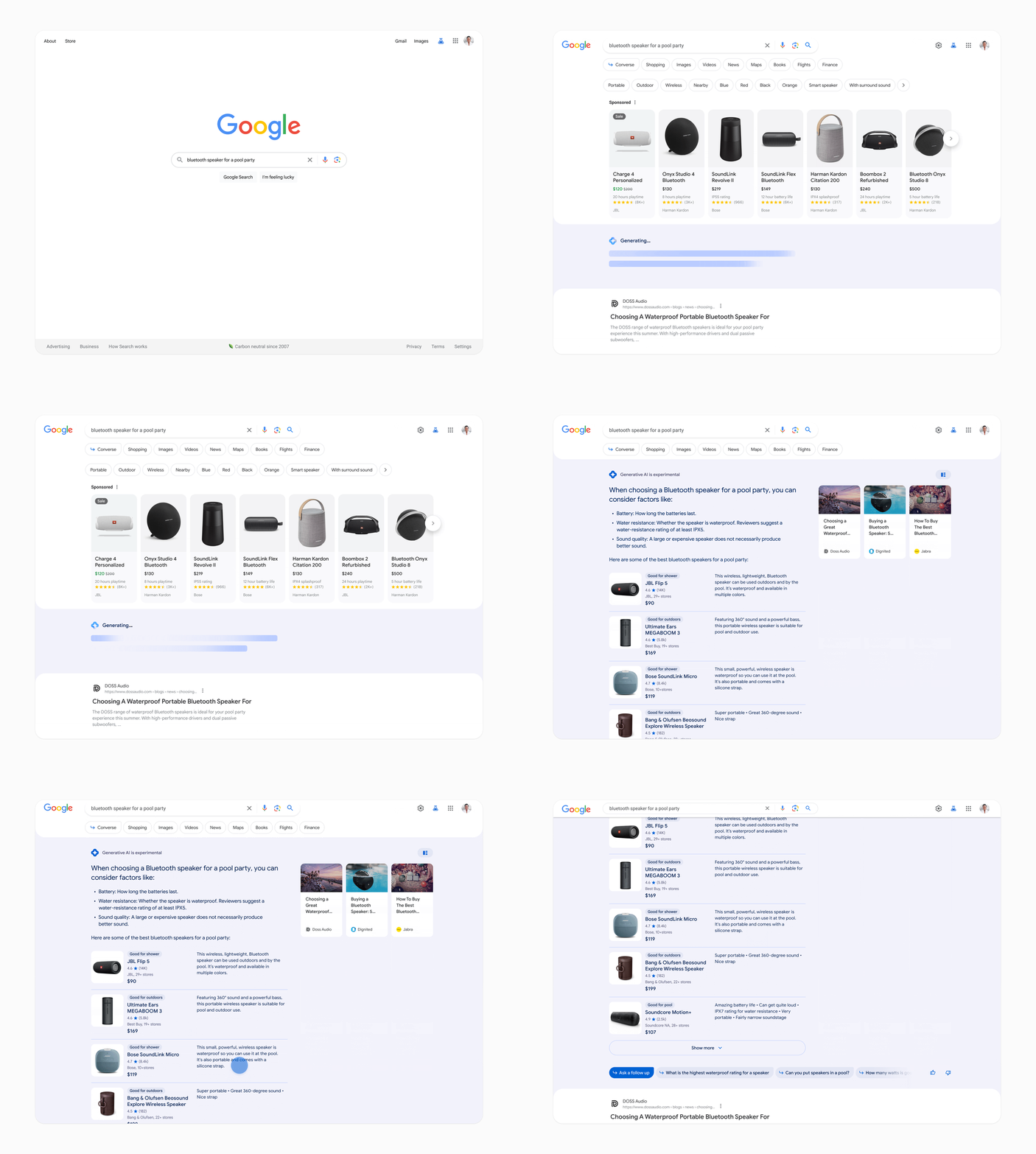
What will happen to ads in Google’s new generative search?
We get it, you’ve just nailed your ad strategy and now search is changing yet again. Whilst Search ads will remain present on the new generative search, advertisers will not be able to opt out, at least not for now.
During the experimental phrase, Google will be closely monitoring the performance of ads. Just like the current search model, ads will remain in a dedicated position and slot, and will still carry the sponsored label.
As Google Said: “In this new generative experience, Search ads will continue to appear in dedicated ad slots throughout the page. And we’ll continue to uphold our commitment to ads transparency and making sure ads are distinguishable from organic search results.”
So how will it look? Google shows us below:
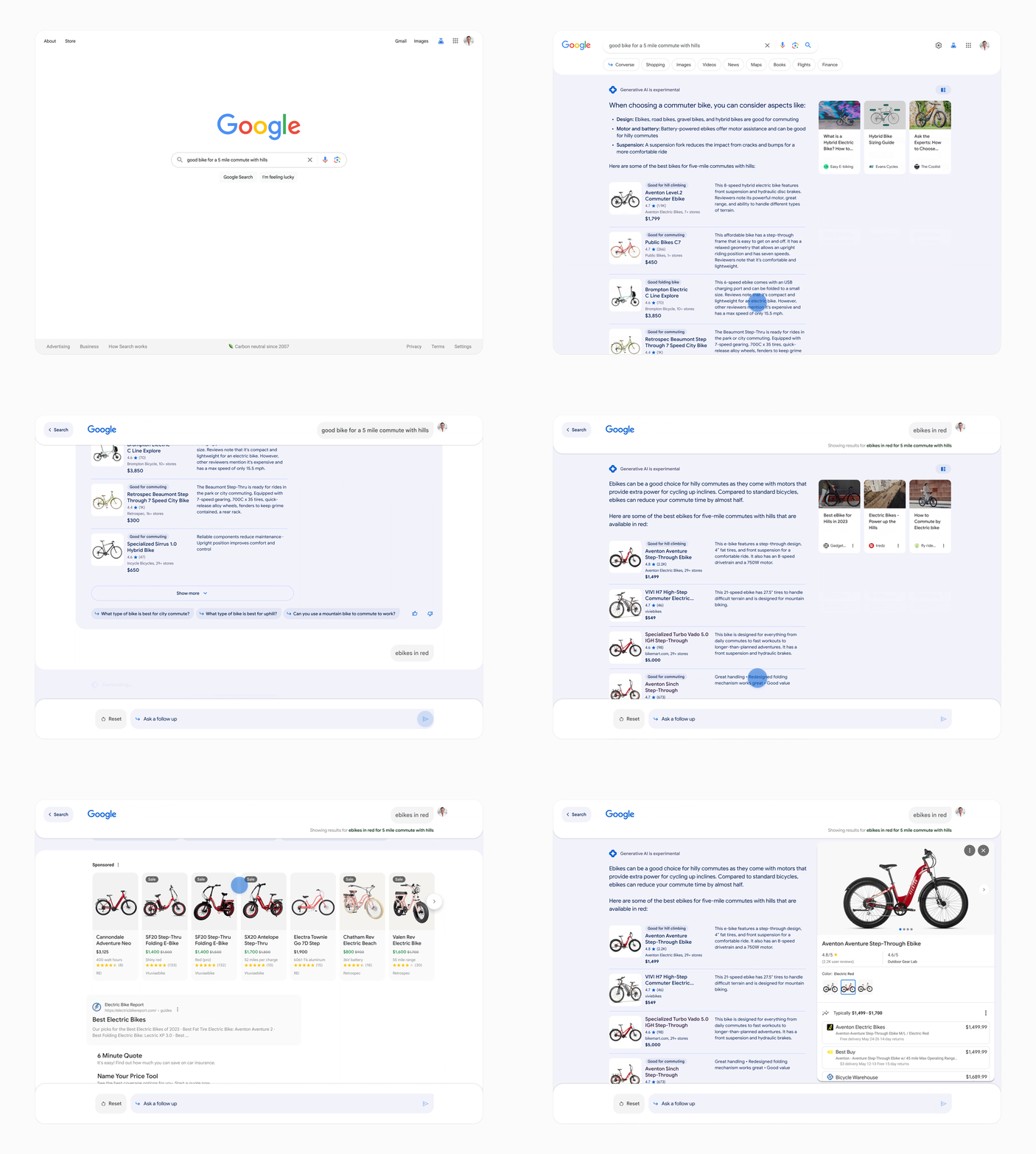
What does this mean for organic search?
When Bard was launched, there was a concern for the lack of references and links to publishers’ websites.
Well, with the new generative search, citations and links will be healthier than ever. Using an array of websites to generate the answers for the user, Google will not directly cite each website, but display the list of sources used under the answer, meaning your content is still thriving in the search experience.
Take a look below
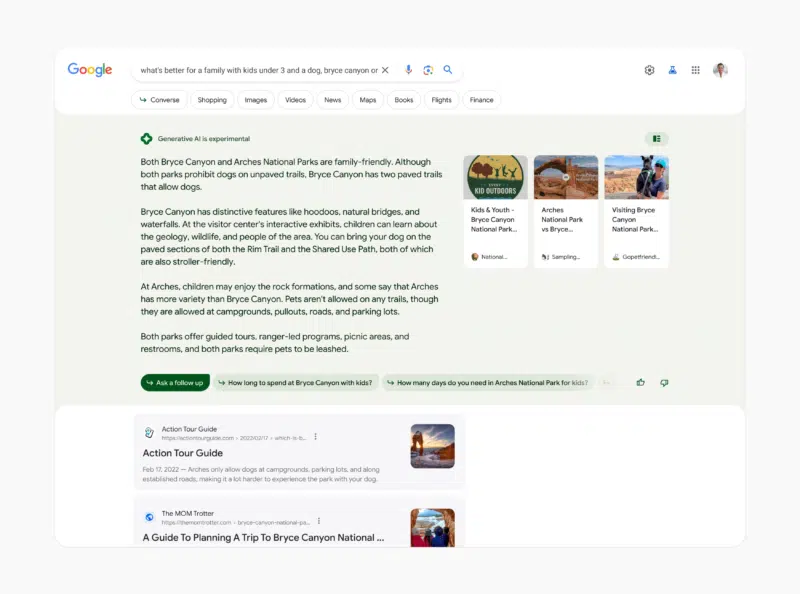
Whilst this is a pretty new experience for search users, it won’t be present on the search you’re using today, for now anyway. Google are likely to test and adapt the feature with feedback before the big launch.
What we do know however is with the generative search experience, Google is doing a much better job at linking to publishers compared to the likes of Bard, which will ultimately help drive more traffic to your sites.
If you’re ready to start optimising your ads to stand out from the competition in the new search experience, get in touch with one of our paid media experts who can help craft the perfect plan for the new era of search.
We were lucky enough to attend the first brightonSEO conference of 2023, and it didn’t disappoint. BrightonSEO is the world’s biggest search engine optimisation conference, a chance for search marketers to gather, meet, learn and share best practices. And best of all, it’s in our very own hometown, a few streets away from our central Brighton offices!
This year, the talks were bigger and better than ever before and there was much to discuss. With so many algorithm updates from Google and of course, the latest AI releases causing a stir among the entire marketing community, the talks addressed the big questions around search right now.
But don’t worry, to avoid your risk of #FOMO, we’ve rounded up the key learnings from this year’s event, and have summarised exactly what you need to know.
-
TikTok is NOT the new Google – but it IS a powerful search tool
With 1 billion active users and ever-increasing functionality, it’s no wonder people are searching TikTok to answer their burning questions. And, in fairness, TikTok and Google have a lot in common. Both have powerful search functionality and a similar prioritisation of content that recommends the most appropriate content to people that best fits their search query.
In many ways, TikTok is a superior search console than Google. As Rachel Pearson noted, people recall 90% of information when it’s shown in video form as opposed to text and therefore can get super quick answers to the questions that stick in their minds.
However, as much as TikTok has in common with Google, its search bar can only search content that has been uploaded to the app, therefore relying on its users to fill the gaps. This means that if no one has covered a certain topic or answered that query in particular in their videos, a person will likely turn to Google for a more in-depth search of its 64 zerabytes of data on the internet…
…yup, you heard right… zettabytes 🤯 (you betcha we googled that stat and swiftly after the meaning of zettabytes).
Also, even though TikToks have begun to appear in search results as answers to queries, the videos are merely indexed with Google as a webpage would be, rather than being embedded content, such as YouTube videos (which are usually prioritised and easier to view due to its Google-owned status).
-
The psychology of search: making your content stand out
When writing keyword-rich content to get your webpage ranking highly in search results, it’s tempting to cram the article full of nice nuggets of information the Google bots will love to have a munch on while they crawl your site. But it’s easy to forget the human typing in the search query that wants the quickest, easiest to digest and best quality information to answer their question or solve their problem.
Therefore, before you even begin writing your content, it’s worth considering not only who your audience is and what you’re trying to convey to them, but also what questions your content answers or the problem it solves for the end user. What questions are they typing in to find your page? Use these questions as the subtitles in your content and use simple, easy-to-digest bullet points or numbers to format the response – Google prefers this type of format as it can read this easily as answering the search query.
Talking about answering the user’s questions and making your content as useful as possible, have you considered FAQs? FAQs are a great way to show Google that you’re answering the user’s query but also to make your content as informative as you can. By framing all possible questions related to the topic, you’re increasing your chances of being ranked highly.
-
AI, GA4 and the Future of SEO
There was a recurring theme at brightonSEO this year, the rise of AI in SEO. It seems you can’t talk about many things to do with search, copywriting or marketing in general without bringing up the impeding fear of our AI overlords taking over…
Okay, maybe its not that serious, but AI is having an impact on the SEO industry, as keynote speaker Areej AbuAli said; we’re in the ‘digital gold rush’ era and everyone wants a piece of the shiny new AI.
However, there was one overriding opinion from the experts throughout the day – AI is a friend, not a foe, and it’s either evolve or get left behind as AI is here to stay. AI tools will help us to work more efficiently when used correctly and open doors to new service offerings to support teams.
On new tech that’s here to stay, it’s nearly time to wave goodbye to Universal Analytics and welcome a new era as Google makes the switch to GA4 automatically in June. And the general consensus is – experts welcome this change. Yes, it may require some initial investment of time and resources in setting up reports and tracking in your new dashboards. However, the next-level capabilities for tracking GA4 now offer promises that’ll be very worth it.
With custom funnel reports, machine learning identifying patterns in data, cross-device tracking and a privacy-centric design – it’s time to bow down to the Google Gods and convert to the word of the GA4. The more you put in, the more GA4 will give.
So, what does all this mean for the future of SEO? Firstly, the competition for SEO ranking is more fierce than ever before. Therefore, investment in SEO is expected to grow for businesses. Secondly, Google will stop being seen as a search engine, and begin to be seen as an answer engine, with content value being ever more prominent than quantity.
Does your website rank for your keywords? Are you getting enough organic and paid visitors to your site? We can help. Get in touch with our team of SEO and conversion experts who can help you achieve your business goals.
Time to talk everything TikTok! What’s the news? Any game-changing updates? Can I still use it? We’ve got you covered.
If you’re not using or considering using TikTok as part of your social media strategy, where you at? Branding, ad campaigns, influencer marketing – TikTok covers a massive range of marketing possibilities. But, as one of the biggest social platforms in recent years, it’s constantly changing and adding new features.
So, let’s keep your marketing strategies fresh and trendy and dive into everything you need to know about TikTok right now.
TikTok For You
Are you confused by yellow chickens everywhere on your feed? Want to see less dancing trends and more business tips and tricks? Well, this is the update for you!
TikTok has announced a new feature that lets users reset their For You page. This means TikTok’s algorithm will perceive users as “new”, and all content on their For You page will be based on new interactions with the platform.
What does this mean for marketers? Well, as the users’ data is basically wiped and refreshed, your ad relevancy may dip as audiences begin seeing new content recommendations.
Not to worry! In the long run, this means your ads will start appearing on new user pages, audiences who likely fit the targeted demographic of your ads.
Keywords are key on TikTok
Another new, grand-slam feature for TikTok is Keyword Insights. The new tool lets you see current keywords being used across successful campaigns.
Similar to how marketers utilise Google for trending keywords and phrases that would boost SEO, TikTok has joined the party, making it easier to see what’s working across the platform.
With Keyword Insights, you can pen trendy taglines, overlays and ad copy, keeping your campaigns in the conversation.
Alongside TikTok’s other new Creative Centre features – including Top Products and Top Ads – you’ll have all the insights you need to deliver fire ads and campaigns that resonate with your target audience.
TikTok bans – Should you be worried?
If you’re like us, you’ve probably been glued to the news sites these last few weeks as TikTok took to the courtrooms.
Due to security concerns, the latest chapter in the story saw TikTok being banned on all London City Hall devices. The update follows an ongoing banning of the platform, including federal bans in Europe and the US and a complete ban in India.
The news has led marketers and brands to ever-so-slightly lose their minds as TikTok has become an integral part of social media strategies across the digital space.
We’re here to very calmly tell you… DON’T WORRY, IT’S ALL OK!
Ed East, global chief exec and co-founder of Billion Dollar Boy, put it best when speaking to The Drum:
“Currently, we are continuing to advise clients to invest in TikTok. I am still bullish about its future, it’s where we recommend our brand partners to increasingly reach new audiences through highly engaging content. And this conviction is supported by hard evidence.”
This evidence reports that 75% of marketers plan to increase their activity on TikTok. There have been no official statements claiming TikTok will disappear for good.
TikTok is here to stay, and there are no signs of audiences shying away from the social platform. If anything, it just keeps getting bigger and bigger.
So you can wipe that sweaty brow dry for now.
What do we recommend?
However, we always recommend having strategies in place in case TikTok goes topsy-turvy – any social platform, for that matter. Looking at you, Meta.
Here are a few recommendations from our expert team to keep in mind:
Keep your social media strategy diverse.
Don’t put all your marketing efforts in one basket. Brands should never rely solely on one social media platform; you need a presence across multiple channels.
Instagram offers Reels, YouTube offers Shorts, Twitter has real-time marketing – there are several avenues you can utilise for you to reach your audience..
To make sure your social media marketing is effective, you need a detailed content strategy, knowing when and what content is being published. Perhaps you could repurpose content from another social channel and utilise it somewhere else?
Arke’s are always here to help you plan and deliver content in the best way possible.
Remember Emails?
It’s not all about social media, either. Email marketing is still an essential part of raising brand awareness and engagement. Make sure your emailing lists are up-to-date and are consistently building up.
Reach customers directly with newsletters, blogs or branded discounts and keep that reputation strong by making your audience feel valued.
If you’re looking to spice up your social strategies, or looking to skyrocket your email marketing into the stratosphere – get in touch with our expert team today.
Technology has overhauled the way we live our lives, from our cars, kitchen equipment or pretty much anything with a screen. The tech industry is a forever dynamic environment, continuously evolving as the world spins around. Sometimes, it can feel difficult to keep up with the latest trends and innovations available in the market to help to grow your business and make it stand out in an ever-increasingly competitive marketplace. But don’t worry, we’ve been hunting in the digital space and have wrapped up all the need-to-know news for you down below.
So, let’s dive in.
TikTok
Is waking up to the power of apps in its latest feature
If UK user Matt Navarra is right, TikTok could be rolling out a feature to directly drive app downloads so that users will be able to download business’ apps directly from the source. The new rumoured functionality will allow businesses to link apps from their profiles, with compatibility across the Apple Appstore and Google Play store.
Already an avid feature to business owners in Asia, Spain and Canada, expanding this functionality to the UK could allow tech businesses with UK audiences to use TikTok as a key platform to grow. It will also mean that profiles can utilise multiple links on their page instead of linking through to external services like Link Tree, streamlining the audience journey.
Looks like our home screens are going to become very crowded very soon…
Amazon Pay
Is giving customers total ease when it comes to shopping
We recently attended the Smart Retail Tech Show where Nicki Rogers, Head of UK Amazon Pay Sales Team, explained what’s new with Amazon Pay and the benefits for businesses.
Amazon Pay is the latest widget that will allow customers to use their amazon payment and delivery information across multiple external websites. 24% of basket holders leave their shopping when asked to create an account, so what better than to allow them to auto-fill their info straight away? Accessible to businesses as a widget you add onto your e-commerce website, users will have the same login and protection as their normal amazon account. Conversion rates have already been seen to improve by 35%.
Abandoning baskets no more!
Microsoft
Has launched its new ‘Accessibility Assistant’, making accessibility for business, well, more…accessible
Announced at the Microsoft Ability Summit, Microsoft is launching a new version of their Accessibility Assistant that will let you know when you are making content less accessible in real-time. This is in contrast to their previous tool, which would only check for legibility issues after you ask it too. Similar to checking grammar, the person-shaped tool will flag the location of the error, as well as the issues present, such as low contrast between text and backgrounds. Making content accessible for everyone will also aid businesses in boosting their chances of ranking high in search.
With accessibility and SEO both being very important aspects of your marketing mix, it’s a tool you simply don’t want to miss out on.
Meta
Is working on a decentralised social media app
Reported by MoneyControl, the new app with codename P92 is still currently in the works. The app is rumoured to use the branding of Instagram, allowing users to log in with their Instagram details. However, the accompanying concern is that P92 will use the data of all Instagram users regardless if they sign up to the new platform or not. This new decentralised app follows the recent development of the Notes feature on Instagram, allowing users to up to 60 characters of text and emojis to share text content across the app.
If we do see P92 roll out to public view, it raises the subject of if people will want to share their details with another Meta app. With the public already worried about the issues with privacy and Meta, this provides opportunities for other apps to take advantage of users not wanting to share chunky details, and invite them in with a more appealing privacy offer.
As Meta asks for more data, and more consumers ask for more privacy, could this roll-out cause users to choose alternative applications?
Learnings from the Smart Retail Tech Show
Is TikTok Live the new Amazon?
This month, some of our Arkenauts attended The Smart Retail Tech Show, in which they were able to digest some really great discussions. One that particularly grabbed our attention was ‘The Rise of Community Commerce’ by TikTok’s Senior Director, eCommerce Operations, Patrick Nommensen.
TikTok Live is a feature that allows users to live stream themselves anywhere, at any time. It is a great tool for driving brand awareness, but it also is effective at driving sales, too. 50% of TikTok users have bought something after watching TikTok Live.
Recently, TikTok has introduced the TikTok shopping function to their live stream service. It provides a great opportunity for businesses to reach and sell to the app’s core audience, Gen Z. With 60% of users labelled Gen Z, and 80% aged 16-34, businesses can really take advantage of the functionality, even going as far as using influencers to sell their products directly to their audience.
You can only use it to sell products right now, but there is a big opportunity for services and or ticket sales from the app. It’s time to grab the tripod and start selling!
That’s just a small round-up of marketing trends that those in the technology world need to know right now. To never miss out on upcoming news and innovations, follow us on Linkedin, or browse our website here.
Are you concerned about the impact that a cookieless future will have on your brand?
87% of marketers believe data is their most underutilised asset – it’s time to change this. The removal of third-party cookies is imminent, despite Google pushing it back once or twice. Change is coming, so it’s up to your company to stay ahead of the curve by building up as much data as you can. But how?
What are cookies?
Cookies track internet users when they interact with your brand – whether that’s on your website or your social media landing pages. Third-party cookies are great to use at the moment as they’re easy to use and provide essential information on your audience, which you can then use to inform your marketing.
Is there more than one type of cookie?
There are two types of cookies: Third-party cookies and first-party cookies. Third-party cookies come from sites which track information on your audience and send that information to you. This could be information like their browsing history or the pages they have visited.
On the flip side, first-party cookies are those you have actively set up to collect data – from a form, for example.
While third-party cookies are being faded out by Google, first-party cookies are here to stay, giving you some control over the data you collect about your audience. Now, you’ve got to get smart about how you collect that data.
Why is Google removing third-party cookies?
Privacy is becoming ever-important, and consumers want to know their data isn’t being sold to companies. In recent years, many privacy-friendly policies have cropped up that give users power over their data, for example, Apple’s App Tracking Transparency feature. Google is simply doing the same!
Our tips for making data your most-utilised asset
Businesses need to act now if they are to prosper amid this uncertain period of data collection. After all, the more data you have about your audience, the better you can target them and get them to buy your products or services. It’s time to learn how you can make data a more integral part of your marketing strategy.
- Use Google Analytics 4
Google Analytics 4 (or GA4, for short) is a marketer’s best friend when it comes to collecting, tracking and analysing data. Many brands use Google Analytics, but they’re missing out on the benefits of the latest version, GA4. The main benefit of this new analytics is machine learning. GA4 is able to accurately fill the gaps in your data, powering your marketing campaigns with better insights.
- Don’t just collect data. Integrate it
If your data doesn’t flow freely between touchpoints, you’ll lose sight of where your consumers are in the funnel.
It’s time to make sure your data tracking systems are talking to each other – especially between your advert, landing page and website.
- Automatically visualise your data with Looker Studio
If you want to see your data in one place and analyse it at a glance, then you’ll need a snazzy data visualisation dashboard. We suggest using Looker Studio, the new version of Google Data Studio, which can be easily integrated with GA4 for that seamless communication between analytics and visualisation. This will help brands with data-driven marketing attribution.
Summary
40% of businesses say they’re planning to increase their investment into data-driven marketing. We’re believers that, whatever your budget, you can make a bigger impact – simply by using data to maximum effect!
Our offers
As a specialist in Conversion Rate Optimisation (CRO), we offer multiple digital services that help brands better understand their audience to achieve their targets, including GA4 packages to:
- Help businesses transition from the outdated Universal Analytics to Google Analytics 4
- Help upskill teams through invaluable GA4 training
- Create analytics dashboards, including setting up conversion funnels so brands never lose track of their prospects
As a full-service marketing agency, everything we do is integrated. Our advertising and creative services link seamlessly with our digital offerings, ensuring touchpoints can be attributed throughout the funnel.
Are you interested in one of our services? Get in touch, and we’ll show you how you can make data your most valuable asset.
AI is everywhere, but does that mean you should be using it?
Artificial intelligence software, like ChatGPT and muse.ai, are making the rounds across news and social media sites. And though it’s pretty funny to ask a computer to write a heartfelt, detailed critique of Shrek 2 (trust me, I tried), it has sparked conversations.
Is AI affecting customer relationships and brand authenticity? Will we still have jobs in the near future? Can AI help one person with everything? (Spoiler. Nope!)
So, is AI friend or foe? Let’s start from the top.
What is AI?
AI (artificial intelligence) is technology developed to perform tasks that, in most cases, needs human thought and interaction. Visual perception, recognising language and communication, and decision-making, for example.
We haven’t reached Blade Runner or movie-like levels of AI…yet… however, in recent years, it has increased significantly in popularity. Why though?
As computer power and processing improve, AI improves alongside it. Unlike us, data can be stored and never forgotten on computers. With more data to play with, AI can piece together more human-like patterns and start performing all the tasks mentioned above.
It’s basically a robot elephant that never forgets.
Why is this relevant to marketing and advertising?
In digital marketing, what’s essential to make sure you understand audience behaviour and patterns? Data. And who better to ask for help than a machine that’s literally got all the data?
Take Google, for example, which harnesses AI machine learning by modelling data from your ads and campaigns – which you can then make sense of with Google Analytics 4 to forecast trends and provide actionable insights.
AI can observe patterns of behaviour – time of day, location etc. – then predict and recommend when and where you should place your ads.
This is just the tip of the AI-ceberg. If you link all your Google properties together – like Google Ads and Campaign Manager – it can combine these data points to train machine-learning-driven bid strategies. This fuels your data-driven attribution models for a better understanding of your media mix.
These data-driven machines will ultimately improve customer experiences as they will report on what’s working and recommend relevant desires – increasing ROI for your campaigns, decrease Ad Spend, and time needed to gather data.
However, and this is a big however, AI is still not at the level of understanding data as well as agencies who live and breathe it. Much like creative, ads need a human touch and level of management to be utilised properly. Think of AI as a tool businesses can use to streamline certain aspects, but should not be left alone to monitor data by itself.
For the people?
Data analysis is one thing, but as we continue to type away and chat online, AI is taking notes/
Recently, instead of teaching AI how to talk the talk, we’ve told it to walk the walk, asking it to learn language for itself. By throwing an almost infinite amount of written words, sentences and articles at it, AI has evolved to predict what to say and says it pretty coherently. Researchers refer to this as a language model.
Because of this, chatbots like ChatGPT can be super useful in conducting basic keyword research on specific topics and surfing the internet to recommend great starting points in blog writing or ideas for a presentation.
But don’t rely on AI to write all the copy for you. Its monotone and repeated descriptions of certain topics can make blog posts dull and sound automated, not to mention its similar responses to topics can cause a negative impact on SEO. Also, my critique of Shrek 2 has much more detail.
Can A–I help you?
Have you ever been on a website and a little box in the corner pops up saying, “Hi, my name is Jenny! Can I help you with anything?”. Aw, that’s nice, sounds like somewhere, Jenny is taking time out of her busy schedule to ask how I’m doing.
Sorry, Jenny doesn’t exist.
This is an AI chatbot, a software used to help answer a customer’s question on a site. Marketers will implement several keywords for the chatbot to identify (also known as a playbook) as simple as “Yes” or “No” and direct them to the solution.
For example:
AI – “How can I help?”
User – “I want to return my shoes.”
Result – The AI detects the keywords and can explain or direct users to the item return page or recommend exchanges for different shoes.
As language models become richer in detail, chatbots can detect more keywords and customer queries and respond to niche questions. As a result, this gives marketers more time to focus on other important tasks, as chatbots can run continuously 24/7.
Chatbots are great if you’re handling multiple websites or social media accounts and need time to keep track of other factors.
We’d always recommend that you employ someone who’s available to chat with customers, though. Even if AI can answer questions, it will lack that spark from your brand’s Tone of Voice, the one you’ve spent years building up, and potentially cost you losing consumers so close to the end of the customer journey.
AI gets bigger and better
If you have a phobia of android overlords taking over, you might want to cover your ears. Artificial intelligence is expected to generate roughly £30 billion in revenue by 2025, and brands aren’t backing down in taking advantage of its potential.
Netflix is no exception. As one of the biggest VOD platforms worldwide, you can imagine it’s a daunting task for marketers to cater to the needs of each individual user. UX is a major factor for customers, hence why Netflix use AI to make it all the easier. And here’s how…
Everything from personalised show and film recommendations to optimised streaming quality based on internet speed is all monitored and managed by Netflix’s machine learning. And the outcomes speak for themselves – over 80% of the shows people watch on Netflix are through its AI recommendations.
So far, sounds like AI is A-OK, right? Well, let’s not get too carried away! AI is great, but it isn’t perfect; there’s a lot you need to be aware of before implementing it into strategies and tactics.
AI has a time and place, and knowing when and where to use it is our (and should be your) mindset.
Creative and AI?
One of the biggest concerns is from the perspective of creativity. Is AI taking creative work away from creatives? The answer is no. Not where creative matters anyway.
In fact, creatives are utilising AI to its full potential. In an interview with The Drum, Invisible North’s Geoff Renaud states:
“By using AI to automate outputs and shrink hours needed for tedious tasks, deliverables will get done faster, more efficiently and minimize costs for agencies and their clients. While human editing and oversight for most of these tasks will be required in the near-term, data is the prime currency for these tools and machine learning will rapidly compound results as usage increases and these new tools improve at an incredible pace.”
There lies the calming clarification – AI isn’t here to replace, rather reduce the tediousness of less creative tasks.
If you ask ChatGPT to write copy, it will do so, but you’ll know an AI’s written it. The same goes for visual creative – ask AI to draw a duck; it’s going to draw that duck the same way, again and again, unless you start tampering with the conditions. Eventually, AI creativity runs dry.
For now, AI can’t add flair or a distinct tone of voice, nor can it give more than one opinion; what’s fact is a fact for Chat.
Ethics and AI
On the flip side, AI raises ethical concerns when discussing data and audience targeting. Why is this?
Well, back on the topic of data and AI’s objective outlook on stats, it’s very easy for machine learning to mistake numbers and percentages for identities; people are simply more than quantitive lists on a sheet of paper.
This can lead to subject bias, where AI takes “stats” regarding personal information – gender, age, race, location etc. – and unintentionally delivers your ads to people who share these factors even if they don’t desire the product you advertise.
This is a massive red flag; you want to deliver campaigns based on targeted audiences, not people who fall under a certain “demographic” – that’s borderline discriminatory.
And with only 48% of customers trusting companies to use AI ethically and 65% concerned about the unethical use of AI, you don’t want your brand getting called out for something Mr Robot worked on.
So, what do we recommend?
AI for creative is another tool to use, not a crutch.
AI offers a wide range of rich data, keywords and topic starters to get you in the zone. The same goes for design and illustration; it’s a great catalyst to get creativity flowing.
However, it’s not – and should never be – the end product. If you rely too heavily on machine learning, eventually, someones going to catch on. Creative still requires that “human touch” and emotional connection. After all, we know ourselves better than the machine does.
Just like next door’s dog, don’t leave AI on its own.
AI is far from perfect. Chances are, it will eventually make a mistake and pick up on rubbish data, awful ideas or discriminatory ideologies.
Have someone monitor your AI processes; no “copy and pasting into the sales deck, job done!”. Make sure the data collected resonates with your audience personas and aims to deliver ads for the people who want to see them.
Be Transparent.
There’s no shame in using AI; everyone seems to be. Netflix and Google openly admit that they use machine learning to gather data, streamline processes and hone in on audience preferences.
So why shouldn’t you? Be open about your privacy and data policies. This rule has always been a given, but with AI now in the mix, it’s always good to remind customers of what data is kept and optimised to help ads find their way to them.
Most importantly, yes, you still need an agency!
AI doesn’t always lead to the best results. We saw Performance Max make its way onto the scene, among other automated ad products like Meta Advantage. But there are still question marks over its effectiveness in boosting conversions.
Sam Dadd, Our Junior Paid Media Executive, had this to say about machine-learning systems:
“Having recently tested Performance Max (P-Max), we have been happy with some aspects of performance achieved, mainly with conversion-driven campaign objectives for e-commerce. However, lack of control and transparency provided by Google on P-Max campaigns limits the ability to learn, make data-informed decisions, and scale performance.”
P-Max campaigns will optimise towards ‘quick and easy’ conversions, which means a strong focus on brand terms in paid search with little consideration of incremental impact. This may cause higher CPCs or CPAs overall, whilst potentially cannibalising other aspects of your marketing strategy.
It’s important to remember that you’re giving ad platforms free rein to spend your budgets with very little visibility on where, how, and to whom your brand has appeared.”
In summary, you’ll need an agency of experts in their field to craft personalised media strategies unique to your business goals, plan and execute campaigns that stand out from the noise, and deliver results with agility and maximum ROI in mind through careful optimisation.
We can help!
Remember, to um is to be human, and to take that extra moment and think about what needs doing, whether creative, paid or in marketing, will make all the difference. But for now, we can Domo Arigato Mr Roboto for letting us get on with the motive that matters most – making the customer happy.
Want to implement AI machine learning into your marketing strategies? Eager to produce next-level creative with that “human spice” for an upcoming campaign? Or asking, “wtf is Google Analytics 4, and how do I use it?” – Contact our team of experts, and we’ll help create strategies in paid and creative that feel right on brand.
Google has launched a new advertising solution that allows advertisers to gain access to customer data shared with web publishers. This is just one of Google’s solutions to navigating a third-party cookie-less world, available on Display and Video 360 campaigns. So, what else do you need to know?
Firstly, what the heck is Display and Video 360?
Display and Video 360 is Google’s Demand Side Platform (DSP) – software that lets advertisers buy media space and manage it all within one place.
It’s pretty neat and has many benefits, including:
- End-to-end campaign management – from media planning and creative development to measurement and optimisation
- Integrations with other solutions like Analytics 360 and YouTube, allowing brands to make the most of the platform to visualise their ads and their performance in one place
- Two tools to facilitate ad campaigns and creative. These are the Campaign Manager 360 and the Studio.
- Improved collaboration between your creative and paid media teams to produce more impactful campaigns
- Holistic oversight of your campaigns
- Better targeting capabilities due to a bigger selection of inventory
What’s PAIR all about?
PAIR stands for Publisher Advertiser Identity Reconciliation, which basically means the bringing together of publisher and advertiser to provide access to consumer data, while adhering to privacy regulations.
PAIR allows brands to cross-match the databases between advertiser and ad platform, helping you to advertise to your potential clients where they are and based on their interests.
It bypasses the need to rely on third-party cookies. Instead, it allows the private sharing of first-party data between advertiser and publisher. Consumers will also be happy to hear that there are also some super secure encryption to ensure other parties don’t gain access. With PAIR, website visitors can rest assured their data is safe.
For brands, it means they can place personalised, hyper-targeted ads on websites where people have given permission for the advertising brand and the site to access their details. If you want to advertise to high-intent audiences, Display and Video 360 is the way to go.
Why is this important?
If you haven’t heard, Google is phasing out third-party cookies from 2024. That means that advertisers will need to find new ways of accessing audience data and finding innovative ways of targeting them. For brands currently relying on third-party data, it’s a bit of a concern. But there are solutions.
From machine learning with Google Analytics 4 (GA4), to Google’s Privacy Sandbox and PAIR, new solutions have been cropping up. We suggest reading up on the benefits of GA4 to help your brand flourish even once cookies are obsolete.
To summarise, the benefits of this Google update are:
- The ability to tap into first-party data that other web publishers have access to while reducing reliance on third-party data
- An increased likelihood of conversion by targeting high-intent audiences
- It’s a privacy-first solution that allows brands to access data in a responsible way
Do you want to start advertising through Display and Video 360? Or do you want to find out how Google Analytics 4 can benefit your brand? Talk to our digital and advertising experts.
There’s no denying that we’ve been growing at Arke, not just our team but our client base too. And there’s a new partnership in town that’s very special to us and our local area: Say hello to our new partners: St Barnabas & Chestnut Tree House, the hospice charity providing essential care for adults, children and their families.
Implementing GA4
We love working with brands that make a difference in our local community, and we already know this partnership will be rewarding in many ways. We’re implementing Google Analytics 4 and training for the charity so they can better understand the web, and donor customer journey. This will provide essential analytics to help the charity build strategies that will engage with their web visitors, and drive donations whilst increasing awareness of the charity.

Arke aims to empower people, so we’ll also be providing over 70 hours of Google Analytics training to St Barnabas & Chestnut Tree House to upskill their team and make using GA4 a breeze. This will help the charity to identify any ‘donation-blockers, i.e. any issues on their website causing donors to drop off, and seek solutions to rectify those issues, improving the user experience along the way.
The new partnership
St Barnabas and Chestnut Tree House sought a partner whose values aligned with their own and an agency that would guarantee results. After seeing our previous work, we provided them with a digital health check to showcase how our analytics and training services could drive donations. Our understanding of their digital requirements, as a local charity, assured the trust in Arke for this project.
Commenting on the partnership, Sam Skilton, Digital Manager, said: ‘We’re thrilled to be working with multi-award winning marketing agency Arke, a brand whose people-first values align with our own. As a charity, we rely on donations to provide hospice care for local people and their families. Understanding how Google Analytics 4 works will help people to find us when they need help and facilitate the donation process by improving the donor journey, which will be invaluable for us and the continuation of our work’.
Our founder Steph Noble commented saying, ‘Our motto at Arke is be real, bold, be curious, and we’re extremely passionate about people. We’ve begun a super meaningful journey with St Barnabas and Chestnut Tree House to help them increase donations and continue the incredible work they do.’
We’ll be sharing the impact of this work on the charity! Be sure to follow us on LinkedIn for all the updates!
61% of marketers named SEO as a top marketing priority in 2021. At Arke, we 100% believe in the power of SEO to boost brands and increase sales. Without a strong presence on Google and optimised search engine tactics, your business faces a digital uphill battle. This is one challenge clients face time and time again and one we’re often sought out to help with.

‘We are often approached by clients whose approaches are centred on keyword-based optimisation and black-hat practices, but these have become obsolete. Modern approaches to SEO that focus on user experience have taken their place and are invaluable when it comes to building brand awareness in a cost-effective way. These are the approaches that we implement for them, and the results speak for themselves’
– Younes Labbar, Senior Digital Manager at Arke
So, if you haven’t audited your website in a while, this is your ultimate guide to checking SEO performance and how to optimise it (plus a free SEO checklist).
Why is SEO important?
Optimising your website, blog posts, and social media pages for SEO is critical for long-term marketing success. Google has recently changed its search algorithm to focus more on SEO, so nailing your strategy is crucial for success, particularly amid the rising cost of living. Understanding how to get your brand ahead of your competitors will help keep customers choosing you.
Not convinced? SEO strategy is a long-term play, but it can be highly effective and low on the cash splash – if you know how to play the game. So, what do you need to do to be on top of your SEO game and reach the peak of the ranking?
It all starts with an audit
How do you know what needs improving if you don’t understand what’s already in place, what works and what doesn’t?
Take time to audit your website thoroughly – from your homepage to your services, your products and your blogs. Even your careers page needs to be looked at with a fine-toothed comb – leave no stone unturned. But what exactly do you need to be looking at?
SEO takes three key forms; technical, on-page and off-page. But we also recommend you audit the overall user experience (UX) and Conversion Rate Optimisation (CRO) for maximum impact.
Let’s delve a little deeper into what your audit should entail.

1. UX and CRO
‘The days of boosting rankings through keyword stuffing and backlinking are long gone. Search engines no longer solely analyse web pages based on keyword usage. Instead, in order to rank highly in organic search engine results, a website must comprehend user intent and provide a rich user experience’
– Younes Labbar, Senior Digital Manager at Arke
So how can you make sure you’re providing a rich user experience? Firstly, you’ll want to audit the UX of your website and your Conversion Rate Optimisation (CRO).
Are you effectively guiding your audience to conversion, or is the process long and complicated, causing your users to lose interest?
‘If we don’t prioritise the experience our consumers enjoy after they land on our website, our SEO efforts will fail miserably. Stop underestimating the value of user experience in your SEO strategy; it is vital to success.’
– Younes Labbar, Senior Digital Manager at Arke
To keep potential customers interested, you’ll want your website to take them on a journey. Less is sometimes more.
When auditing the user experience of your website, you’ll need to take a look at your:
- Loading speed and site security
- Call/s to action – is your messaging clear?
- Performance across devices – does your website function well on desktop, tablet and mobile?
- Page flow – what is the user drawn to as they read your article or experience your product page?
- Tracking and measurement setup – have you set up your goals and event tracking correctly in Google Analytics?
Our digital and analytics experts love all things data and advocate Google Analytics 4. If you haven’t set it up yet, you’re missing out on key tracking and measurement opportunities. Without analytics, you won’t have access to crucial data.
What’s more, Google plans on phasing out cookies in 2024, and GA4 is the solution to a cookie-less future powered by machine learning and AI. Contact our experts if you’re interested in making the switch.
2. Content optimisation (on-page SEO)
You can think of on-page SEO as the parts of your website that your site users see (the front-end) – your homepage to your categories, product pages and blogs; everything counts. And it all needs to be optimised for maximum performance.
We recommend focusing on creating a keyword strategy informed by what your audience is searching for. Once you understand your audience persona’s, get keyword-savvy and guide your audience to the product they’re looking for and to that all-important check-out basket. Making it simple for people to navigate your site will, in turn, make it simple for Google to rank you over your competitors.
3. Technical SEO
Consider technical SEO as the way your website is built and how it functions. How does your menu display; have you got breadcrumbs for easy navigation and how is the overall architecture of your website performing?
A website that’s easy to navigate with the proper setup will rank far higher on search engines than one with confusing architecture and a subsequently high bounce rate. If Google can’t understand it, neither will your audience. And it certainly won’t show up at the top of search engines.
‘Poor technical SEO will result in your website performing poorly in crawler assessments, or search engines might not be able to crawl your site at all. The end consequence? No search rankings, no organic traffic, and no conversions. Auditing your technical SEO is a must-do for brands.’
– Younes Labbar, Senior Digital Manager at Arke

4. Off-page SEO
Ever heard of backlinks? They’re SEO gold and will seriously help your rankings. They’re essentially any link to your site from another website, building up your credibility and trust among your customers. But remember – backlinks from trusted sites will prove advantageous for your ranking, whereas links from untrustworthy sites can negatively affect your rankings, so it’s something to monitor often.
If your content is original, relevant and useful, chances are other sites are likely to cite you! In marketing, this is called your earned media. Think PR, social media, guest blog articles and other off-page activities – these all count towards your ranking!
Imagine a negative review on Twitter with a link to your website. That would affect your SEO score negatively. So, it’s time to review it!
What’s next?
Refining your SEO strategy will allow you to increase the performance of your website, your ranking and improve your customer journey, resulting in a higher conversion rate.
Now you know what you need to be monitoring in your SEO strategy, it’s time to implement the tips!
Download our free SEO checklist, and put the tips into action to prepare your brand for search engine success 👇
DOWNLOAD YOUR FREE SEO CHECKLIST
Is your business struggling to find the perfect marketing strategy that assures business is booming? Looking to spend minimal but keep engagement up? High-impact marketing could make all the difference; want to know how?
Today, we’re diving into how high-impact strategies can maximise your marketing efforts whilst keeping costs down, ultimately improving your ROI and brand’s bottom-line.
So, let’s start off with…
What is high-impact marketing?
High-impact marketing is any tactic or method that will have significant, positive effects on your brand’s net income.
Let’s say you write a really informative blog about your services which grabs the attention of thousands of potential customers, resulting in a 10% increase in leads and a 15% increase in website traffic. Jackpot! You’ve successfully found yourself a high-impact marketing strategy.
Notably, this means you can achieve your goals through high-impact marketing without splashing the cash; your methods just have to grab the audience’s attention and lead them through the buyer’s journey effectively.
As the cost-of-living continues to rise, it’s essential that your brand keeps budget considerations a priority, especially if you plan to run multiple campaigns or have a range of goals. High-impact marketing is a great way to avoid big-spend but still deliver creative and persuasive advertising.

Types of high-impact marketing
What types of high-impact marketing could you use?
Your high-impact marketing methods will differ depending on your area of business and the goals your brand wants to achieve. However, it’s a course of action that all businesses should consider.
Let’s say you want to increase awareness for a product your brand offers. A high-impact strategy could be a Youtube series showing off why your product is unique. An in-house, low-budget series will save you money on production whilst driving continued awareness of your brand on a platform rich in SEO opportunities.
On the flip side, high-impact marketing doesn’t have to relate to a specific product; it can be a purely PR-related objective. Perhaps the goal is to increase positive reception regarding your brand online. All you’ll business will need is a LinkedIn profile and a schedule for when posts regarding your brand’s values and positive efforts are released.
These examples show how expansive high-impact marketing can be and how little it can affect your finances. However, with a range of avenues, you’ll need to consider a few things before putting your methods into action…

Effective high-impact marketing
What should I do to make sure I’m using high-impact marketing effectively?
We’ve come up with a few recommendations that make sure you’re making an impact whilst keeping methods intact.
1. Make your goals SMART
Before even coming up with a campaign, make sure your goals are precise and detailed. Saying you’d like to increase online sales is great, but its vagueness could lead your high-impact campaign to splinter and lose focus.
How do you avoid this? Make your goals SMART! Your objectives should always be Specific in what you want to achieve, Measurable in terms of outcome, something you know your brand can Achieve, and ultimately Realistic and doable in a Timely manner.
SMART goals will help your team understand what needs doing, how to do it and when it needs completing in a quick, easy-to-understand objective.
2. Know your audience
It’s all well and good to have objectives set out, but unless you know where your audience is online, it won’t have that spice that gets specific results.
Conducting audience analysis and understanding who they are, what pain points they have, and the platforms they use online to converse with each other is an absolute must if you want to know how to market your product online. It will only make your SMART goals smarter!
3. Retain your current customers
Did you know it can cost 5 to 25 times more to acquire a new customer than retain an existing one?
If you’re objective is to acquire new customers, that’s great, but you also need to consider maintaining and building upon the relationships you have established with your returning audience.
So, a possible SMART goal could be to attract new audiences through a referral programme which offers your existing customers a discount for one week. Once again, this is an effective way to market whilst keeping costs low.
4. Social media is key to keeping costs down
If you’re looking for a crazily cheap way to engage audiences, look no further than social media.
73% of marketers believe their social media marketing has been successful for their businesses. Each platform offers its own audience your brand can target, whether it’s B2B relationships on LinkedIn or unlocking the potential of Gen Z engagement on TikTok.
Organic social posts are a fantastic money-saver that can easily be monitored and optimised through apps like Hootsuite. We’d recommend split-testing your posts to see where you’re getting the most engagement and then cater for those platforms.
For all the latest updates to social media platforms, check out our monthly social blog series covering the latest updates and trends that will keep you in the social loop.

Plenty of methods to pick from!
Whilst high-impact marketing is definitely something your business should consider – there are plenty of other avenues to consider when you want to increase ROI and audience engagement.
From SEO and creative approaches to your brand’s TOV and values – we’ll be back very soon covering a barrel’s worth of methods you could implement – so be sure to keep your eyes posted on our socials.
Until next time, if you’d like more personalised recommendations on how to use high-impact marketing across your online strategies or would like us to conduct research into your social media posting – get in touch with our marketing team now.
Ever wondered how to set up Google Analytics to track each step your website visitors take? Asking why your leads aren’t moving through the funnel the way you’d like? You’re not alone, and we’re here to clear a few things up.
On 24 August, our digital and analytics expert Younes Labbar hosted a masterclass webinar, talking participants through all things conversion.
The session aimed to empower businesses with the skills needed to understand and build effective conversion funnels, covering commonly asked questions and providing step-by-step guides to understanding funnels.
With this knowledge, brands can successfully and accurately track the metrics that mean the most to them, getting an understanding of where consumers are in the funnel and informing marketing strategies going forward.
While the session focused on educational institutions, funnels are vital across all sectors of business, and Younes’ expertise is relevant for anyone looking to build conversion funnels that work.
If you’re in the education sector and you missed the session, you can catch up on-demand here. If you’re just here for the quick tips, keep on reading!
But before we delve into our experts’ top tips, why is it important to have visibility of the funnel?
Conversion funnels help businesses to:
- Analyse the performance of a specific area of your website, such as people arriving at the check-out window or viewing a course page.
- Identify drop-off at a glance. When you set up conversion funnels correctly, you can visualise where your leads are dropping off. With this information at hand, you can plan to re-engage those users and use it to inform your marketing campaigns.
For educational institutions, in particular, conversion funnels help map the sub-steps in their student application journey, all the way from clicking the home page, to booking an Open Day, to enrolment (fingers crossed!)
For businesses, funnels facilitate the ecommerce journey, giving you visibility from the initial click, to adding a product to their cart and then to the final purchase.
What’s more, if you want to take it one step further, you can include data about your campaigns, which will allow you to calculate the return on investment for your paid media spend.
For brands looking to convert more than ever, here’s our guide on how to use conversion funnels successfully.

It all begins with a measurement framework
A measurement framework allows you to map out a complete and comprehensive conversion plan. It’s the first step in getting to the root of what you want to achieve and helps brands question their goals. Ask yourself the following questions to create your measurement framework:
- What do you want to achieve? Include your business objectives and KPIs.
- What data and metrics do you need to measure your success?
Other aspects you’ll need to consider are…
- How are you going to visualise your funnel? Will you use Google Analytics 4 or Data Studio? While it may seem obvious, how the funnel is displayed can be the difference between getting buy-in and not getting buy-in from your team. It will help you show them exactly where customers are dropping off, and where you need to funnel spend to ensure your consumers stay on the path to conversion.
- Testing your campaigns and how your systems are communicating. If data is showing incorrectly, check that you have set up your conversion tracking correctly.
- Implementing tools and systems like Google Tag Manager, Google Data Studio and Google Analytics – all essential tools for conversion tracking.
Get your platforms talking to each other
Often, systems fail to communicate with each other, leading to incorrect funnels and, as a result, misinterpretation of data patterns. How can you fix this?
To fully understand your data, you’ll need to ensure that Google Tag Manager, Google Analytics and Google Data Studio are connected to accurately feed data into one another. Using these platforms together will provide powerful insights and ensure that you never lose track of another customer in your conversion funnel.
Get GA4 (and get it now)
If you’re not already using Google Analytics 4, what are you waiting for? GA4 is the best tool to view each stage of a conversion funnel, and soon it’ll replace Universal Analytics.
GA4 is designed for the future, with integrated AI-powered insights to help you understand how people move through the funnel. As a free tool, it’s a no-brainer when it comes to making the switch. Plus, migration from Universal Analytics to GA4 is easy if you’ve already got a Google Analytics account, as you can transfer data from one to the other for free.
Getting to grips with GA4 now is the smart choice, as it enables your analytics to build up a wealth of historical data. Plus, machine learning will begin to fill in the gaps in data when cookies become obsolete, meaning you’ll never be left with data gaps.
If you’re unsure how to set up Google Analytics, get in touch with us now.
Get buy-in from your team and decision-makers
Not in a position to implement GA4? We’ve all been there – it can sometimes be difficult to get your team to see just how important this tracking tool is and how much of an impact it can have on the bottom line.
To get your team on board, we recommend making your funnel aesthetically pleasing – you can use the explorations menu to do this. It’ll offer pre-designed templates so you can display your funnel with finesse, making it easy for the team to identify any blocks in conversion. Then it’s over to you to dazzle them with your marketing recommendations.
We recommend you do this in your current analytics platform, then send them this blog so they can read all about the power of GA4 and it would improve your brand’s strategy.

Now you’re powered by our expert advice, what’s next?
If you feel confident implementing the tips we’ve shared, then go ahead and build a conversion funnel that catches the attention of everyone!
If you still need additional support and want to develop and optimise your conversion funnel with us, then get in touch so we can recommend tailored advice. And if you’re unsure on how to get your channels talking to each other to ensure accurate measurement and analysis of your data, we can support you with that too.
With the decision by Google to delay the crumble of third-party cookies until 2024, now is the perfect time to understand, integrate and utilise Google Analytics 4. So, what do you need to know about GA4, and how can your business make the most of it?
What can GA4 do for you?
GA4 is an analytics service that enables your business to measure traffic and engagement across your website or branded apps.
You may already be familiar with Google Universal Analytics which is GA4’s old, soon-to-be outdated version.
GA4 became a hot topic across the web last year as Google announced their plans to remove third-party cookies across Chrome in the near future, making it harder for businesses to gather metrics on audiences.
However, you’ve been given some breathing room, with cookies now likely staying online until 2024. But they won’t be around forever – for SEO and authority urgency – Google recommends businesses to prepare their practices on GA4 sooner than later.
GA4 is a home-runner for businesses looking for accurate, real-time data and want access to AI-powered insights. Here at Arke, we’ve been using it for the past year, living by its improved reporting and campaign measurements.
There’s plenty of analytical software and tools around; what makes GA4 the optimal choice for you?
The benefits of GA4
1. Optimised user journey analysis
GA4 is entirely user-focused and event-driven. Its approach to data means businesses can view a single set of metrics and dimensions to pinpoint and map out the journey a customer goes through.
For example, if a user becomes aware of your brand through their mobile but decides to register or make a purchase in your app, GA4 will keep you posted. These tools will help your business track and piece together the user’s journey accurately and efficiently.
2. Improved privacy options and tracking
In an increasingly ad-heavy environment like the web, privacy is a big concern for audiences. We’ve seen companies, such as Apple, make massive changes to user monitoring – such as the iOS 14.5 update prompting iPhone and iPad users to opt out of tracking in apps.
GA4 gives you and users control over what personal data is collected, meaning your ads will always comply with any further changes to privacy regulations – as long as businesses keep managing the settings correctly.
But don’t panic about missing data due to this! GA4 uses a flexible approach to measurement and will include AI-powered modelling that fills in data gaps that may be incomplete due to a user’s privacy settings.
3. Simple goals and easy event set-up
Go on, add a little laziness to your objectives. We won’t judge, and neither will GA4. From the second you begin using GA4, it will pre-create several actions and events that require little-to-no editing of code or goal set up.
What was once complex is now extremely straightforward. For businesses investing in eCommerce, this is particularly useful when transactional functions, such as application forms and checkouts, are hosted on a sub-domain or third-party site. It’s now very easy and intuitive to “mark” any event as a conversion.
A quick heads up – some form submission and e-commerce goals may not automatically track, but the set-up for these is now much easier and less time-consuming.
Those are just the highlights of what GA4 can offer you. Here there are even more examples of GA4’s top-notch benefits.
Why should I be using GA4 now?
For those businesses who may have put off setting up GA4 – you’ve just been given a second chance! Google announced it will officially remove Universal Analytics from service on July 1st 2023.
That may seem like a while away, but consider the insane amount of data and metrics your business may have within it. You can’t migrate across your existing audiences within Universal Analytics – once it’s gone, it’s gone.
However, if you get a head start and set up GA4 whilst using UA, you’ll already have historical data and AI models trained with your data and your user behaviours – so it’s a win-win getting ready now!
How do I implement GA4?
To get the most out of GA4’s metrics and measurements – Google recommends a few of the following:
- If you’re adding GA4 to a site already utilising Universal Analytics, you can use Google’s Setup Assistant to help. This will create a new GA4 property that will collect data alongside the Universal Analytics property and eventually replace it.
- Map Universal Analytics custom events to GA4 – here you can access the guide for event migration. From there, you can migrate your goals and conversions.
- Make sure you leave your UA implementation unchanged. Instead, create duplicate events for your property. Use the new event names and parameters required for Google Analytics properties.
- Have fun testing and exploring the new reports and tools. Our personal favourite is the conversion funnel report.
Those are only a few steps to ensuring a fine-tuned GA4 for your ads or business. If Google’s guide leaves you a little blurry-eyed – we have one more recommendation.
Use Arke!
Analytics and data science are Akre’s bread and butter. Not to brag, but we are Google Analytics Certified Partners – helping businesses build their online branding is what we love to do.
Arke design and implement custom end-to-end industry-specific solutions, so you can transparently track and measure every touchpoint of your customer’s journey; whilst using your data to improve marketing decision-making.
Like to see our work in action? Explore our case study Chesterfield College Group, in which we carried out a data and technology audit for the college, identifying areas of data breaks and sources of erroneous data. This developed into bespoke on-site training sessions, focusing on the activities the college could conduct to enrich the data further.
If you’d like help implementing Google Analytics into your campaign strategy or looking for best practice recommendations regarding your data – contact our team now.
User experience (UX) is a pivotal driving force behind audience engagement. It sounds obvious, but if a product’s accessibility isn’t good, users won’t want to come back and use it again.
Building upon this, accessibility isn’t as simple as everything functioning properly. It’s also about taking extra precautions when marketing to audiences who may find it difficult to use and navigate platforms.
So, how can you make sure everything and everyone are working towards UX being amazing across the board? Let’s dive into how brands are paving the way for greater accessibility.
A brighter, better tomorrow
Media should be accessible for all – but making that a reality takes time and needs careful consideration.
Many brands have started making progress in accessibility via their platforms. For example, Meta added automatic closed captioning and audio-only options to its live-streaming functions – meaning the reach for those services will only increase.
However, as technology continues to get more advanced with what it can accomplish, accessibility experimentation will only grow, especially as the Metaverse begins introducing more unexplored avenues in design.
But, before getting into the nitty-gritty of what needs improving, the first thing to set in order is your values regarding UX and accessibility. Does your brand promote these issues which need improving? Better yet, do you act upon them?
Where’s the issue?
Conducting audience research is one way to understand how users interact with your product and how accessible it is for everyone.
However, an even better option would be having users who struggle with accessibility at the ground level of discussion – which right now doesn’t seem to be the case:
“Recent research findings undertaken by C Space on behalf of The Valuable 500 show that while 88% of corporations claim disability inclusion is important to their business strategy – only 8% regularly include people with disabilities in marketing and communications.”
Perhaps UX improvements would rocket forward if more people with disabilities were contributing to marketing and brand strategies from the get-go, pinpointing where the issues are from both a design and engagement perspective.
Until these changes are made, users won’t engage with your services. In fact, 71% of web users with a disability will leave a website that’s not accessible or user-friendly.
Though we’re still far away from complete inclusivity, there are brands making strides for a brighter UX. Let’s take a look at a few and make some notes on how they’re getting it right!
The right way to do it
Recently, Snapchat partnered with a group of passionate developers and designers from SignAll, a company dedicated to improving communication between users who are deaf and those who can hear.
From this, Snapchat created a new fingerspelling lens through its augmented reality (AR) tools.
The AR lens allows users to sign words which will then replicate on the screen through emoticons and spell out the statement.
Snapchat’s new feature increases social media communication for those hard-of-hearing whilst encouraging users who can hear to engage with sign language in an immersive and creative way.
Kenny Mitchell, Snapchat’s chief marketing officer, stated:
“It’s important to us to make that human-to-human connection possible for everyone in our community, and that’s why we are passionate about fostering linguistic equity between people who are deaf or hard-of-hearing and the hearing world.”
With over 15% of the world’s population encountering a disability – it’s essential social media brands provide tools that efficiently allow for all kinds of communication, and Snapchat is heading in the right direction.
Not only has Snapchat shown how creatively engaging and positive accessibility can be on digital platforms, but it also presents itself with strong corporate social responsibility (CSR).
Update: Meta has also just showed off its AI assistant “Builder Bot“, which lets users craft and create virtual worlds in the Metaverse by speaking directly into the mic. Though we still have a long way to go until achieving complete inclusivity across UX, these are definitely the right steps forward.
Celebrating accessibility
Inclusivity doesn’t have to come from the products alone, branded events in which we praise accessibility can also do wonders.
To celebrate improvements in accessibility, writer for Sony Santa Monica, Alanah Pearce, hosted the second annual Video Game Accessibility Awards. Based on guidelines published by the charity, AbleGamers, the event awarded brands for bringing inventive and accessible designs to video games so everyone can enjoy them.
Live-streamed across Youtube and Twitch, the ceremony highlighted how the biggest brands could help spread the importance of UX.
The big winner was Xbox Game Studios, which gained five nominations, including praise for clear and readable text and offering a “training ground” to practice skills and button layout.
The event reached a huge gaming audience, with the Youtube stream of the event gaining 29,383 views.
A great takeaway from these ideas is that you can maximise CSR in several ways – whether it’s making a product more accessible or joining in on the conversation and supporting those who do.
What’s vital is that it feels genuine and realistic; there’s no point preaching about better UX and accessibility without contributing to the cause.
How can you be more accessible?
Looking for some ideas to spark your move into accessible design? You’ve come to the right place!
Here are a few tips to get the UX ball rolling:
Use screen reader software
Also known as text-to-speech, screen readers read out written text on the screen, from text to images!
Twitter brought in new team members to help develop its “voice tweets” function in 2020, helping users who struggle with reading to understand and engage with the platform more conveniently.
However, be cautious of your copy! Screen reader software will read out long stretches of URLs or emojis as a whole, so make sure to use them sparingly. Additionally, avoid emoticons (for example, XD) as text-to-speech won’t recognise these as emojis.
Subtitles and Captioning
Captioning your content is essential for users who are deaf, hard of hearing or have learning disabilities.
Though you can caption and subtitle your own work, there are plenty of tools that automate the process available on the Google Play Store or Apple Store if you search “closed captions”.
According to the BBC, “around 10% of broadcast viewers use subtitles regularly, increasing to 35% for some online content.” – The BBC have a fantastic subtitle guide to read through, which you can view here.
There are more ways subtitles can enhance accessibility; they also assist in the varying ways we consume entertainment. Take commuters, for example; having captions for videos can keep users engaged with your content in busy and booming environments.
Voice Descriptions
For those who have difficulty viewing your content, we’d also recommend producing versions of your content that describe what’s on the screen.
Here’s a quick ‘n easy tip – play your content with your eyes closed. Based on the descriptions alone, is any part of the content missed out?
What’s next?
Though we’ve seen positive changes and developments in accessibility and UX, there’s still plenty of progress to be made.
Whether your products need tweaking, brand values need improving, or marketing made more inclusive, everyone should be on board to make products, media and entertainment accessible to everyone.
Good UX doesn’t just make content accessible for everyone; but from a business perspective, it also increases conversions. Always remember that the needs of the consumer come first, and the conversions will follow.
There’s still so much to discuss regarding UX – we’ve only scratched the surface of what’s possible. Colour correction, elderly audience accessibility – we’ll be covering it all!
Keep an eye on our LinkedIn page for our next blog drop in our UX and accessibility series.
Until then, if you’d like help improving UX for your platforms, websites and products or want further insights into how accessibility can improve audience engagement – contact our digital team now!
Update: 2022 has already been a year of major technological developments and Google’s plan to sunset Expanded Text Ads is no different. In fact, it’s in full swing – by 30 June 2022, you’ll no longer be able to make or edit ETAs, but you won’t be left in the dark as reporting will continue.
And now Google’s recommending that you include one responsive search ad in every ad group by summer 2022, with RSAs resulting in 7% higher conversions than ETAs.
Want to know more? Keep reading to find out.
As we venture boldly into 2022, we can barely keep still; the infinite potential of marketing and technological advances are right at our doorstep. However, let’s not give New Year all the credit. The 2021 curtain call brought along a bundle of industry news that’s making an appearance in 2022.
And who better than the gigantic Google to kick it all off! As the sun sets on the year, so does Google’s decision to keep ETAs.
Sunrise, Sunset
By July 2022, Google will no longer allow marketers to create, upload or edit existing ETAs (Expanded Text Ads) in Google Ads.
ETAs are a type of Google Ad that appears after a search. They consist of up to 3 headlines and 2 descriptions. Additionally, brands can run multiple ETAs simultaneously and compare which ad performs better. Well, that used to be the case anyway…
Sylvanus Bent, Product Manager of Google Ads, made a statement on the issue. “From 30 June 2022, responsive search ads will be the only search ad type that can be created or edited on standard search campaigns.”
Now, before we all start claiming 2022 is officially the worst year yet for those who advertise on Google, don’t panic! Though you won’t be able to edit or create new ETAs, advertisers will still have access to their existing ETAs as they work alongside the shiny new RSAs (don’t worry, we’ll talk about them in a mo). You’ll also still have the ability to monitor and report on an ETAs performance.
Change to Engage!
The systems and media that the audience interacts with are constantly evolving. With that comes a marketplace where engagement can fluctuate at the drop of a meme. To increase the likelihood of conversion, you need your audience to connect with your brand as smoothly as possible. Enter RSAs.
Responsive Search Ads (RSAs) blend both machine learning and creative tactics to improve an ad’s relevancy depending on the market. It’s basically a digital marketing smoothie with all the juicy bits.
Before, ETA’s had 3 headline fields, with the last being where you can add additional text to your ad. On the contrary, RSA’s allow for a whopping 15 headlines and 4 descriptions for just one ad!
Once your copy is ready for the world, your ad adapts to show more or less description and, over time, will test which combination of headlines and text are most effective regarding audience engagement.
With 15% of queries on search engines being new every day, RSAs and their automated systems seem to be the best way forward. In fact, according to Google, advertisers who have already moved from ETAs to RSAs see an average of 7% more conversions at a similar CPC (Cost Per Click).
And this is only the tip of the iceberg. At Arke, we’re seeing RSAs generating conversion rates 19.58% higher than ETAs across the board! Check this if you’d like further insight into how RSAs work, such as how to edit or pin specific headlines.
The Pros and Cons
RSAs seem like the perfect replacement for advertisers now ETAs are done and dusted. However, we want to make sure you know all the ins and outs so you can ask yourself, RSAs, yay or nay?
The Positives
- RSAs allow advertisers to create flexible ads that adapt to the width of a device – of course, we’re talking about that all-important mobile optimisation!
- You can tailor your headlines and descriptions with strategies like geo-targeting so that a customer sees personalised, unique interests.
- RSAs combine copy to produce the best result for your ad, saving you time and allowing you to focus on other stages of the customer journey.
The Negatives
- Many advertisers prefer ETAs as they allow you to decide what copy goes where. Though it takes longer, there’s the argument that the copy should stick with the writer.
- Currently, reporting on RSAs is not great due to the extremely high number of ad combinations an RSA produces, resulting in a lack of detail on the report. But we’re hopeful that reporting refines in the future.
So, by leaving the ad displays to Google, we have more time to spend on the campaign as a whole, which can lead to a stronger focus on creative themes, paid media research or audience building.
However, we don’t want copywriters churning out 15 headlines/descriptions for the sake of it. We want creative freedom in our copy, and though the words are yours, the splicing of the two feels mechanical and clunky. Sometimes, it feels sweeter coming from an actual person.
An intriguing start to the year indeed; if this is how we’re kicking it off, who knows where we’ll end up! Nonetheless, Arke will make sure to keep you posted on all the latest!
Until then, if you want to shake up your ad strategy and improve your conversion rate by 19.58%, get in touch with us and we’ll have our paid media team create a stellar strategy for you.
We all know and love Google Analytics for its reporting features. But the interface has experienced a refresh in the form of Google Analytics 4 (GA4).
GA4 launched in October 2020; one year later, 34% of marketers still knew nothing about it, and only 25% of marketers were using it.
But it looks like Google got the last laugh. Soon, it’ll be the only option available.
So, what do you need to know? Let’s get you up to speed. Check this page instead if you’re looking for support with your digital strategy.
What’s new, Google Analytics?
Google has stated that GA4’s predecessor – Universal Analytics – needed a refresh, as it’s built for a measurement methodology ‘quickly becoming obsolete’ – what a zinger!
However, they’ve whipped up a modern refresh for the uber-popular reporting dashboard, and Google Analytics 4 was born, which will be the default from July 1 2023.
Don’t panic, though! For those still using Universal Analytics for reporting, you’ll be able to process data until October 1, 2023 – phew!
Google Analytics 4 versus Universal Analytics: What’s the difference?
Although it may seem like a hassle to jump ship to Google Analytics 4, Google argues that GA4 is ‘designed for the future’, so you’ll reap many benefits from your new, shiny reporting dashboard.
Who is GA4 for, exactly?
GA4 is a no-brainer for businesses looking to supercharge their brand with accurate, real-time reporting. We’ve been using Google Analytics 4 for the past year, falling in love with the improved reporting and campaign measurements.
Benefits of GA4:
- Better flexibility to measure different types of data in one platform
- Machine learning – helping to predict new insights and keep up with changing privacy regulations
- Everything is stored as an event, helping you to gain a complete view of the customer lifecycle
- Data-driven attribution – allowing you to analyse the impact of your campaigns throughout the customer journey
- GA4 is set up and aligns with your objectives, helping you to focus on those in your tracking and measurement
- Improved integration with other Google products like Google Ads, allowing you to see all of your insights in one place
What was wrong with Universal Analytics?
People are creatures of habit, so you might be wondering why your beloved analytics is shaking up. To make you feel better, let’s outline some of the pesky downsides of Universal Analytics:
- Universal Analytics measures bounce rate – a measure of users who immediately click off your site versus those who stay on-site. At Arke, we strongly believe that bounce rate is an inaccurate measure of success. If users only need to be on your site for two seconds to perform the desired conversion action, why should a high bounce rate signify failure?
- Universal Analytics focuses on the devices and platforms rather than users, leading to inaccurate user tracking
- Users’ IP addresses are not anonymised – that’s a big GDPR concern, especially in times of changing privacy regulations
- Measurement frameworks are not flexible and tailored to your needs – you have to add code and enter information for each of the required parameters, whether you care about those metrics or not
- Customer journey mapping is outdated on Universal Analytics
Need we say more? If you’re not convinced that GA4 is vastly better than its predecessor, we hope the improved accessibility and integrations will seal the deal!
GA4 is now integrated with Search Ads 360, allowing users to see attributed ad traffic from Search Ads 360 in cross-channel reporting. Why’s this good? It means you can see even more of your data in one place.
Why stop there? You’ll also be able to integrate Display & Video 360 integrations for free!
What does Google Analytics 4 look like?
In a not-so-shocking surprise – Google Analytics 4 looks similar to Universal Analytics.
However, one of the main differences is in the menu bar, where you can better customise it to what you really want to analyse. It focuses on the customer lifecycle more than Universal Analytics. So instead of ‘audience, acquisition, behaviour’, you’ll see ‘acquisition, engagement, monetisation and retention’ on the left menu.
Plus, as the emphasis of GA4 is now firmly on users and their interactions, which are captured solely as events, you’ll see ‘events’ everywhere in your GA4 dashboard.
But to get the most out of GA4, you will need your developers to create and capture a custom User ID within your app and web environments. This will help you get granular with your web and app data, helping you zoom into your audience.
Our digital team can help with this, so get in touch and let us take the work off your hands.
Are you using Google Analytics 4 without knowing it?
If you’re wondering, ‘how do I know if I have Google Analytics 4?’ there’s a simple way to check. All you need to do is look at your property ID. According to Google:
Universal Analytics property IDs start with UA and end with a number (UA-XXXXXXXXX-1).
Google Analytics 4 property IDs have only numbers (XXXXXXXXX).
If you’re still unsure, there’s one more way to tell. If you created your GA property before October 14 2020, it’s Universal Analytics. After that date, your property will have been set up on Google Analytics 4.
As an agency already making full use of Google Analytics 4, we’ve started seeing improvements in reporting efficiency, allowing us to visualise our own website and our clients’.
TL;DR
If you’re wondering, ‘is Google Analytics 4 better?’, the simple answer is yes!
GA4 allows you to analyse users across platforms holistically, tracking users consistently and not relying on crumbling cookies.
If you’re not set up on GA4 and would like help with site migration from Universal Analytics to Google Analytics 4 – get in contact with our digital experts – they’ll help simplify the process so you can make the most of the platform.
First, there were cookies. Then there was FLoC. Now there are Topics. Finding it hard to keep up? We don’t blame you.
So, what’s Google’s latest step in replacing cookies?
Say hello to Topics; will they lessen the blow when we eventually say farewell to third-party cookies? Let’s talk about it!
FLoC Off!
Before we delve into Google’s latest product, to jog your memory, let’s rewind to Google’s first attempt at creating a product that would enable brands to continue tracking users without relying on third-party cookies: FLoC.
FLoC stands for Federated Learning of Cohorts – rolls right off the tongue, right?
It was a way of keeping users’ data within their browsers, creating anonymous categorisation based on ‘interest cohorts’.
For the user, it was awesome, offering the privacy they so crave. On the other hand, for brands and companies, FLoC made it difficult to delve into data related to those visiting your website.
Before cookies even showed signs of crumbling, Google moved back to a focus on consumers’ privacy needs. And it’s in the form of broad topic-based targeting.
So how are Topics going to save the day?

Topics to the rescue?
Browsing habits will be automatically categorised based on the topics users search, look at and browse most.
For three weeks, you’ll have access to your users’ behaviour on your site, helping to inform you of your audience and their interests.
OK, we know three weeks isn’t exactly a long time, but we’re trying to stay positive…
The good news is that interest-based targeting should become a lot easier, meaning you can plug your findings into your advertising campaigns.
We predict that Topics will mainly benefit brands looking to build awareness. Lookalike audiences created off the back of data collected through Topics will be broad – meaning you can target larger groups of people with similar interests.
However, in an ever-connected world, targeting a broad audience isn’t always the best way to go, especially if you’re putting a big budget behind it.
Although Topics may allow you to get your brand name out to more potential customers, the broadness of the targeting won’t allow you to create hyper-personalised messages that help connect to your audience.
For example, someone who looks at your eCommerce site for sportswear may be interested in hockey, while another looking at the exact same page may be interested in a completely different sport.
Try creating an ad campaign that targets both those audiences and offers products for each customers’ needs. It may take more time, but it’ll be worth it.
Consumers are in control
Forget robots and AI; without an audience, you wouldn’t have anything to sell or advertise. That said, without your customers’ support, you won’t get very far when it comes to conversions. Here’s some food for thought:
According to Forbes, ‘Over 90% of consumers say transparency by a brand is important to their purchase decisions.’

Over a third of consumers will only use brands that are transparent about their data collection and give control of data to their consumers.
While Google is trying to keep up with the demands of consumers, it’s going to take more innovation to come up with a solution that also satisfies advertisers.
With the funeral of third-party cookies creeping ever closer and consumers even more conscious of how their data is collected online, things need to change.
The industry is pushing to bring new solutions to the table that comply with privacy responsibilities while enabling brands to keep track of users’ behaviours. It’s going to be tough to balance both.
The conversations around GDPR are blowing up right now.
Data transfers from Google Analytics cookies violated data transfer requirements in Austria, throwing Google Analytics into the spotlight and prompting a discussion around its longevity.
While we’re doubtful that Google Analytics will be getting the scrap completely, we’re definitely looking towards a future of changing privacy regulations in addition to those we’re already experiencing.
Change is all around us
Google isn’t the first to alter its privacy policy and most certainly won’t be the last.
Apple gave its customers more control over their privacy settings in their iOS14 App Tracking Transparency update, allowing users to opt out of tracking. And users loved it, with an overwhelming 96% of US users opting out of tracking.
‘How to clear Google cookies on iPhone/android’ is one frequently searched term on Google, so there’s certainly a buzz in the air when it comes to passing over power to the consumers.
It was brands that felt the hit; with so many users opting out, brands had little visibility of their users. Combine that with the removal of cookies, and it can feel like we’re left in the dark when understanding our consumers.
And with consumer groups like GenZ, gamers and millennials pushing the boundaries of what it means to be in those groups, it’s key for brands to understand their consumers more than ever.
Privacy is heating up
Not only are consumers opting out of third-party cookies, but they’re also becoming more conscious of data collection in general. But sometimes tracking and cookies can come in handy.
For some consumers, simplicity and efficiency are paramount. Imagine trying to complete your ASOS shop, only to find that the items you put in your basket a week ago are no longer there. Enter panic mode.
Search engine autocomplete features like password autofill facilitate our online shopping, which users appreciate greatly across markets. Keep an eye out on our blog for updates on digital user behaviour.
What do we recommend?
- Stay up-to-date
For now, get to grips with Google’s updated tracking tools like Topics and keep on top of the latest developments to third-party cookies and GDPR shifts.
- Use Topics to your advantage.
While Topics may not offer the best targeting and tracking solution, you can use it to inform your content marketing strategy. Use the outcome of Topics to direct your content strategy, such as helping to determine which topics you need to discuss more.
Of course, we’re looking for that silver lining.
Topics are super limited. I.e. for someone interested in sports – you can’t drill down into what types of sports they want to read about/what sports products they’re interested in buying, making Topics pretty limited.
Paul Bannister, Co-founder of the ad management firm CafeMedia, says that ‘Topics seems to be a step forward for people’s privacy, but a potential step back for advertising firms.’

Not all doom and gloom!
Luckily there’s Google’s Privacy Sandbox – an open-source effort for us to come together and create new web standards. Sandbox gives marketers the power to influence how the internet is used, which is perfect for balancing the demands of advertisers with the consumers!
We’ll keep you posted with all the latest news from Google over on LinkedIn, so follow us to stay up-to-date.
If you would like advice on effectively targeting your audience amid the changes to Google, get in touch with our team of advertising experts today.
Stop your trollies! Google just announced big changes to its Smart Shopping and Ad Campaigns. Want to know what’s hot off the press?
Let’s give a warm welcome (maybe) to Performance Max Campaigns (PMC), the all-in-one upgrade coming to the Google Ads Space.
But what is a PMC? When can we use them? Arke has the answers.
Maximum Power!
PMC is basically Google’s answer to everything. The new campaign format will allow advertisers to access all their Ad Channels from a single campaign.
The new campaign system is a shiny new tool for marketers to use for specific advertising and conversion goals that they want to control through channels using one easy-to-access source.
After a successful launch last November, PMC will be fully integrated into Google Ads by the end of Q3 of 22, so we best get to grips with it now.
If you’re working your marketing magic through Google’s Smart Shopping or Local Campaigns, we will likely be saying au revoir very soon. Let’s get into the nitty-gritty of the new setup, shall we?
How PMC works
Through Google’s automated algorithms and capabilities, PMC promises to drive better ad performance and rocketeer conversions across all of its services.
Yes, you heard correctly, all of them. From Gmail to Youtube – PMC wants to ensure your ads are being seen at the right place, at the right time, by the right target audience.
Okay, that sounds great, Google – but how do we set up our PMCs and make sure our ad reach is stretching to its full potential?
All those assets
PMC seeks to simplify the campaign process by asking you for all your assets upfront. By telling Google what your advertising objectives, conversion goals and audience signals are, Google will (hopefully) do the rest for you!
So, what do you need to do straight out the gate? Submit all you can from your brand!
By adding in every asset you’ll need (videos, images, Search Engine Copy etc.), Google will automatically shake and stir all the media together, creating the best ad-based cocktail based on where your ads appear.
However, it’s not the end of the world if you miss something out.
PMC allows you to preview your campaigns and tweak them based on the specific content. Not only that, you can submit additional signal suggestions (such as shoe delivery or shoes online), which will guide your ads to audiences ready for conversion.
The key takeaway here is to get detailed with your submissions. The more you give to Google, the better the outcome of your campaign. Just remember, there’s a fine line between detail and overstuffing – don’t add things just for the sake of it. It’s all about striking a balance!
If you want a full rundown on how PMC works – Google has an excellent tutorial you can watch right here.
The Good, The Bad & The Algorithm
With new systems comes new considerations – what are the pros and cons to this new campaign format?
Positives:
Simplified Campaigns:
Through automated systems optimising your ad placement, management for campaigns won’t just be quicker and more efficient; they’ll be easily accessible for all!
Usability means marketers at all levels can find use in PMC. Small business owners will have the same tools and toys that big-dog brands optimise.
Transparent Insights:
According to Google, PMC will continuously report on how your creative impacts ad performance and optimises your campaigns around this to help improve your ROI.
On top of that, PMC will keep track of rising trends around your ads, helping users understand performance change and how audiences respond to new creative.
These insights will keep your campaigns feeling fresh throughout their run whilst advising your future, broader marketing strategies.
Concerns:
Simplified Campaigns (again…)
Simplifying things can be a double-edged sword.
While this new campaign process might allow more marketers to utilise Google Ad Space, where does that leave those who want to delve deeper into the intricate algorithms of their campaigns? Speaking of…
Automation
Every day the robots come closer to ruling over us all. Though automation may remove some workload, having (human) control over your spending ensures users the absolute choice in where to budget and maximise effective campaigns.
Only time will tell how efficient the Google bots budget our money. Be sure to keep up-to-date with Arke for all your algorithm needs – until artificial intelligence takes our jobs too.
How to max out your PMC
With these considerations out in the open, what are the essentials to jot down when using PMC?
Strike a good goal:
As we mentioned earlier, PMC will optimise your ads depending on how detailed your assets are; this includes your objective goals.
To make sure you’re getting the most with PMC, your brand needs to identify what matters most for the campaign. Do you want to generate new leads or retarget to already converted audiences? Is your goal to increase sales or a blend of everything?
Before you even head to the Google Ad space, defining what needs achieving will make PMC all the more powerful.
Bid Smartly:
Don’t throw your money away – set the right bidding strategy! PMC allows you to specify how and where you splash the cash for your campaign.
The most effective strategy for PMC is Smart Bidding, where Google Ads will continue to use its machine learning to place money in the best place automatically.
However, maybe you’re the hardcore type, with the aim for your campaign to drive as many conversions as possible? It’s risky, but you could always manually bid if that’s the case – though we would advise not to as it can lead to overspending.
What’s next?
Though automated services can have their limitations, they also offer an experience all marketers can find comfort working alongside.
Through its detailed asset services, alongside the addition of more in-depth insights, Google’s new campaign system might not appeal to everyone straight away; but there’s still time for PMC to evolve.
We’re yet to see how PMC will work specifically for retailers and OOH campaigns; Google will likely continue to invest in its automated systems and conduct further research throughout the year.
Until then, if you’d like help setting up an online campaign or want expert advice on the best bidding strategies for your ads – get in touch with our ad team now.
On October 14th 2020 Google announced the introduction of Google Analytics 4. This version of the much-used analytics platform is built upon the App + Web property that was released in beta 2019.
There are some stark differences in the current and new versions. Most pertinently is its use of machine learning to help bring to light insights from the data collected. It’s claimed by Google that the new version of the programme is “privacy-centric by design”. That is, as the collection and sharing of people’s data becomes more regulated, Google Analytics will be able to fill in the information gaps.
In order to remain useful to website owners whilst increasingly reporting on less data, changes had to be made to Google Analytics.
In this blog, we’re going to take a look at some of the following features and benefits of GA4 in more detail:
- Improved Customer Journey Tracking
- Improved user engagement analysis
- More powerful audiences for your ad campaigns
- More intelligent user privacy and tracking features
- Simplified Goals and Events Setup
- Enhanced visualisations and reporting
- A plethora of parameters
1. You see more of the user journey
Google Analytics has really changed – and not just in how it structures its reports within the user interface. It has changed to its core. The focus is no longer on measurements that are easily fragmented by device or platform such as sessions. The emphasis is now firmly on users and their interactions – which are now captured solely as events.
This new user focus and event driven data model means you can now use a single set of metrics and dimensions to look at both web and app data, allowing more intelligent aggregation. For example, a user may visit your website on their mobile device, revisit on their desktop computer, and then download, purchase or register through your app. Google Analytics 4 gives you the tools needed to track and stitch together user journeys more accurately.
2. Analysis tools are more focused on engagement
As well as being able to collect and aggregate more data, Google has made it more intuitive for marketers and analysts to dig into user centric reports, by aligning report menu sections with the customer journey.
Gone are the trusty Audience, Acquisition, Behaviour and Conversion menus. In their place is a ‘Lifecycle’ section which divides analysis into Acquisition, Engagement, Monetisation and Retention, whilst there is now a separate ‘User’ section which focuses on user demographics and technology.
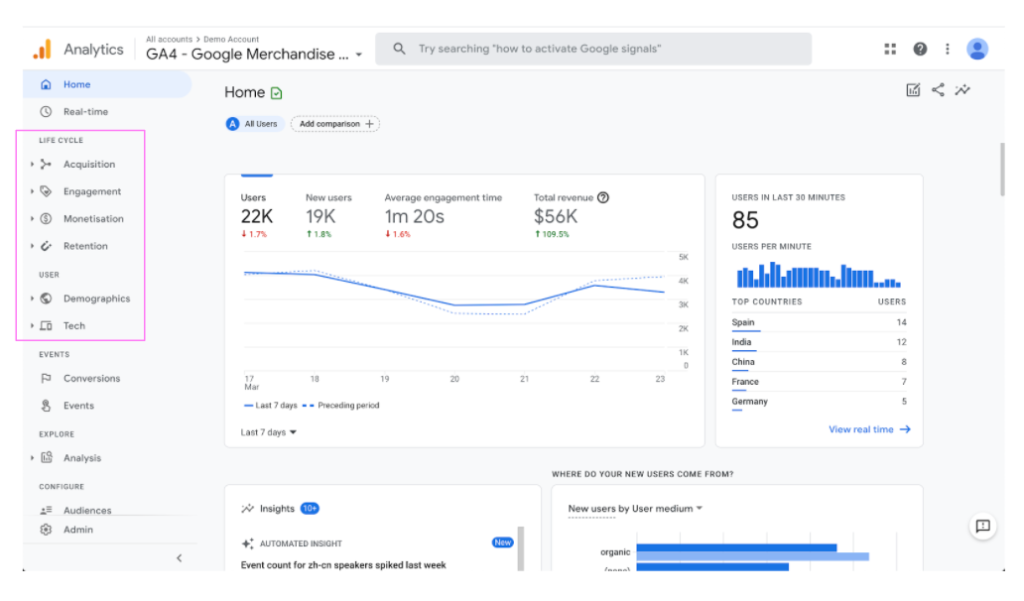
One of the best features of Google Analytics 4 is its powerful new user centric metrics and dimensions that use AI to predict customer actions and value.
Meanwhile, Bounce Rate has been done away with by Google and been replaced by some more powerful, and useful, engagement metrics. These new engagement metrics combined with the new pre-configured scroll, video, outbound clicks and file download events should enable you to get a good idea if your content is engaging or if users are engaged with the content.
3. Create powerful audiences for your ad campaigns
GA4 comes with new more powerful measurements, and more powerful analyst tools and integrations means more powerful audiences for marketing campaigns, which means better ROI on ad spend.
For example…let’s say you’re a university running an ad campaign across both mobile and desktop devices, and across web and app platforms. A user comes onto your site through a browser on a mobile and fills out a contact form; they then come back through a desktop computer, using a different browser and begin an application form; they finally complete the application form using your native Android or iOS App…
Until GA4, it would be difficult to optimise ad-spend for these kinds of user journeys – not least because you would struggle to join these different device and platform journeys together. Now, if you configure your web and apps correctly, you can stitch user journeys together and avoid wasting your ad spend.
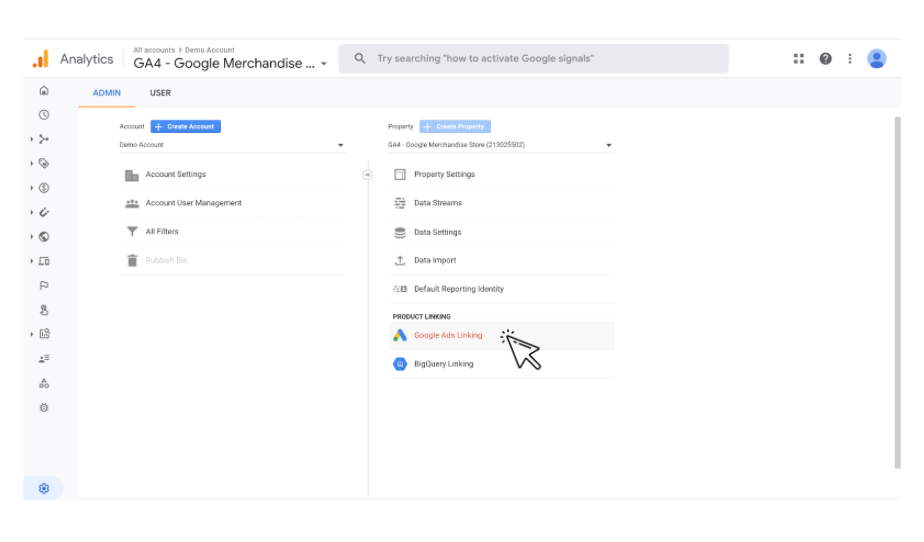
Additionally, new predictive metrics being released by Google will help to optimise those audiences even quicker and more intelligently. Google has said: “We’re continuing to add new predictive metrics, like the potential revenue you could earn from a particular group of customers. This allows you to create audiences to reach higher value customers and run analyses to better understand why some customers are likely to spend more than others, so you can take action to improve your results.”
4. Intelligent user privacy and tracking features
Google Analytics 4 gives you and your users more intuitive and precise control over what personal data is collected, which will help you comply with current and future privacy regulations. For example, with GA4 you can now exclude specific events and user properties from ads personalisation.
Google’s new approach to analytics is fundamentally designed to be more flexible and adaptable to a future where cookies will be much less common, and where privacy will be an ever more central concern for users and regulatory bodies. GA4 uses a flexible approach to measurement, and, in the not too distant future, will include modeling to fill in the gaps where data may be incomplete.
5. Simplified Goals and Events setup
Termed ‘Event Editing and Synthesis’ by Google, this enables you to really hone goal tracking and get granular behavioural data with little-to-no requirement for editing code, and editing and optimising goal set up. What used to be complex is now straight forward, which will be particularly useful when transactional functions, such as application forms and checkouts, are hosted on a sub-domain or third party site.
Right from the get go, GA4 pre-creates a number of actions and events. Previously requiring manual set up, some default options include clicks, scroll behaviour, transactions, file downloads and a user’s first visit. Some form submission and e-commerce goals may not automatically be tracked, but the set up for these is now made much easier, and again requires much less time to implement than previous iterations of GA.
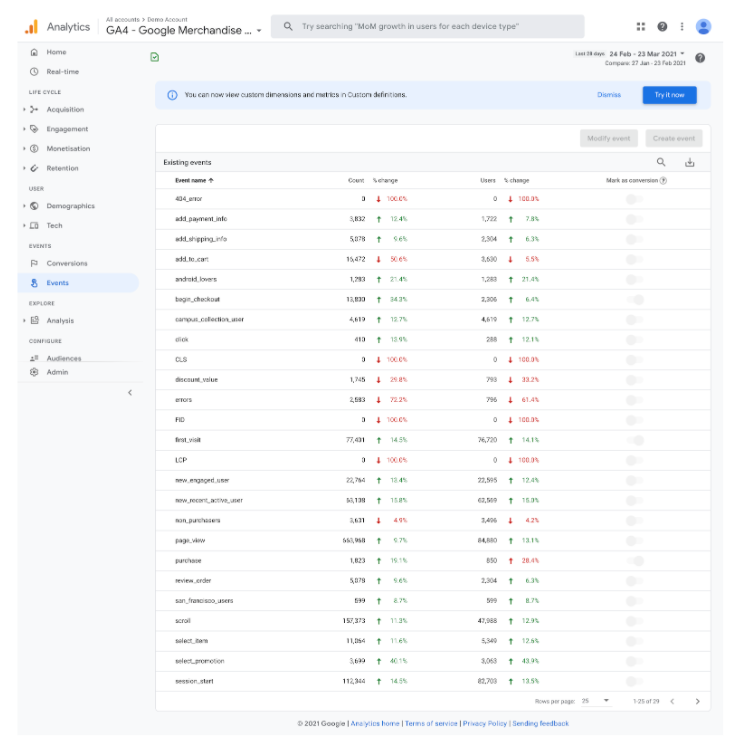
6. Enhanced visualisations and reporting
Whilst a lot of the UI has remained fairly similar within the platform, there are a number of new visualisations and reporting functions. Existing visualisations and firm favourites such as ‘Real Time’ have been enhanced and made more engaging, but it’s the additional reporting visualisations which are a game changer.
The ‘Analysis Hub’, which features a template gallery with charts which can be created, such as exploration, funnel analysis, segment overlaps and path analysis, is a vast improvement and helps to simplify some more complex cross-dimensional metric reporting.
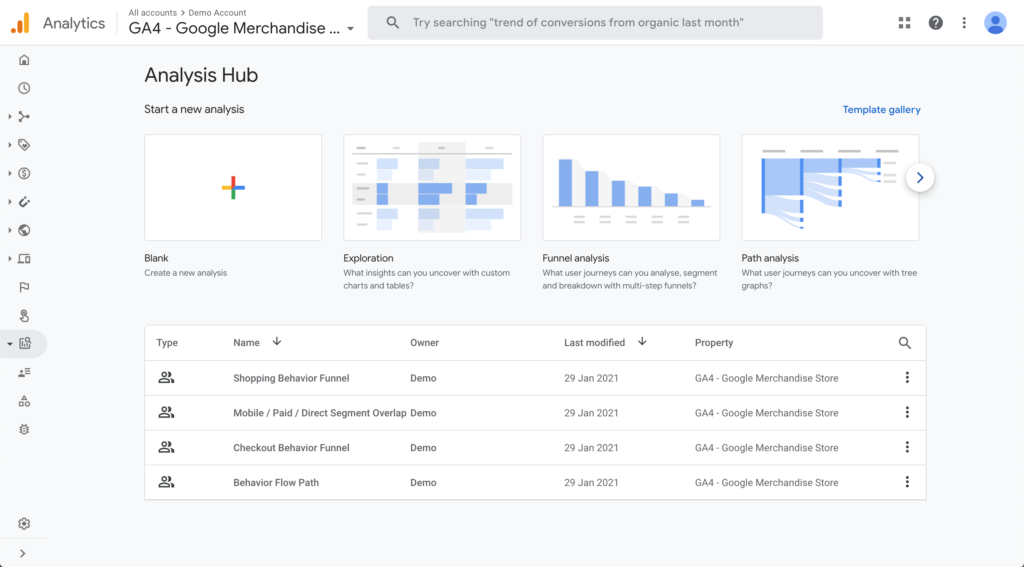
One of the most valuable parts of the ‘Analysis Hub’ is the reporting by ‘Use Case’ and ‘Industries’ which generates templated reports based on typical metrics users would want to see in these areas.
7. A plethora of Parameters
With analytics, having the right data and granularity for certain metrics is absolutely vital to be able to draw value from them. Whilst more data doesn’t always mean better data, having the right parameters is a benefit..
For example, in an e-Commerce setting, parameters can be used to attach the value of a purchase, where the purchase was made, the referring URL and the cross-device journey. Most of the dimensions which were available in the old version are still there, but they’re made more easily accessible and usable with GA4.
Google explains: “In Google Analytics 4 properties, you can send parameters with each event. Parameters are additional pieces of information that can further specify the action the user took, or add further context to the event. For example, parameters can be used to describe the value of purchase, or to provide context into where, how, and why the event was logged. Some parameters, such as page_title, are sent automatically. In addition to the automatically logged parameters, you can log up to 25 parameters with each event. For a game-style event such as level_up, for example, you may want to add parameters such as level_number, character_name, etc. Or, for a content-style event such as content_view, you may want to add parameters such as article_id, article_title, author_name, author_id, and so on. The reports in a Google Analytics 4 property provide information about the events and parameters that were sent from your app and/or website.”
This new and improved GA4 is essentially a re-architecture of the platform we know and love, and the features and benefits are numerous. Whilst it’s still in its infancy and is continuously being developed our number one recommendation is to start learning how to use GA4 effectively now to get ahead of the competition and save time in the future.
We recently ran a masterclass all about Google Analytics 4. We’ve embedded the recording below, but if you’d like to find out more about Google Analytics 4, or to arrange a free 30 minute consultation with our Google Analytics IQ Certified consultants, get in touch now.
Changes to Google could be approaching, as the company considers moving away from their cohort-based advertising and instead focus on a topic-oriented system. A significant impact for targeting methods on Google could be heading our way.
What’s happening to FLoC?
Google Privacy Sandbox has revealed what the potential next steps are for Google and its targeting methods.
One area that may see a change is FLoC (Federated Learning of Cohorts).
FLoC is a web tracking service that groups users into cohorts. These cohorts are based on factors such as browsing history and what individuals are googling.
Due to growing concerns surrounding privacy online, Google wants to move away from cohort IDs and instead focus on a topic-based algorithm.
For example, instead of assigning individuals specific IDs, Google’s algorithms will sort users into topics such as “marketing” or “advertisement”.
Tests related to these changes concluded on July 13th, and Google is now awaiting feedback from all you web-wizards out there before launching further updates and trials.
A tech-lead manager of the Google Privacy Sandbox team, Josh Karlin, provided some insight as to what’s coming for Google’s browser system. Though not set in stone, he laid out the undecided developments:
- Google may assign a website topic based on the interests reflected by who visits in a week.
- Topics would come from a shorter, public and standardised list corresponding with the Interactive Advertising Bureau’s content taxonomy.
- Karlin developed on this, stating, “Say, 256 topics as opposed to the roughly 30,000 cohorts.”
- Additionally, people could choose to opt-in and out of topics assigned to them, leading to more control on the users part.
What do these changes to FLoC mean for you?
As Digiday reports, advertising agencies and tech providers were intercepting cohort IDs, analysing their benefits concerning existing user profiles, leading to better accuracy in detecting people’s identities.
If the updates to FLoC become fully integrated, the ability to search for users and their behavioural patterns will become challenging to monitor due to the broadness of the topics.
The changes to FLoC are not the first instance of a large company honing down on privacy concerns. Recently, Apple announced new privacy features for its emailing service, impacting Open Rate marketing on its platform.
Right now, Google’s best interest is to make sure FLoC works for all parties. Its revenue comes from advertisers, so the most crucial priority is to find a way advertisers can keep doing what they do best when targeting users.
However, as mentioned beforehand, these changes are only being considered and are not currently how things work on Google. It’s another spooky privacy story to tell around the marketing campfire.
Don’t panic! Arke will update you with any news we hear through the grapevine. In the meantime, if you want more information on how FLoC currently works or are looking to boost your marketing methods at the peak of online privacy, contact our expert team now.
It’s time to get green(er) everyone, get those brand values up-to-date and reviewed as the government is beginning to knuckle down on businesses that mislead falsely implemented green claims.
Wait, what’s going on?
The CMA (The Competition and Markets Authority) have given the red-light warning to companies that claim their products comply with the law should (unsurprisingly) follow the law.
Investigations carried out last year by the CMA found that 40% of green claims made online could be misleading. This evidence implies that businesses could be breaking the law through false representations of their products and brand.
These new rules have been labelled under the “Green Claims Code” and will aim to provide companies with steps into making their credentials as eco-friendly as possible. These laws won’t be mandatory until New Year, so we have plenty of time to improve our values and refine our images so that they’re squeaky-green.
Firstly let’s get to grips with greenwashing…
What’s Greenwashing?
Greenwashing is a marketing term that suggests environmental PR is applied deceptively to persuade the public. These methods include spinning aims and policies to emphasise an environmentally-friendly image for the brand, even if that’s not the case.
In a statement, Andrea Conscelli, Chief Executive of the CMA, said: “More people than ever are considering the environmental impact of a product before parting with their hard-earned money. We’re concerned that too many businesses are falsely taking credit for being green, while genuinely eco-friendly firms don’t get the recognition they deserve.”
Previously, we’ve seen many companies muddying the water when it comes to greenwashing, such as Ryanair Air, who posted statistics based on data from 2011 to keep a specific brand representation.
The Claims
We’ve established when and why the rules are coming, now let’s look at what they are. HM Government has a lovely little video explaining the laws, but we thought we’d post them too and elaborate on what your business can do to keep clean and green.
1: Are your claims truthful and accurate?
2: Are your claims clear and unambiguous?
3: Do your claims omit or hide important information?
4: Do your claims make fair and meaningful comparisons?
5: Have you substantiated your claims?
6: Do your claims consider the full lifecycle of a product?
Not too bad, right? These rules should already be methods you have integrated into your brand values in some shape, way or form. Now it’s a matter of improvement; fine-tweaking those values to make sure your business shines brightly in the eyes of the audience.
How can we make sure of this?
Live up to all the claims you’ve made.
- Don’t be the person who brags about how good they are without clear and detailed examples. Make sure you’re providing credible evidence to back up your claims.
Don’t be vague!
- The classic tale of “customer comes first” never fades. Your statements should be transparent and clear so that everyone can appreciate where you stand and make an informed choice on what they’re purchasing.
Establish your impact!
- Emphasise the effect your product has in the grand scheme of things, from creation to disposal. You should bring your audience on a journey that keeps them fully informed about how passionate you are about making environmental changes.
Additionally, it’s vital to remember supply chains are in constant flux; there will always be a consistent evolution in social and environmental regulation. Rework brand values from time to time ground your business at the forefront of a positive brand reputation – as long as you can live by them!
Anything else, Arke?
Shout your values from the rooftop! Every company is unique and has the right to emphasise its importance in environmental change.
Remember, carrying out your statements is just as important as stating them, so be as eco-active as possible. We have a great blog regarding brand values and how to make an impactful stand, which you can read here.
We live in a very eco-conscious world with sustainable and green credentials becoming more and more the norm. Are you ready?
Would you like advice on how to invigorate your brand values? Perhaps you want to gain insight into maintaining an environmentally-friendly presence online? Contact our expert team now.
Everyone get those pads and pens ready; it’s time to take some notes! The DMA (Data & Marketing Association) have released their 2021 insights into customer engagement and consumer mindsets.
The Big Picture
Before we jump into the nitty-gritty specifics, we wanted to highlight a few keynotes the DMA brought to the forefront of their insights. They may seem obvious, but sometimes the simplest of examples can benefit us the most.
-
- Unsurprisingly, “the digital world has overtaken physical spaces for interaction, and the use of virtual communications, social media and video are increasingly valued and in demand.” With everyone stuck inside for most of last year, this doesn’t come as a huge shock.
- “The more brands can make themselves available to their audience, the more customers will continue to shop with them.”
- “The pandemic has accelerated some changes that were probably happening anyway, but the rate of change has been faster than one might have expected.”
Those Sweet, Sweet Statistics
When it comes to marketing online, who still reigns supreme? Our old-reliable friend…email marketing, that’s for sure! Through their research, the DMA concluded that email marketing remains the customers’ preferred channel, with 63% ranking it in their top two favourite ways to receive marketing messages.
The inbound approach of email marketing will always be beneficial. However, it’s important to remember it changes with the times too. For example, Apple removed the ability to track open rates within its emailing app, making it harder for businesses to track where people are.
Next up, the DMA stated that 4 in 10 customers say they’d like the ability to filter products by factors such as what personally matters to them, sustainability and localism. With third-party cookies crumbling across the internet, gathering information on your customers will be an avenue we’ll have to evaluate. Codes that get generated and stored on a website visitor’s computer (first-party cookies) could be the road we’re strolling down soon.
On the topic of localism, 6 in 10 consumers claimed they try to shop close by, showing a strong desire to support the local economy. We’ve already seen companies embracing these changes throughout their marketing tactics. For example, Walker’s “Support Local” campaign emphasised the importance of supporting local cuisine and created several unique flavours such as “Fish and Chips” and “Thai Green Curry”.
Notably, people are also getting tired of pandemic-related marketing. 34% of consumers agreed that they receive too much information about COVID from companies. Though it’s still a vital matter in the grand scheme of things, “COVID fatigue” could be affecting the engagement of audiences who, for a brief moment, might want to forget about these trying times.
-
- If your campaign contains pandemic-related information, make sure it’s essential information only. You should be asking yourself, “Is this information relevant and timely?”
In-App shopping is popping right now! 20% of consumers claim they have bought products directly through the social media app they’re using. Companies such as Shopify have expanded e-commerce opportunities to purchase items within a specific platform. We have a blog deep-diving into how social media platforms are taking advantage of In-App shopping.
Speaking of online shopping, around 50% of consumers have said they’ve bought a product through a reselling platform and are interested in doing so again. Brands such as Depop and newcomer Swopped are paving the way in this area, representing themselves positively regarding environmental importance in the process.
Lastly, we couldn’t talk about the importance of consumer engagement without mentioning top-dog TikTok. TikTok allows for a variety of experimental and creative methods to engage with new audiences. Furthermore, the DMA insights noted that 1 in 3 consumers aged 16-24 (page 6) claim influencers increase their level of trust. TikTok thrives in this area; it’s Gen Z territory. Additionally, many big TikTokkers use the site to promote and sponsor brands they support, which is why it’s a fantastic spot to place your campaigns if you’re looking to engage with this audience specifically. As we saw the effect of influential TikTokking throughout the 2021 Olympic Games.
Get Split Testing!
The opportunity to advertise has never been brighter for businesses, with an endlessly open market right at your fingertips. However, with so many options at hand, it raises the question, “where should I place the chips?”.
That’s where Split Testing comes into play. Running several marketing experiments at once and monitoring which is the most successful will lead to a less stressful workload in the long run.
Doing all you can to network and getting people to promote your product (through user-generated content as an example) goes a long way. Remember, the bigger the brand awareness, the bigger the audience!
If you’d like help levelling up your brand awareness online, or want further insight into e-commerce tactics related to social media, contact our marketing experts now.
Huge transitions are coming to the UK and its data protection regulations in 2021 and beyond. These changes will have a significant impact on online users and marketers. We wanted to give you a quick heads up on what to expect following these recently announced changes.
What’s going on?
The government has announced that Britain will attempt a departure from the European data protection regulations (GDPR) which were established by the EU in 2018.
The cultural secretary, Oliver Dowden, has said he wants to call for rules based on “common sense, not box-ticking”. Moving away from these existing regulations could allow the UK to chart its course and lead to an end of cookie popups and consent requests online.
The current privacy commissioner of New Zealand, John Edwards, will be overseeing this remodelling and will be replacing current information commissioner, Elizabeth Denham.
Through the official announcement, the government said it will prioritise creating new “data adequacy” partnerships that will allow it to send people’s data internationally, to other countries such as the United States, Korea, Singapore, Dubai and Colombia.
These changes will make for a huge transition concerning the UK’s data policies now that Brexit has been finalised.
What is GDPR?
The General Data Protection Regulation was the replacement for the EU’s 1995 Data Protection Directive. Until now, it had set the standard for processing data in the EU. GDPR introduced several rights to users including: “individuals gaining the right to demand companies reveal or delete the personal data they hold; regulators were able to work in concert across the EU for the first time and rather than having to launch separate actions in each jurisdiction; their enforcement actions had real teeth, with higher maximum fines for breaches”.
In the run up to Brexit, the UK reworked its data protection laws to mirror GDPR to avoid discord between British and European Law.
Now that we’ve officially left the EU, the government has the power to alter the rules of data privacy and protection regulations. And that is exactly what they plan to do.
From a compliance perspective, GDPR has a heavy cost for businesses. For example, GDPR entails the hiring of a data privacy officer (or assigning that role to a member of staff and adding to their existing workload). Additionally, first-party databases, partners or vendors must be audited, which, if found to be breaching the law, can lead to a risk of fines and lawsuits.
Moving away from these regulations could be the catalyst for a change in marketing tactics for companies in the UK…
The Cookies Back in the Jar
Back in June, Google pledged not to kill third-party cookies without the UK competition Watchdog’s say so.
According to the UK’s Competition and Markets Authority (CMA), Google has agreed to address concerns about its plan to remove third-party cookies. This compromise follows an investigation into the Chrome Privacy Sandbox proposals made by the CMA and ICO in January.
The Ad Exchanger reported that “specifically, Google has pledged not to discriminate against its rivals in favour of its own advertising and ad tech businesses when designing or operating alternatives to third-party cookies.”
As a result of Google involving the ICO in its developments, could we now see Google reversing its decision to kill third-party cookies as a result of these changes to GDPR? Watch this space…
Privacy – us, and you
Here at Arke, we’ve seen a lot of news throughout 2020 and 2021 about privacy transitions online. We recently discussed the changes to Apple’s emailing policies that will alter the world of email marketing.
Furthermore, China has recently been in the news as their new privacy laws borrow from Europe’s GDPR. However, their laws, (known as PIPL) are much stricter, as any proposal to move data overseas must first undertake a security review by China’s data authorities.
Whilst these transitions to a more transparent and user-first approach are positive from a user perspective, it undoubtedly makes it more challenging for marketers to advertise online.
However, we’re still in the early days since these changes were announced, and the potential impact is still unknown. We’d recommend keeping an eye on this space…we’ll be updating this story as it develops.
If you’d like advice on how to gain an advantage over your competitors or how to mitigate the impact of these changes,, get in touch with our digital experts today.
Email marketing is one of the most effective ways to advertise to your audience. But what happens when a company changes the game, removes the ability to track open rates, fundamentally adjusting how we can use it?
On Monday, June 7, Apple hosted its annual Worldwide Developers Conference at the San Jose Convention Centre in California.
The event demonstrated a variety of interesting additions, including information on their new operating system, iOS 15 and macOS Monterey which coincidentally, has paved the way for the introduction of Apple’s Mail Privacy Protection.
So…What does that mean?
This new feature, which can be turned on through Apple’s mail app prevents individuals and companies from collecting information when their customers receive or open an email.
This process is done by blocking tracking pixels. Tracking pixels are tiny images that download with other pictures in the email. Blocking this process means that any email opened by a consumer can no longer be tracked and can’t be linked to any other activity such as a purchase, discount activation or subscription.
So, it just got a whole lot harder for companies to know who you are and where you’re from just from an email.
Although this feature leads us one step closer to an internet where the consumer has more control over who can access their personal information, this makes marketing tactics, such as email marketing, challenging for marketers. Whilst this may be a positive step for the consumer, this update will have a direct and detrimental impact on one of the bread-and-butter statistics of an email marketing campaign – open rates.
What’s an Open Rate?
An Open Rate is a measure concerning how many subscribers opened a specific email. By using the tracking pixels we discussed earlier, images are downloaded onto the customer’s device and the sender can then track if that individual has interacted with the email. Historically, an Open Rate metric has been seen to be a useful gauge of how successful a campaign has been with its audience.
However, Open Rates may not be as objective as you think. Known as a vanity metric, Open Rates are easily manipulated. As a number, an Open Rate will always be higher than a Click Through Rate and thus makes whatever’s being marketed look better. This could be used for example by tallying up and presenting the statistic in a company presentation (we’re not pointing fingers at anyone…honest!)
This metric has been the standard for marketers since HTML emailing became the norm.
Zack Doffman, CEO of Digital Barriers, a frequently cited expert on security privacy risks, and commentator for broadcast news had this to say about the Open Rate metric – “It’s a marketing tool that has gotten completely out of control, with most emails now tracking user behaviours. Suffice to say, make sure you enable Mail Privacy Protection when iOS 15 arrives.”
The Effectiveness of Emails
So, you’ve just started a campaign and you’re ready to send out emails to your audience. And now one of the largest conglomerates in the world adds Mail Privacy Protection to its emailing system and suddenly you can’t see how many people have opened your email…what now?
Don’t despair just yet! Here at Arke, we have a few methods here to share with you that will get you on the right track. Such as…
– Conversion Rates and Click Through Rates
A conversion rate is a process of increasing the percentage of website visitors who take a desired action. This action can take a variety of forms, such as filling out a survey, making a purchase or engaging new leads to your website. All of this can be tracked in Google Analytics, which should be a common conversion tool in your marketing arsenal. If you’re unsure how to make the most of it, or simply want your Google Analytics to be implemented, we know just the people. Click to get in touch with our analytics experts.
One example of a conversion you’ll want to track is Click Through Rate, which will give you a really good idea as to whether the content within your emails is engaging, and is undoubtedly more powerful than an open rate. You can track this in your Email Marketing Service Provider software, and you can then track the user journey in Google Analytics.
– A/B Split Testing
Another approach that can prove useful is to use Split Testing. Split Testing is the process of running marketing experiments to see what resonates and works best for yourself and your audience. A few examples of Split Testing concerning certain marketing strategies are:
– CTAs (Calls-to-action)
– Landing Pages
– Effective and engaging copy for your emails
What would we recommend?
We recommend a consistent tracking of your conversions. You don’t have to stare into the endless abyss of your Google Analytics every day but setting aside some time and gaining an understanding of what’s working (and what could be doing better) is an effective and easy routine to get into. Look at your email marketing analytics tools, see what links users are clicking on and then dive into Google Analytics to see what they’re up to when they’re on your site.
Research, testing and monitoring your traffic can be super informative and tell you where you should be improving your email marketing strategies.
What has the overall growth of your mailing list been like recently? Has there been an increase or decrease in your unsubscribe rate? Exploring these numbers could start you on the path of improvement.
What happens now?
The good news is, you’re not the only one dealing with these changes to email marketing right now!
The Mail Privacy Protection system won’t be implemented into Apple’s emailing app until September, so you have a little bit of time to plan around the changes.
Despite all this, it’s important to remember moving away from Open Rate Metrics won’t affect conversions or revenue, it’s just a fancy statistic that’s all glitter and no gold.
If you’d like more advice on how to combat the iOS 15 updates or want to explore the different ways you can engage with your audience through email marketing, get in touch with our experts today.
Since we’re here, why don’t we start at the very beginning…what actually is a cookie?
A cookie is a small bite-size chunk of data that is given to a user once it visits a website and clicks ‘Accept Cookies?’ and it is then sent straight back. The idea is that it monitors the user’s behaviour, activity and interests.
Cookies have allowed advertisers to create an incredibly in-depth and accurate process for targeting and advertising that allows them to show ads to people that they know are interested. Once a user expresses an interest in a company’s website, this company can now display ads throughout the user’s browsing experience.
“In other words, the guy that keeps calling because you told him you liked his shirt.” (Intricately)
As we’re sure you’re aware, third-party cookies are cookies that are stored under a different domain than you are currently visiting. They are mostly used to track users between websites and display more relevant ads.
What’s happening to cookies?
Again, as we’re sure you’re aware, Google has relatively recently announced plans to stop using tracking cookies on its Chrome browser by 2023, replacing them with a group profiling system in a move the company says will plot “a course towards a more privacy-friendly web”.
There’s no doubt about it, this change is significant. Chrome commands around two-thirds of the web browser market. Third-party tracking cookies, meanwhile, underpin much of the targeted advertising industry. And, while Firefox and Safari have already stopped supporting third-party cookies, Google is the first to produce replacement advertising support…which we’ll come onto shortly.
What’s Apple’s part in this?
Released on the 26th April, the latest version of Apple’s mobile operating system, iOS 14.5, prompts iPhone and iPad users to opt-out of tracking in apps that monitor their behaviour and share data with third parties.
There’s no doubt about it, this new feature is a significant step for user privacy, as it gives people more control over their data and how it’s used by companies, such as Facebook and Google. On the other hand, the development has frustrated app developers, tech companies, and advertisers who have relied on that data for years.
The biggest difference that most people have seen is the introduction of Apple’s new privacy tool, named App Tracking Transparency, which pops up when you first open an app.
From an iOS 14 perspective, understandably, Apple’s new privacy feature has caused a bit of panic among marketers and advertisers alike, primarily due to how it limits the amount that we can track from users in apps. Advertisers around the world rely heavily on this data, especially on platforms like Facebook and Instagram, to build audiences, measure conversions outcomes, and track analytics.
It’s difficult to assess the full impact of the change now, but before the update was released, it was estimated that the percentage of iPhone users sharing their unique IDFA with apps would drop from 70% to as low as 10%.
Perhaps the most alarming stat is that 96% of users access Facebook through the mobile app, so this change is going to have a big impact, leading to those previously mentioned reduced tracking capabilities for advertisers, and also less personalisation and relevant ads for users.
Research by Epsilon shows that 69% of advertisers think the crumble of the third-party cookie will have a bigger impact than GDPR.
The results of an Ad Age survey show that 70% of advertisers asked feel that digital advertising overall will take a step backward.
Why is this happening?
These changes have come about because of people’s desire to be more in control of their data, plotting a move to a much more privacy-centric world. According to Google, “users are demanding greater privacy–including transparency, choice, and control over how their data is used–and it’s clear the web ecosystem needs to evolve to meet these increasing demands.”
What’s the impact going to be?
There’s no doubt about it, these changes have the potential to really rock the advertising and attribution landscape. Naturally, you’ll find it difficult to build audience lists and measure ROI … if you stick to what you were doing before.
Reach:
Approximately 80% of advertisers depend on third-party cookies. Without them, those advertisers will need to find a new way to reach their customers and prospects online.
Personalisation:
Behavioral and browsing data will be limited, making it hard for advertisers who depend on third-party cookies to personalise ads to the user, and this will naturally lead to a drop in engagement.
Campaign management:
Basic capabilities like A/B testing and frequency capping will be more challenging for advertisers who depend on third-party cookies – purely because you’ll have less reach and less visibility on who’s clicking and engaging.
Performance measurement:
One of the biggest impacts will come in the form of analytics and attribution – it will undoubtedly become more difficult to measure and attribute using platform pixels which rely on third-party cookies.
In summary
There will likely be…
- Difficulty in building custom audiences
- Difficulty in accurately measuring conversion outcomes
- Difficulty in tracking analytics
- Difficulty in proving ROI from ad campaigns
Get in touch
If you’re interested in speaking to our experienced team to discover how we can help you to track and understand your audience’s behaviour in a cookieless world, then get in touch today.
On Thursday 25th March, our expert marketing panel hosted the latest episode in our digital masterclass series: ‘Google Analytics 4: what you need to know’.
You might have heard that Google will soon be scrapping third party cookies. Propelled by major shifts in consumer behaviour and privacy-driven changes to longtime industry standards, Google Analytics 4 is there to help overcome what’s been described by some as the ‘rewriting of the rules of the internet’. This masterclass helped prepare attendees for the migration from Universal Analytics to Google Analytics 4, minimising the potential impact and maximising the opportunity it presents.
A huge thank you to everyone who attended and submitted a number of thought-provoking questions…we’ve rounded some of them and our panel’s responses up, so you can digest them at your leisure.
If you want to watch an on-demand recording of the masterclass, we’ve embedded the YouTube video below too.
1. Will the GA update happen automatically or do we need to do something?
GA4 is a new platform in its own right. So yes, you will need to create a new GA4 property within your Google Analytics account, and get it linked to your website either through the code or, ideally, through Google Tag Manager.
2. Can you still build Data Studio reports with GA4 or do you need to build and export reports?
Data Studio will natively connect to Google Analytics 4 just like it does with the existing Google Analytics instance, and it will also connect to Google BigQuery as well. That Google BigQuery integration, up to certain usage, is completely free, unless you’re querying terabytes and terabytes of data a month! Everything will ll integrate natively into Data Studio, as well as a whole host of other platforms. If you do integrate with BigQuery, it will be incredibly fast to interpret and query data.
3. How do you import an audience from Google Analytics into Google Ads?
GA4, just like Universal Analytics, supports a native Google Ads link and once you’ve done that all audiences available within GA4 will be available in your Google Ads account, alongside your goals, which are conversions as well. However, you cannot migrate across your existing audiences within Universal Analytics, so implementing GA4 sooner rather than later is recommended to avoid starting from scratch once UA becomes obsolete.
4. Do we interpret engagement rate as the opposite of bounce rate? I.e if there’s a 60% engagement rate can we assume a 40% bounce rate?
No, is the short answer to that! Bounce rate isn’t actually a thing in GA4. In terms of the interpretation of it, bounce rate isn’t the opposite of engagement, and engagement isn’t a bounce. Engagement really should just be an amalgamation or an assembly of touchpoints or key performance indicators that you set up, or decide upon, yourself, that contribute towards certain touch points or certain conversions. So, if an individual doesn’t bounce from page and they click through one page deeper, but then don’t do anything more, we wouldn’t count that as an engagement, but if they then went on and visited three or four more pages, read a blog post and perhaps made an enquiry, that would certainly be an engagement.
It’s very subjective and dependent on what you’re tracking, how deep your funnel is, and what you’re trying to get the users to do on your website that defines your engagement. Bounce rate is just an indication really of page quality and the quality of the user that you’re driving to the page; especially if it’s paid media.
5. When GA4 is set up would it include the old data from universal analytics or start from scratch?
Similar to most things with Google Analytics, it always starts fresh. If you’ve already got Universal Analytics running, you can keep that going and you can pull and merge that data by using a variety of tools. Look outside of Google Analytics and start to understand your data that you’re tracking and how you can do it in GA4. You’ve got plenty of time to make that transition, but in short, you cannot migrate across your data.
6. Is raw data available in BigQuery free from sampling issues or is sampling irrelevant now with the AIs we rely upon?
In terms of the event data from BigQuery, this is a big new advantage. There won’t be any sampling issues when doing a look back of six months. If you’re in Data Studio, or if you’re creating a custom Google Analytics API query, if you’re looking back longer than 6 months, it will start to sample. But, if you’ve got that data from day one going into BigQuery you won’t have any issues with sampling.
In terms of the AI and the way it stitches that data and builds that intelligence, it won’t have much effect on the event data streams that are getting pushed to BigQuery, which is very much like hard data and is not in any way modelled upon. But, it is very much the audience stuff that uses the AI, so if you’re bringing in information around segments of users around certain interaction points, and then using that to compare the event data, you might see some kind of irregularities, but on the whole sampling won’t be an issue.
7. When will it be compulsory to have Google Analytics 4? Is there any benefit in waiting until 2022?
We estimate that Universal Analytics will be redundant in 2022, but all the data will still be in there. As we said earlier, when it goes, so will your data!
We really recommend you start experimenting with GA4 now. Run the two instances side by side until you’re fully comfortable with GA4. You can compare the two instances side by side to ensure that all tracking is in place and you’re tracking what you need. If you get started now, it will be much easier when Google does remove support for Universal Analytics.
If you’re spending any money on paid media, especially in Google Ads, it’s really important that you get GA4 immediately. Those audience definitions are going to become smaller and smaller as platforms and users search the web with fewer and fewer cookies.
That’s a wrap on our Q&A session, if you have any queries in regards to your Google Analytics 4 implementation, get in touch to book a free 30 minute consultation with our experts and as promised the full masterclass is below
How often do you receive a targeting brief with an audience like this?
-
- Markets: UK, France, Italy, US, Germany
- Gender: 60% Male, 40% Female
- Age Range: 18-35
In the example above, we might guess that insights have been gleaned from an overall view of the data due to the lack of overlap between the variables. This means that these conclusions are susceptible to various statistical fallacies that occur when not properly segmenting data.
As a marketing agency, we regularly receive briefs based on a client’s analysis of their customer data to inform our campaign targeting. However, we aren’t always certain that the audiences provided will produce the best results. Data can be strange, especially if the analysis is surface level or oversimplified.
Simpson’s Paradox
One of the most prevalent of these fallacies is the Simpson’s Paradox (also known as the Yule–Simpson effect). Simpson’s Paradox is a phenomenon in statistics in which a trend seen in different groups of data reverses or disappears when the groups are combined.
This paradox is one of the oddest occurrences in statistics and highlights the need for scepticism when interpreting data for real-world applications. Failing to account for it can severely impact your marketing, waste money and negatively affect user experience.
You can read more about the specifics of the Simpsons Paradox here: https://arkeagency.com/news/simpsons-paradox-is-your-data-telling-the-truth/
Continuing with the example above, let’s take a closer look at the gender targeting suggested. When observing the total income from purchases made by gender, we understand how the client has reached the prospective split in targeting:
We see that just over 60% of all purchase income is from male customers, so it would be reasonable to focus a higher percentage of the budget on male prospects.
However, there’s a hidden story in this data. Is that true for all audience segments? We investigate further and observe purchases by gender in each of the 5 given markets:
In fact, when we look at the data more granularly, we see that in all markets but the UK we find the opposite result to when we looked overall, with more of the purchase income generated by women. If we had taken the insights at face value and focused on male prospects in these markets, it could have led to low performance and increased costs.
In this case, Simpson’s Paradox has been caused by a large proportion of male customers in the UK market. The UK is the largest market and so the high number of purchases from males has skewed the overall result when the market segments are combined.
We call the market variable a ‘confounding’ or ‘associated’ variable when considering gender. It is important to take as many of these associated variables into account when reaching decisions from your data.
The impacts of Simpson’s Paradox
As demonstrated, Simpson’s Paradox is especially dangerous in a commercial company or any sector that requires predictions of a person’s intent or behaviour. Incorrect insights may be more readily accepted if the conclusion aligns with our own biases. For example, if the company in question sold boxing equipment, the heavier focus on male prospects could seem reasonable due to existing beliefs and the evidence for this conclusion would be less likely to be interrogated.
In this instance, our bias was correct for the UK but in all other markets, women outperformed men.
Overcoming Simpson’s Paradox
It is vital to identify segments and variables for which an overall analysis produces incorrect results. Targeted variables must be broken out as much as possible, not just in performance reporting but in campaign setup and planning as well. Analysing granular segments is key to combating this common mistake.
There’s added complexity to the campaign for each variable accounted for, and there’s a point where optimisations and setup become overly cumbersome. Too many different audiences can also stretch budget and mean small sample sizes for analysis. Discover key associated variables and ensure that a campaign’s complexity is not disproportionate to the budget.
It’s also important to question insights you are given. Make sure you understand where data has come from, how the analysis was designed and how a conclusion was arrived at. Even an insight that an organisation has historically understood for years may be incorrect if it hasn’t been investigated in an in depth manner.
It can be daunting to tackle this paradox.
-
- Too little or too much data can make it difficult to reach proper conclusions or fully uncover all the associated variables.
- Start with key variables you know you can control and have enough data for statistically significant insights.
- Going just one level deeper (breaking out one confounding variable) can yield surprising results and greatly impact your planning and performance, as shown in this example.
- Keep reassessing your strategy but do not be too hasty.
- Make sure you have a large enough sample size to prove your assertions and once you have that, don’t be afraid to act on new data.
Stay sceptical, interrogate data and find the hidden patterns beneath the surface for truer and powerful insights that you can leverage for your marketing needs.
Get in touch with our data science & analytics experts to find out how to tell stories from your data and make data-based decision making to transform your organisation.
It was announced on 4/2/21 that Google will be merging phrase match and broad match modifier keyword types – the latest in a series of match-type rule changes brought forward over the years. In 2014, the search giants ended support for ‘pure’ exact match types and required advertisers to opt-in to allowing for close-variants of these keywords. More recently, Google has allowed additional queries to be matched to exact and phrase matches, driven by machine learning that identifies user intent, paraphrasing in queries, and implied words.
This latest move signals the end of the broad match modifier match types in favour of “bringing the best of broad match modifier into phrase match”. This means that the new version of phrase match will now pick up the vast majority of traffic previously caught by broad match modifier keywords. Google explains; “we’ve seen that phrase match and broad match modifier often serve the same use cases and that you can reach more of the right customers through a combination of the two”. The updated phrase match will continue to respect the order of words when it is important to the meaning of queries, but additional words can now be inserted into the phrase.
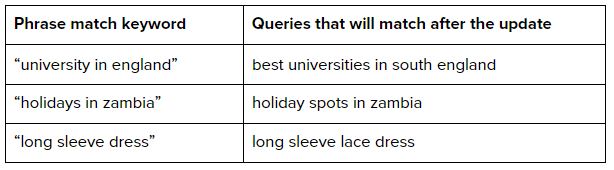
The update will begin in the UK in mid-February and will roll out worldwide by July when advertisers will no longer be able to create new broad match modifier keywords.
In addition to this, improvements are being made to pure broad match keywords. Google will now identify additional signals within the advertisers’ account to deliver more relevant traffic when using this match type.
What does this mean for advertisers? During the next few weeks when these updates begin to take hold, advertisers may need to recalibrate their Google Search campaigns to ensure that traffic being delivered remains relevant, and slowly transition any broad match modifier keywords over to phrase match for long-term campaigns running past July.
Whilst Google ultimately promises that keywords will be easier to manage following this change, traffic is expected to fluctuate during the transition as the platform introduces new learnings. We have already put robust measures in place to ensure that campaigns continue to deliver the quality traffic Arke is known for, staying well ahead of the game. Your move, Google!
If you’re interested in taking advantage, get in touch with one of our advertising experts today.
Attribution modelling is a framework for analysing the various marketing touchpoints, channels and tactics and determining which receive the credit for a specific conversion. Using attribution models helps marketers to better understand which parts of their marketing efforts are having the most effect on conversions, therefore enabling better data-driven decision making which can transform organisations.
There are a number of different attribution models, with each attributing conversions to marketing channels differently. Let us introduce you to three of them…
Last-click attribution
Without proper tracking, Google Analytics uses last-click attribution to attribute conversions. With this model, all (100%) credit goes to the last touchpoint before a customer converted, therefore not taking into account awareness and nurture tactics which may have influenced the customer’s decision to purchase.
For example, applying this last-click attribution model to an education setting, the vast majority of conversions (applications) are attributed to remarketing and conversion tactics. No credit is given to those awareness and nurture tactics on paid search and display:

Linear attribution
On the other hand, a linear model gives credit to each touchpoint along the user’s journey equally, allowing a more even spread of attribution. For example, if there are 4 touchpoints, then each touchpoint would be given 25% of the credit, 5 touchpoints and each touchpoint would be given 20%, and so on…
However, should all touchpoints be given the same value? For example, does first entering the site via Google Search actually influence the likelihood of a conversion?

Markov Model
The Markov Model is arguably the most advanced attribution model that uses Markov chains to calculate the probability of a set sequence of events happening, essentially analysing the likelihood of each touchpoint influencing conversion.
In an education setting, we can calculate the sequence of touchpoints for all applicants and then calculate the effect of a certain touchpoint on the probability of an application.

Let’s observe the effect of removing the Facebook advertising touchpoint from an applicant journey:

By comparing the two images, you can see that having a Facebook advertising touchpoint doubled the probability of a conversion – the Markov model assigns a score to that channel based on this. We can use this process of removal to gain an understanding of how different media touchpoints affect conversions, allowing the importance and performance of a channel to come through, and data-driven decision making to be made.
A real Markov model would look like this:
Let’s stick with the simplified version!
Why is this important for you?
When reporting on return on advertising spend, certain tactics can receive an overinflated amount of credit in a last click attribution model, whilst others seem like they have contributed few conversions. You could therefore channel more money into the tactic that, on the face of it, is performing best, but that doesn’t give you the full picture.
A more complicated attribution model gives a more accurate return on advertising spend (ROAS) for each media channel, and this where the Markov models comes into its own. The model gives an idea of which media channels actually drove conversions and how they did it. You can then use this information to decide on future campaign strategy and media budget.
If you’re interested in exploring data-driven attribution that not only calculates ROAS, but analyses how paid media channels work together to drive conversions, get in touch with one of our data experts today.
5G is the next evolution in mobile technology which will have a significant impact on every aspect of our lives. From faster up and download speeds to lower latency and greater capacity, it promises to revolutionise the way we engage with and consume content.
So, what is 5G?
5G is estimated to be 1,000 times faster than 4G (5G.co.uk), with latency that is 4.5 times faster than 4G (Data Makes Possible) – latency is the time it takes for a request to travel from the sender to the receiver, and for the receiver to process that request. In other words, “the round trip from the browser to the server.” (KeyCDN) Obviously, the desire is for this to be as close to 0 as possible. In short, 5G is fast.
5G is currently available in 98 major towns and cities across the UK (5G.co.uk), with EE first to the party in May 2019. Since then, Vodafone, O2, and Three have all launched their own 5G services. However, the rollout of 5G in the UK hit a stumbling block in July 2020 when the UK Government announced that Huawei was to be removed from UK 5G networks by 2027. This is expected to delay the UK’s 5G rollout by a year. (BBC)
At the end of February 2020, 5G had expanded to 378 cities across 34 countries (Tech Republic), with South Korea leading the way, followed by China, the United States of America, and the United Kingdom. In May 2020, 5G finally arrived on the African continent, with Vodacom launching its 5G network in 3 major cities in South Africa. (Total Telecom)
What effect will this have on marketing and advertising?
You may or may not be aware that website speed and load times have a huge effect on SEO, conversions and page views. Mobile sites traditionally have had limited functionality and content so that load times are faster, meaning that they don’t lose valuable traffic. However, these faster 5G data load times will allow for far richer digital content on mobile devices, without impacting load times.
Not only does speed affect SEO, but it has a huge impact on the delivery of ads. Advertising on mobile has traditionally suffered from those same issues with lag times and latency. Users scrolling a web page may skip past an ad before it’s loaded and before it can capture their attention. But, this is where 5G comes in! A faster rate of delivery and a network than can cope with larger file sizes will allow for better, more sophisticated ads to enhance the user experience and get more engagement…creativity is your oyster.
What about the opportunity?
It also offers a massive opportunity for alternative reality experiences where data has to be rendered in real-time in order to be immersive, convincing and consumed by the audience.
Another huge opportunity comes in the form of events and event-based marketing, where traditionally 4G networks can’t handle the volume of traffic; 5G presents opportunities to deliver real time ads to users when they’re at their most interested. For example, at a football stadium, you could serve an ad for an offer in the club shop for a player who scored the winning goal, or food and drink vendors at festivals can serve ads for deals that they’re running at that moment in time, or education institutions can serve ads to students visiting their college or university for an Open Day. 5G presents a fantastic opportunity for innovative advertising that is video and instant experience first.
Other benefits to marketers include
Enhanced location targeting – user location information will be even more precise and accurate.
Ability to utilise video more heavily in advertising without having to worry about load speeds.
Long-form video content strategies will come to the fore, as users will be more likely to consume longer videos on their phones as buffer times will be minimal.
Great opportunity to target different countries that you may not have been able to reach before, because of slow speeds.
Emphasises a mobile first website. In the past, it’s been considered a bit of an afterthought, although this has changed in recent years, the development of 5G will speed this shift up.
What is the impact to you?
5G will have profound effects on our everyday lives, as we become more connected than ever before. This presents huge opportunities for marketers to really develop the way they communicate with their customers…get personal, in real time, with amazing creativity, and watch the results roll in…
If you’re interested in learning more about the impact of 5G on the future of
advertising & content marketing will be, and how you can take advantage, get in touch with one of our experts today.
Higher Education Institutions (HEIs) worldwide are operating in an increasingly uncertain and competitive environment, responding to economic and social changes whilst maintaining high levels of teaching, learning and student satisfaction.
Complex decision making is needed for dealing with these contemporary challenges, and often the role of data in making these decisions, planning for changes and the future is less understood or even overlooked.
We recently published a report which showed that 4 in 5 marketers are using Google Analytics data to report, rather than to strategise, whilst 68% of marketers are reactive, rather than proactive, in using data to make key decisions. Additionally, a recent Forbes article stated that “more than 95% of businesses face some kind of need to manage unstructured data.”
It’s evident that organisations struggle with data and how to best utilise it. The benefits of a data-driven approach to decision making cannot be underestimated. But, whilst efficient aggregation and cleansing of data can go a long way to identifying recurring behaviours and trends, it’s through predictive analytics that we can access real tangible forward-looking solutions.
Predictive analytics for marketing
The most common method of predictive analytics we undertake for our clients is determining customer preferences and behaviours to create a personalised and streamlined approach to marketing. Predicting what a user’s future behaviour will be, based on their demographic profile and activity history, helps to design and deliver highly personalised and effective content. Not only does this reduce costs when serving this content through advertising, but it also ensures a user isn’t bombarded with irrelevant content which doesn’t match their needs, reducing the overall customer brand experience.
Within Higher Education, we use predictive analytics to follow a prospective student’s enrolment journey beyond the application point. Using past admission data, we build predictive models through which we categorise new applicants in real-time, giving the opportunity for quick responses to nurture relationships and increase conversion and retention.
One of the key aspects of a predictive model is that it doesn’t separate attributes from the individuals who hold them. When simply calculating the proportion of enrolment of a segment of the data, other factors influencing the applicants within that segment aren’t considered. This is where predictive analytics steps up, elevating an approach from just knowing your data to learning from it, uncovering patterns and trends that inform decision making. The ability to fully understand prospects and customers provides you with a competitive edge and allows for cost-effective and more impactful marketing campaigns.
Predictive analytics for decision making
In addition to using predictive analytics for marketing, HEIs carry a large quantity of data for each student throughout their student life at university and can, therefore, utilise data science techniques to predict the following, helping to ensure the best possible student experience:
- When is a student at risk of dropping out?
- Which student actions will achieve higher grades?
- What features of learning and living environments lead to better grades?
- What grade is a student likely to get without intervention?
- Should a student be referred to a councillor for help?
- Which students use facilities in groups or alone?
- Which assignments and courses are learning choking points?
Beyond this, data can also be used to develop institutional practice, from enhancing user experience to improving academic performance, and respond strategically to global trends with efficient, evidence-based decisions.
Get predicting
Just how important is a data-driven approach to marketing and decision making? Research from BARC suggests that organisations “that use big data saw a profit increase of 8% and a 10% reduction in overall cost,” whilst a Mckinsey survey has revealed that “data-driven organisations are 23 times more likely to acquire customers and six times more likely to retain customers and 19 times more likely to be profitable as a result.”
Whilst it’s imperative to have data at the heart of your organisation, it’s only useful if you can utilise this data to make better future decisions to improve experiences, results and money.
Need some help?
If you’re struggling to make sense of data or want to find out more about how predictive analytics and modelling can help your institution or organisation, get in touch with one of our experts.
Download the Arke data marketing report which analyses how data is used by marketing leaders, the challenges they face and recommendations for greater data-driven decision making.
Welcome back. Ok, let’s pick up where we left off. If you missed our media trends in 2020 part one, check it out here. But this post is all about media trends in 2020, part two.
What you will learn from this article:
- Ducks should swim like ducks
- TikTok’s been on a raid
- Likes are bad for our health
- 475 years worth of stories are uploaded every day on Instagram
- 5G will shape user behaviour
Ready to get started with media trends in 2020? Let’s go.
Brand will outweigh performance
The last decade has seen marketers fervently swarm towards volume and performance metrics from their advertising strategies and using digital to drive & measure direct response and return on ad-investment.
We all love to be able to directly demonstrate that £X returned £Y, right?
However, Gartner report that 72% of CMO’s put Brand Awareness as a top priority marketing objective of 2020, with performance metric ROI, a close second with 70%.
They go on to report that marketers struggle to attribute performance metrics to brand impact, for the following reasons:
- Difficulty tracking all consumer touchpoints and thus gaining the full picture;
- Difficulty quantifying the long-tail brand impact
That’s where an integrated and effective marketing analytics implementation comes in. Allowing marketers to draw unique insights and strategic direction, rather than just reporting. This is clear, with 64% of marketing leaders stating that their biggest investment area will be Marketing Analytics, occupying 16% of their total annual budgets.
For more information on how to achieve this, feel free to drop our data science team a line.
The old brand vs performance adage always reminds me of Marty Neumeier’s 2005 book, ‘The Brand Gap: How to Bridge the Distance Between Business Strategy and Design’. Marty uses a variety of colourful metaphors to illustrate the challenges faced when addressing the gap between business strategy (performance) and creativity (brand), and where some companies do it well, while others less so.
The classic adage being: “ducks should swim like ducks” … hard to argue with.
Oh, and in case you were wondering, here is a breakdown of the types of advertising marketers are spending their budgets on:

TikTok’s been on a raid
TikTok has been busy raiding Facebook’s senior leadership team, across EMEA & North America, so we can expect big developments in their commercial strategies, and we have an inkling that their advertising product portfolio is going to expand, much in the way Instagram’s developed over 2016/17.
Currently, most of TikTok’s ad revenue comes from brands partnering with their platform to sponsor #hashtags, in a bid to go viral via user challenge content. We anticipate growth in the feed & over-content-display, currently still in its infancy, yet with a flashy new executive board made up of Facebook’s exes we can certainly expect this to be expanded and pushed.
We’ve seen strong engagement from our TikTok campaigns for clients. However, with a fixed starting price of $10 CPM, it is the most expensive social platform to advertise on. Nonetheless, as this destination is not saturated with multiple ad products and every man and his dog advertising there, reach and engagement is high – 3 times higher average engagement rate than Instagram, according to Influencer Engagement Hub.
The average session time on the platform is 5 minutes, longer than both Instagram and Snapchat.
But remember, audiences go there to be entertained. So, get creative folks.

If you want to know more about getting the most from your TikTok advertising, check out this article.
Likes are bad (for our health)
In a bid to encourage users to share more content, Instagram continues to roll-out their trial of the removal of likes on brands’ and users’ content.
This big change is designed to ‘remove social pressure’, says Instagram CEO Adam Mosseri, and encourage the sharing of more content that we love, irrespective of the likes. Just like the good ol’ Facebook days of the mid-to-late noughties.

This roll-out is now in effect in the US & UK, with the permanence of this new feature dependent on audience feedback. No formal announcements have been made as yet.
We’ve been testing this feature throughout January and the general vox pop from across the company is that this is a positive change.
Comments from the Arkenauts generally fall into one of the following categories:
“It’s good for mental health and self-esteem”
“It’s good that I can’t see how many likes other users content has, but I still want to see mine, as I get a boost”
“I don’t care. But then again, I only get circa 8-10 likes, so I don’t think I’m part of the problem”
So, what does mean for brands and influencer marketing?
With likes being an existing ‘go-to’ barometer of brand, we can expect advertisers to focus more on higher engagement performance from their campaigns, such as shares, saves and click-throughs. These actions obviously suggest a more meaningful impact with your audience; however, this will challenge brands to put user-need and intent first, with any content they publish. Which they should be doing anyway, but as any ‘Gram user knows – this isn’t always the case.
Influencer advertising platforms that connect to Instagram’s API can still see likes as a volume metric, so no big shakeup there. But we can expect a shift in how influencers & advertisers measure and ‘sell’ their influence… by the quality of content.
“56% of brand sales lift from digital advertising can be directly attributed to the quality of their content” Straight from the horse’s (Zuckerberg’s) mouth, folks.
5G opens up long-form video content
With the UK greenlighting Huawei, we can expect to see 5G roll out over 2020. This means uninterrupted on-the-go content streaming, with super-fast upload and download speeds. Also, the transition from in-app to web will be instant, no latency.
Very cool.
Ok, here are some stats:
Cisco report that 82% of all consumer content traffic will be video, by 2022, with live video accounting for 17% of that figure.
This is not surprising, seeing how popular live episodic video content has become on YouTube, IGTV & TikTok.
Current figures suggest that long-form video content between 4-7 minutes has the greatest engagement success.
As youth marketers, we’re focused on the 13-18 years demographic segment, with 85% of this audience group in western countries accessing the platform weekly.
Despite all of this, we still don’t see many brands adopting longer-form episodic video content to tell their stories, with a focus on ephemeral video content being preferred, particularly in the US.

5G will allow brands and users to upload long-form content, stream live, and reach wider, mobile, audiences. Therefore, we can expect reach and engagement to continue to rise.
Of course, short-form video content is not going to diminish in popularity. We’ve seen this patently with TikTok and Instagram stories, the latter publicly stating that globally half a billion users produce and upload 1 billion stories in one day. So, on average we are uploading 2 stories each, every day.
If you were to watch all those stories it would take you 475 years, and that’s with no toilet breaks.
Ouch.

However, with brands focusing on more meaningful consumer engagement metrics, over vanity, episodic and long-form storytelling is going to be an important weapon in their armoury to communicate authenticity and bring value to the viewer.
Thanks for reading folks. If you’d like to pick our brains and jump on these new trends, get in touch to speak to an Arkenaut & let’s do something awesome together!
2019 has been a busy year in the Arke paid media team. Some key highlights include programmatic providers doing their best Lance Corporal Jones of Dad’s Army impression; telling everyone in the wake of the decline in third-party cookies “not to panic”, Google telling us repeatedly that we must embrace their automation in its every form, only to then call us up a few weeks later to tell our analysts what a fantastic job they’re doing in optimising our client advertising campaigns (100% true story); and our friends at Facebook essentially telling us in no uncertain terms that they’re going to hammer any advertisers that don’t follow their best practice… then go on to change their best practice, and not tell anyone.
Oh, how we laugh!

I was recently asked by a client to share our top media trends we foresee for 2020 and beyond, and we had so many that we thought we’d turn it into a series. You lucky devils.
Let’s start with a nice easy one…
Google Continues to Push Automation, Hard
Just under 7% of total marketing budgets are invested in search advertising, but when you add in the amount allocated to search engine optimisation, search marketing accounts for over 13% of the total budget.
When we examine other non-search forms of digital advertising, the budget split by marketing teams is pretty evenly spread:

Source: Gartner (September 2019)
Confidence is high in digital, with a belief in high efficacy from this form of advertising, but this efficacy is challenged if marketing decision-makers lack the data required to effectively target audiences with the right message at the right points in the customer journey.
This is where Google is pushing us. Collect more first-party data, automate your advertising strategy, integrate their marketing platform suite and track media performance vs customer acquisition.
A breakdown of some of the more commonly used Google automated ad products are:
Extensions
Can include call, message, site link, structured snippets, location, seller ratings, and callouts. Good if you have don’t have a sprawling product inventory and have an always-on paid search strategy. Bad if you have a vast and complex product portfolio. Unlike a manual extension, you can’t measure the performance of these.
Responsive
Mix and match. Input your headlines, images, descriptions and Google will pick combinations of these and test with different audience segments. Google is pushing for this to be standard practice for its display network, which its AI will then learn so that it can personalise the right advert for the right audience.
We have seen some improvement in performance using this approach for clients when benchmarking outcomes. However, on balance we still see better results from campaigns where we are manually selecting content and messaging according to each segment’s previous engagement with the brand. Good ol’ human brainpower still has some credit.
Dynamic
Dynamically generates adverts based on your products, URL’s, website content, customer segments etc. Good if you have comprehensive and reliable data on your customers and products and your website content is correctly structured, including titles and descriptions etc. Bad if you don’t, as you will erode your customer experience as we have seen some extremely questionable results from brands or agencies trying this, but without having done the necessary leg work at the beginning.
Start by auditing your website content and ensure your technical structure is sound.
Automation is great when it prevents us from carrying out repetitive tasks at scale. But for it to add value to the work done by human beings, it’s those people who must implement the initial strategy, which cannot be carried out by a machine. Your data also needs to be comprehensive and reliable, and you need to be able to make sense of it and make meaningful buying decisions from it.

Third-Party Cookie Blocking
Make no mistake, this is a HUGE shift in the online advertising world and it is reshaping not just advertising strategy but advertising businesses and the industry entirely.
So, what are third party cookies? These are created by domains other than the one you are visiting. They are traditionally used for tracking and advertising by third parties to the website you are visiting, such as DoubleClick.
Safari web browser, which accounts for 14.6% of web traffic, has already done away with them completely on mobile and now also removes first-party cookies (dropped by the domain you are visiting) after seven days.
Under growing pressure from regulators, Google announced earlier in the year that it would be making it easier for the users of its Chrome browser, which accounts for 59.2% of web traffic, to remove third-party cookies entirely, with debate still raging on as to whether they will follow Safari’s lead and remove them automatically, in time to come.
What does this mean for marketers?
We’re going to see a greater shift towards a user-based advertising model, meaning your ability to understand and segment your customer and prospect data accurately has just become even more important. We’ll also see a switch from anonymous cookie-based data management platforms to first-party data-based customer data platforms, which feature user ID tracking for all customers, and which therefore reduce reliance on cookies that can expire and be deleted.
This is arguably a good thing. It means fewer cookies and more meaningful user data being used to target and personalise more effectively, improving customer experience and subsequently improving performance.
But this means marketers will be under pressure to collect more data, make sure it’s accurate and most importantly be able to understand it and use it effectively to make buying decisions.

Voice Assisted Search
According to Google and Amazon, voice-assisted search will account for 50% of all searches made in 2020. Wow. Best performing voice technology award goes to Google Assistant, which scored 93% for search results accuracy, followed by Siri with 83% and Alexa with 80% of answers right in a recent study.
In 2019 we saw a 40% increase in voice-assisted searches from prospective students for our higher education client campaigns, compared to 2018. And it is this demographic segment (16 – 24 years) that is the greatest driver of these predicted behavioural changes. However, we are seeing that marketing teams are unsure as to how to best optimise for this monumental shift in consumer behaviour.
We are working closely with our clients to give them the competitive edge with scooping up this incredible search opportunity and are seeing some fantastic results, particularly during the summer of 2019 and the UK Higher Education Clearing period, where we saw a 33% reduction in advertising cost, compared to traditional manual search.
Huge savings and competitive advantage to be gained for those who trailblaze voice assistance within their marketing strategy for 2020.

Programmatic Out of Home Growth
8% of outdoor media inventory is digital and bought programmatically. However, in 2019 this form of media accounted for 50% of all out of home media revenue. Another wow. So, we can safely take from this statistic that a) programmatic OOH is more expensive than offline OOH and b) the media owners are only going to capitalize on this higher revenue yield and roll out more digital inventory and push this programmatically.
Fundamentally, programmatic out of home is still and will continue to be limited by the amount of inventory available, which dictates the opportunity available and the price. Currently, it’s more beneficial to larger brands with a substantial customer base. It is also only as good as the first and third-party data you have access to, how well you know your target audience, and finally how you evaluate success: brand vs performance.
We are seeing positive results when we employ this form of outdoor advertising within a fully integrated campaign strategy, using mobile geofencing of the placement and then customizing a remarketing strategy to the target audience. It requires customer knowledge, data, strategy and creativity to get the best results.
Find out more
What a year 2019 has been in the media industry, 2020 looks even more fun. And if there’s one word to take away from this article its “data”. Data, data, data…
If you would like to discuss any of the trends in this article or need help with your advertising strategy for 2020 then feel free to speak to a friendly Arkenaut.
In part one of this series, we introduced you to the Importance of a Testing Culture within your marketing strategy.
So why bother with a testing culture? Ultimately, introducing an AB (or other) testing culture will:
- provide you with a learning purpose to every task, even the most repetitive
- drive a deeper understanding of what’s working and what’s not, helping you to identify new opportunities faster, reducing the time and money wasted on underperforming efforts
- help your company to instil a new approach to being curious and push the boundaries to continually improve
In this follow up, we explore split testing in action using Google Tag Manager. It’s simple to do and the great thing is you probably already have this free technology. If you don’t, then talk to one of our friendly experts today, and we’ll get you set up.

WHAT IS A/B TESTING?
Before we get into the how, let’s just define what it is, and why it’s important.
A/B tests are simply a way of testing two options against each other to identify which one works better. It’s an experiment where two versions of a webpage or ad are shown to users at random, and statistical analysis is used to determine which variation performed better against a given conversion goal.
This is important as it removes subjectivity from your web/ad design choices, enabling data-driven decisions to be made based on what you know, not what you think you know. It allows companies to continually optimise their user experience, learning along the way about the impact changes to their digital channels have on user behaviour.
Testing one change at a time via A/B testing enables companies to pinpoint exactly which changes had an effect on visitors’ behaviour, and which did not. Over time, they can demonstrate the effect of multiple ‘winning’ changes, for example, improving a single goal like conversion rate over time.
It all starts with:
1. IDENTIFYING YOUR GOAL
- Which conversion goal are you testing?
- Conversion goals can be anything from clicking on a button or link to product purchases and email sign-ups

Next, you need to:
2. GENERATE YOUR HYPOTHESES
- Think of A/B testing ideas and hypotheses – why will they be better than the current version?
- Prioritize your list in terms of expected impact and ease of implementation – are there any quick wins you can focus on first?

And now to the nitty-gritty, setting up your experiment on Google Tag Manager.
The aim of this particular experiment is to split test conversion rates from two pages which users are randomly sent to via a submit button redirect.
3. THE VARIABLE
We’ll start by building a custom Javascript variable which outputs either path1 or path2 at random. We achieve this by using the random number variable in GTM which can go up to 2147483647 and refreshes with each page view.
We’ve written the below function which simply asks, is the value less than exactly half of 2147483647? If yes, we return path1 and if no, we return path2. This provides a completely random assignment of either path.

In the GTM debug mode you can test that this works:

4. THE TRIGGER
Next you build your trigger. As you’ll be editing the DOM (Document Object Model), you need to wait until the tag’s finished loading, otherwise you risk not being able to identify the element you’re trying to edit.

5. THE TAG
You now need to build a custom HTML tag and insert a Javascript function – this function includes the element we’re editing (in this instance, a submit button). You then need to insert the value of the ‘href’ redirect link using the ‘Test Path Select’ variable that we built earlier.
**IMPORTANT**
Don’t forget to tick document.write (to safely amend the DOM) and remember to place the function inside <script>….</script> tags as the tag is HTML and needs to know that it’s deploying Javascript.

6. CONNNECT THE TAG TO THE TRIGGER
Finish by connecting the tag to the trigger. If everything works correctly, your button should redirect at random to either of your two test redirect pages.
This same approach would work for changing the text within the button – and even the appearance of the button – if you were to dynamically switch CSS classes. It’s worth noting that you can place the code from the step 1 Javascript variable into the HTML tag, but we’ve found that separating them out keeps typed code to a minimum and easier to understand by the non-developers amongst us.
If you’d like more information on where to start with A/B testing via Google Tag Manager, or any other marketing tests, get in touch with one of our experts or give us a call on 01273 041114.
This is the third and final instalment in our blog series on last month’s BrightonSEO conference. We’re rounding off with our three favourite takeaways from the day, all of which we think will be key focuses for the digital marketing industry over the coming years.
1. SEO is About Having the Best Answer in the Most Conversational Format
The first lightning talk of the day in the main auditorium at BrightonSEO was by Greg Gifford of Wikimotive. Greg’s talk, entitled “Beetlejuice’s Guide to Entities and the Future of SEO”, was a fascinating journey through the state of SEO today and where it’s headed. It was a brilliant combination of being highly technical, but also clear for SEO beginners to understand.
In broad summary, Greg’s message was that SEO has become a lot less about ranking factors such as links, meta descriptions, and keywords. Yes, they’re still important and certainly play a part, but the main determiner of whether your page will rank highly is the degree to which it matches the intent of the searcher. According to Greg, this is a move that Google has been making gradually over the years, ever since the significant Hummingbird algorithm update in 2013.
It comes down to the fact that to achieve a top spot in the SERPs (Search Engine Result Pages), your page must provide the most relevant answer to the searcher’s query. It’s also got to deliver that answer in the same way a human would to another human. In other words, conversationally, so that the searcher can not only easily find, but also clearly understand, the information they’re looking for.
We think it’s nothing but a positive move for Google’s ranking criteria to become synonymous with making the internet a more useful and fact-based place! Yet, it does mean that some SEO professionals may need to rethink their approach.
2. It Would Take 31 Years for a Human to Count to 1 Billion (so AI is Vital)
This is definitely one of those statistics that makes you do a double-take. But that’s not all; it’s also a very good reason for why we need the development of artificial intelligence (AI).
At the moment, it’s safe to say that no one’s really sure what the impact of AI will be on humankind. There are genuine concerns from some, along with scaremongering by others. Sal Mohammed from Adzooma sought to address the anxiety and uncertainty surrounding AI in his BrightonSEO presentation: “Why AI Will Be a Key Part of Your Team, Not a Replacement”.
The shocking fact that it would take a human a staggering 31 years to count to the number one billion is a great example of why AI is needed and how it can be utilised. As said by Sal, AI will be invaluable in automating some of the tasks that would prove too long-winded or unnecessarily complicated for a human to complete. With the pressure of such tasks removed, humans are free to focus their time and energy elsewhere.
It’s also important not to forget that there are human skills that it is very unlikely technology will be able to develop – empathy, for example. The best, and most optimistic, way to look at the relationship between humans and AI is as well-needed support.
3. Employee Wellbeing Must Be Addressed
There were some really important talks in the Wellbeing and Inclusion stream by Allegra Chapman and Amy McManus at BrightonSEO. The topic for both speakers was the mental health of those working in the digital industry, where it is now, and where it needs to be.
Some of the statistics quoted were:
- Only 51% of people report they are happy in their jobs
- 43% of millennials will quit their job within the next 2 years
- The digital industry has the highest rate of staff turnover for any industry
- It takes an average of 28 weeks to get a new recruit up to speed
- Feeling happy in a job improves productivity by 20%
What’s Going Wrong?
Of course, every workplace is different and happiness at work is dependent on multiple aspects. However, there are some factors, consistent across the digital industry, that are likely contributing to the current problems with employee wellbeing.
1. The Workforce is Young
A fact is that the digital workforce consists of a high number of younger people – particularly those in their 20s and 30s. The reason for this is because these generations have grown up with technology; it’s second nature to them, which isn’t always the case for older generations. However, along with issues like Brexit and climate change, these generations are facing a range of uncertainty and pressured sociological issues outside of work. All of this will be contributing to their general sense of wellbeing, which will also be having an impact on their jobs.
2. Screen Time is High
For many, a consequence of being a digital native is spending an incredible amount of time looking at screens every day. This means high blue light exposure, which can often lead to problems with sleeping and trouble “switching off” (accidental pun!).
3. There’s Pressure from Social Media
Again, a high number of people working in the digital industry have grown up with the pressure of meeting a “social media ideal”. Instagram, we’re looking at you. Last year, a study into the negative effect of social media on mental health found not only correlation but causation between time spent on social media with loneliness and depression.
4. The Pace of Change within the Industry is Fast
Things change every day in the digital industry. There are new developments, advert formats, and algorithm adjustments around every corner! As such, it can be difficult for those working in the industry to keep up. It’s easy to feel that you can’t afford to take time off in case you miss something important. As Amy McManus said in her talk, you can go to sleep an expert but wake up a novice. This can lead to the feeling of imposter syndrome, which contributes to a decline in employee wellbeing.
With World Mental Health Day earlier this month, it’s very timely that we’re talking about the wellbeing of digital workers. But this should really be an issue that’s addressed by both employees and their employers every day of the year. If you’re struggling, or know a friend or colleague that is, start by checking out these resources.
More Takeaways from BrightonSEO
It’ll be interesting to see how these three topics are addressed by the digital marketing industry over the next few years, and also the impact they each will have on audiences, businesses and the workforce.
For more takeaways from BrightonSEO’s September 2019 conference, don’t miss the first post in our series, which summarises the powerful keynote delivered by Dave Trott.
If you have any questions or wish to discuss your SEO strategy or any other aspect of your marketing, then don’t hesitate to contact one of our friendly experts.
It would be an understatement to say I was excited when I heard the keynote speaker at this month’s BrightonSEO would be Dave Trott. I’ve been a big fan of his blogs and books for years.
Of course, he didn’t disappoint!
In true Dave style, he was blunt, straight to the point, and spoke complete sense. He delivered a powerful 30-minute presentation about why simple is smart and complicated is stupid – particularly when it comes to marketing. Here are the highlights.
89% of Adverts are Forgotten
It’s a worrying but not overly surprising statistic. 89% of adverts aren’t noticed or remembered. According to Dave, that’s approximately £18.5bn flushed down the drain every year in the UK by so-called “experts”!
So, what are the experts doing wrong? It’s simple really. They think that complicated is clever. They like to impress each other with complicated language to show they know all the long words and the latest acronyms, jargon and terminology.
The problem is that complicated doesn’t work for your audience. They will immediately tune out. If you are not absolutely clear and simple in your communications, then you’re part of the 89% that isn’t noticed or remembered. You see, complicated only works in presentations with other people who like complicated stuff. It falls flat in the real world.
One of the things I particularly liked about Dave’s talk was all the quotes he included from other thought-leaders. For example, Einstein said: “If you can’t explain it to an 11-year-old, you haven’t really understood it yourself.”
We think complexity proves that we’re intelligent, but it doesn’t. In reality, it proves that we don’t know how to go beyond complexity to simplify something. Marketers often start with something simple and make it complicated. But, as Dave put directly, any idiot can make something complicated! To be effective, you need to start with complicated and make it simple.
“What I’ve learned is smart is simple and complicated is stupid.” – Dave Trott
Blame It on Technology
According to Dave, the problem of overcomplicating has occurred because technology has replaced thinking. Technology has developed faster and faster over the years; the result is that there’s no time to think anymore. Instead, all of our time is spent desperately trying to keep the pace with new technology.
Rory Sutherland said: “We spend so much time thinking about how marketing, social media and direct mail work, that we’ve taken our eye off the more important question of how do people work?” We’ve become so distracted by technology that we’re not even talking to people anymore. It’s no wonder that 89% of what we do doesn’t work!
Everything’s always changing, said Dave. Be it technology, media, and channels. But the one thing that doesn’t ever change is the consumer. We should pay them more attention.

Who Doesn’t Want to Go Viral?
Dave vocalised what we all know to be true: all good marketers want to go viral. And to go viral, all you have to have is a great idea.
It’s time to face the facts: a bad idea doesn’t become a good idea because you’ve presented it in a unique way, using an interesting technique. If it’s a bad idea, it will always remain a bad idea.
Dave’s definition of viral is synonymous with word-of-mouth (more about this here). He used the example of Greensleeves. Everyone knows the tune; it’s even used by ice cream vans. So, where did Greensleeves come from? You might not know that Henry VIII actually wrote it for Anne Boleyn!
Now, this was long, long, long before Facebook and YouTube, yet it still went viral. Greensleeves has been spread by word-of-mouth from generation to generation, showing that a good idea will go viral regardless of the media that it’s shared on.
There wasn’t even any electricity back when Greensleeves was created; there was barely any printing! Yet, if your idea is good, it will be shared. Your audience will use whatever is around and available to them to share it with others. Don’t worry about the sharing part. You just need to have a great idea.
To Have a Great Idea, You’ve Got to Understand People
The thing is, you can’t possibly understand the difference between a good and a bad idea unless you understand people and how they work.
The good news is that people don’t change. Bill Bernbach, one of the three founders of DDB Worldwide, described human understanding as simple, timeless human truths. Marketers should use these human truths to communicate with their audience.
Simple, Timeless Human Truths
The simple, timeless human truths are that every human interaction, from which we want a result, has to have three elements to it. And they have to be in this order:
- Impact – we have to get the other’s attention
- Communication – we have to tell them what we want to happen
- Persuasion – we have to give them a reason for why it should happen
Dave’s example was simple; say you’re watching TV and you want your partner to make you a cup of tea. There are three steps to achieving this:
- First, you have to get their attention – e.g. say their name
- Then, you have to communicate what you want to happen – e.g. ask them to make you a cup of tea
- Finally, you have to give them a reason to do it – e.g. tell them that you’ll take the bins out when your programme finishes as long as they make you a cup of tea now

Don’t Overcomplicate!
The difference is that most marketers overcomplicate the communication stage. For example, an advert would probably describe the cup of tea as “warm”, “refreshing”, “smooth”, rather than just calling it what it is: a cup of tea. This would just be odd in face-to-face interaction. Human beings get straight to the point, while marketers overcomplicate things. Just say it simply, exactly as it is.
“Creative people have a fear of the obvious, but they must sell their work to people who have a love of the obvious.” – Rory Sutherland
Repositioning for Impact: The Importance of Being Different
“ ‘People must notice this advertising’ is the most important sentence in any brief. But it’s never written on any brief.” – Dave Trott
Think back to that initial statistic: 89% of advertising isn’t noticed or remembered. In other words, the impact stage fails. And if you’ve got no impact, then you’ve got no chance of achieving what you want to.
To understand how to have an impact, Dave says that we first need to better understand the human mind.
He referred to Gestalt, a school of psychology about how our mind programmes itself. According to Gestalt, our minds are pattern-making machines. The mind is programmed to look for commonalities and group things together. On the other hand, it will remember things that are totally different.
We could say that, essentially, marketers and advertisers are trying to buy “real estate” in the mind. The way to do this is to avoid being overlooked as a commonality or a trend; you need to be different.
You Don’t Have to Be Liked
It’s important to keep in mind that you don’t have to be liked. A marketer’s job is not to do something that people like. It’s to do something that they will remember.
Dave talked about how it’s easy to think of an advert that you like but that you can’t remember what it was for. According to Rob Levenson, the test is to find an advert you love and then take the product out. If you still love it, it’s a lousy ad. Sure, it’s a nice piece of creative but it’s not an effective advert.
This is where the real opportunity lies:
- 4% of advertising is remembered positively
- 7% is remembered negatively
Strategy is Sacrifice – Key Takeaway from BrightonSEO
“Strategy is sacrifice.” – David Ogilvy
Dave rounded off his talk with this quote from David Ogilvy and the advice that all marketers should refer back to it when they have something complicated that they’re trying to simplify. Think about it when you’re alone at your desk and when you’re in a meeting where everyone is trying to pack in as many ideas as possible.
He finished with a powerful scenario from John Pearce of Collett Dickenson Pearce (now part of Dentsu). Pearce used to say that if you throw the consumer 10 tennis balls, they will only be able to catch one (and that’s if you’re lucky!). The problem with this is that the odds are 9:1 that it will be the wrong tennis ball they catch…
After the event, you’re only going to look back and wish you had thrown the right tennis ball. Since you’re bothering to put the effort in at all, you should have thrown only the one ball that it’s essential for them to catch.
Dave’s parting words were: before you even pick up a pen and start planning your marketing strategy, strip it back to the one essential thing for your consumer to know. The more you clutter it, the less chance you have of being successful. You can read more of Dave’s thoughts on his blog. Or, check out the 5 golden rules of successful suggestion and persuasion for more valuable learnings from this year’s BrightonSEO.
There’s no denying that we are living in a fast-paced digital world. These days, content is everywhere in one form or another, and we’re all vying for each other’s attention. The impact? Modern consumers have short attention spans and lack patience, demanding fresh content here and now. Your audience can be fickle and what they want from you in any one day may not be the same tomorrow.
As the way we consume content is forever changing, the way we produce it has had to adapt too: first moving from text-based to image-focused, before favouring video, to today, where short video clips prove most engaging. Social media giants like Facebook and Instagram have taught us to scroll until we find something that stands out. But we’re often not fully engaged and it’s never long before we’re looking for something else.
Today’s thriving content providers (like TikTok) are well aware of this. In fact, they even take advantage of our diminishing attention spans; users have the ability to create and consume short and snappy, perfectly scrollable content. As marketers, we can certainly learn a thing or two from TikTok!
What is TikTok?
Since 2017, TikTok has been capturing the attention of (predominantly) 16-24-year olds from all over the world. With over 500 million monthly active users, TikTok is fast becoming a social media force to be reckoned with.
Learn more about what TikTok is and why people use it >

How Does TikTok Accommodate Our Short Attention Spans?
The maximum length of each video clip on TikTok is 15 seconds, which makes it perfect for quick consumption.
It’s also because of this content style that TikTok keeps its users in the app; before you even realise it, one video has ended, and another has already started playing. Due to the constant novelty of its content and the continual change of focus, TikTok users tend to spend significant amounts of time on the app – lost in a world of ever-changing content!
Why Does Content Go Viral Regularly?
TikTok features a specific video sharing mechanism; the more users that show interest in a video, the higher the “authority score” of that video. Videos with high authority scores spread easily and quickly across the app, appearing in more users’ recommended content.
While this isn’t unique to TikTok, and other platforms like Instagram and Twitter employ similar algorithms, the difference on TikTok is that your account stats have no bearing on whether your content will go viral. On other platforms, accounts with a high number of followers or a large amount of previous content have a better chance of their new content going viral – but not on TikTok!
So, if your video is creative and stands out from the crowd, there is a chance with each upload that you could get famous within the hour. An undoubtedly great incentive for TikTok users to publish something amazing.

5 Reasons for Brands to Use TikTok
1. It’s Good for Raising Awareness
Since you’re in with a strong chance that your content will go viral on TikTok, it’s a channel using as part of a brand awareness campaign.
2. You Can Target a Specific User Demographic
While it doesn’t purposefully exclude other age groups, TikTok has established itself as a specialist platform with a userbase of predominantly 16-24-year olds. Young people have flocked to the app thanks to TikTok’s targeted customer acquisition campaigns, and they’ve also been drawn in by the Gen Z-friendly design of the app’s interface.
3. Because Content is Cheap and Easy to Create
Another reason why TikTok is so appealing to the youth market is because of the authentic, DIY nature to its content. This is also great news for marketers with limited resources. There’s no need for a production studio or high-level equipment (key to growth on platforms like YouTube). Just use your phone’s front camera and fire up your creativity!
4. The App’s Popularity is Growing
TikTok is growing fast – really fast. It has experienced the fastest growth amongst all social media networks, notably due to the investment from ByteDace and the acquisition of musical.ly in 2017. It has even surpassed Instagram in the total number of app downloads (over 1 billion according to SensorTower).
5. There Are Exciting Advert Formats in the Pipeline
Currently, the only options for advertisers on TikTok are influencer marketing and direct insertion orders (IO). But according to Adweek, TikTok will soon release a biddable advertising option.
TikTok began to test ads in the US earlier this year, pitching four different advert formats:
- In-feed video ads
- Brand takeover ads that appear when a user first opens the app during the takeover period
- Banner ads that encourage TikTok users to participate in brand-designed video challenges
- Branded lenses that work in a similar way to Snapchat filters
So, advertisers – watch this space!
The Darker Side of TikTok
It’s got to be noted that it hasn’t all been plain sailing for TikTok so far. Twice the app has been investigated for taking advantage of its young fans. In fact, in February of this year, TikTok received a $5.7 million (£4.3 million) fine for hosting content from users despite knowing they were under the platform’s minimum age requirement of 16. More recently, the app has been under fire about whether it is doing enough to safeguard its young users and protect them from grooming and financial exploitation – an investigation which is still ongoing.
These issues aside, TikTok has undeniably reinforced the power of bitesize video content in the era of ever-shrinking short attention spans.
… Are you giving your audience what they want?
One of the services our Analytics team provides, is a comprehensive Google Analytics health check. In fact, we have conducted one for almost a third of UK universities, gaining invaluable insight into common and complex issues and providing solutions to overcome them. To give you the chance to reflect on your Google Analytics set-up, Joe, our Digital Manager, has compiled a list of the five most common issues found in our audits…
What We’ve Learnt From Our Google Analytics Health Check
Starting work with any new client involves understanding what normal looks like to them. So ahead of a full Google Analytics audit, we first run a “discovery stage”. It’s as part of this stage that we do a Google Analytics health check. During the process, I examine several elements within the client’s Google Analytics (GA). The simple aim is to understand what data is present and to assess the quality of that data for making informed and robust business decisions.
Here are the top five issues we’ve found with the Google Analytics set-ups that we’ve come across:
1. Google Analytics View Configuration Issues
For those new to Analytics, a View is the lens by which you ‘view’ your analytics’ data. A view, or views in most cases, sit under the Property, forming the most dynamic part of the whole Google Analytics (GA) account.
Each view is individually configurable to include, exclude and understand data in different ways depending on what it needs to show.
We find that most issues arise not within the features that distinguish views from one another, such as different filters. These are often configured correctly. The problems often occur due to inconsistencies in the constant settings that should remain the same between views.
As an example, let’s take a UK University who create a separate view for each one of their markets: UK, EU, USA. The filters successfully segment traffic from each market. However, the UK is the only view that has Goals set up, bot filtering turned on and is linked with the company’s Google Ads account. Both the USA and EU views have e-commerce reporting turned on with the currency set to US dollars; they also maintain the UK GMT zone.
Now, some of these choices may be intentional. But in most cases, a view configuration like this would hinder reporting as the data between views would not be entirely relative making cross-market comparisons difficult.
More info on a healthy Google Analytics account structure >
More info on view configuration >
2. Goal Tracking Issues
We regularly find either little to no conversion tracking or a large amount of tracking setup by different suppliers for their activities (some of which are no longer active). We encourage our clients to move away from this additive approach and develop an integrated model allowing for tactic specific tracking inserted into an existing configuration; this keeps things neat, fast and scalable.
In Analytics, events and goals are kept separately, one under ‘Behaviour’ and the other under the ‘Conversion’ section.
Events are configured externally either in the site’s code or through a tag management system such as Google Tag Manager (GTM); events are then pushed to the Analytics account and appear in the views.
Goals are different and are configured inside the view settings in the GA admin section. You can create goals around a variety of different types of user behaviour including creating one from an event as it enters the account.
I regularly see event tracking of ‘non-interaction’; e.g. a promotional banner impression that often causes site-wide issues with bounce rate.
Regardless of configuration, Events and Goals are essential in understanding user behaviours and onsite experiences. They also form the conditions by which to measure outcomes against organisation/marketing objectives and to segment audiences for targeting purposes which is a fundamental part of a comprehensive remarketing strategy.
3. Direct Traffic
Direct Traffic plagues all web analytics accounts. Traffic is labelled as ‘Direct’ when it enters the GA account with no referral information e.g. GA doesn’t know where it’s come from. We’ve seen cases where it can make up to 65% of all traffic to the site, which makes it hard to attribute behaviours to specific sources.
There are various reasons for Direct Traffic, including but not exclusive to:
- Untagged Links in Emails – Email channels rarely pass over referral information for security reasons so ‘in email’ links need to be manually tagged
- Traffic from Mobile Apps – Again, apps rarely carry over referral information, but links can be tagged in most cases
- Your Site is Not Encrypted – If your website domain starts with http:// rather than https:// it means that it’s not encrypted. For security reasons, a user’s browser will refrain from passing over referral information to a ‘non-secure’ site.
4. Personally Identifiable Information (PII)
“We’ve found PII.” This is never something we like telling a client! But it’s important to do so as soon as possible as the ramifications can be huge.
PII mainly appears in the site’s URL, which then gets pushed to GA and is viewable in the content breakdown. In most cases, this occurs during user interactions with forms that query the site during logging in, changing personal details, searching, etc.
The most commonly found instances of PII:
- Email Addresses
- First Names and/or Last Names
- Public Usernames
- Postcodes
- Partial or Full Addresses
The simplest way to check for PII is to scan behaviours and the URLs listed against them within a 30-day lookback window. If you see one instance of PII, chances are there will be many more.
For advice on how to find out if there is PII in your Google Analytics data, check out this post.
If you do find PII, you need to act quickly. Normally this would be a case for developers. However, there are things you can do to prevent any further instances of PII from reaching your GA account. Get in touch to find out more.
5. No Link to Google Ads
PPC advertising is a big part of many of our client’s digital strategy. Google offers a simple linking feature between its Google Analytics and Google Ads platforms.
Without this synchronisation between the two products, marketers and advertisers miss out on crucial data such as campaign attribution in Analytics and onsite Conversion insights in Google Ads.
As universities have a long recruitment period, there are multiple touchpoints over many months, therefore understanding this and not using last click attribution is crucial as Google Search will almost always win!