When organisations start thinking about a rebrand, the conversation usually begins with logos, colour palettes, illustration and photography styles. Typography often arrives later in the hitlist, treated as a practical, secondary decision, rather than a strategic one.
But realistically, your font choice is doing far more heavy lifting than you might realise.
Before someone reads a single word about your organisation, your typography has already started influencing how they might feel about you. It dictates whether your brand feels trustworthy, contemporary, premium, approachable, playful or serious. And when encountering a brand, those signals matter hugely.
At Arke, typography is never an afterthought. It is one of the foundations of a visual identity, because the way your words look is inseparable from the way your brand feels.
In this article, Matt, our Head of Creative, explains all you need to know if you’re looking for a rebranding agency, or devising a new brand from scratch.
What do we mean by typography?
Before we go into the details: Fonts. Typography. What are they?
Typography refers to both the design of the letterforms and the way text is laid out. In simple terms, it is how your words look and, as a result, how they feel. The use of fonts specifically – the files on your computer that affects the look of the letters – is the way you control this.
It can sound technical, but most people already engage with typography every day. Every presentation deck, user interface, social post, website or document involves font choices, whether consciously or not. And that is your opportunity for your brand to assert itself.
At Arke, we use typography consistently across our own brand communications because repetition builds familiarity. Over time, those visual cues become part of your identity in the same way a logo does.
Typography is crucial for your brand voice
Imagine the exact same sentence written in two different fonts. One version might feel authoritative and established. Another could feel informal and energetic. The wording has not changed, but the perception has.
That is the power of typography. Let’s AB test this.
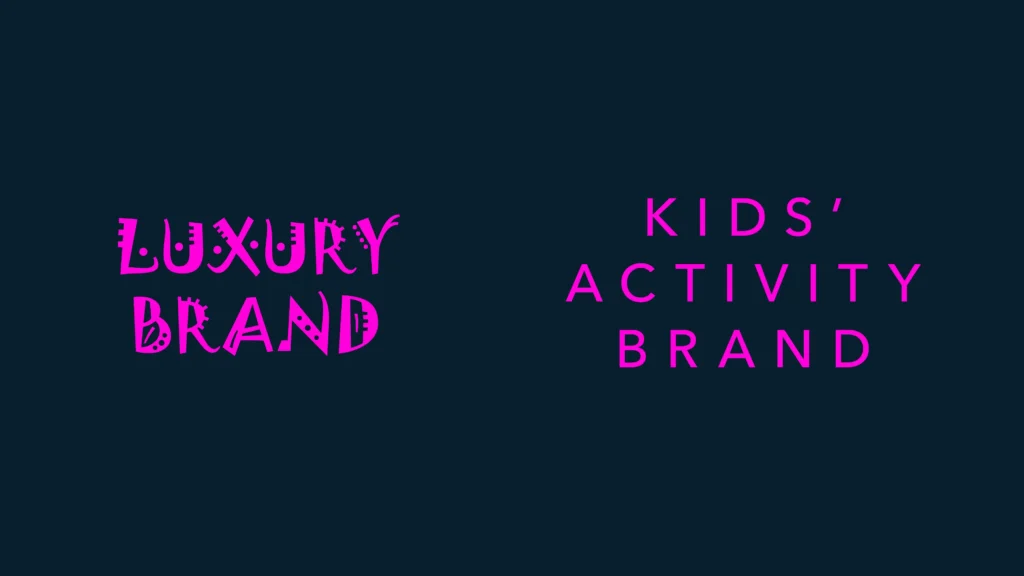
You would not expect a luxury brand to communicate using Jokerman, just as you would not expect a children’s activity brand to use something rigid and corporate. These choices aren’t simply decorative. They because the font communicates personality, positioning and intent.
Typography acts as your tone of voice in visual form. Rounded letterforms can feel softer and more welcoming. Sharp edges can feel more technical or formal. Tall, elegant typefaces might feel premium, while heavier fonts can feel bold and dependable.
When you’re rebranding, these nuances become incredibly important because every design choice contributes to how audiences understand your organisation and offering.
Why typography matters
One of the biggest mistakes organisations make during a rebrand is leaving typography until the end.
Often, a font gets selected simply because it is accessible, safe or already installed across all the computers in the business. While practicality matters, choosing typography purely for convenience can weaken an otherwise strong visual identity.
Your typeface system should work as hard as your logo or messaging strategy. Because typography appears so consistently, it becomes one of the most recognisable parts of a brand over time.
Think about major public-facing organisations. Transport systems, healthcare providers and global brands all rely heavily on typography to create consistency and recognition.
In the UK, the NHS uses Frutiger across its signage system because it is clear, legible and dependable. Airports rely on typography to guide people quickly and confidently through complex environments, so use the same font across their wayfinding systems.
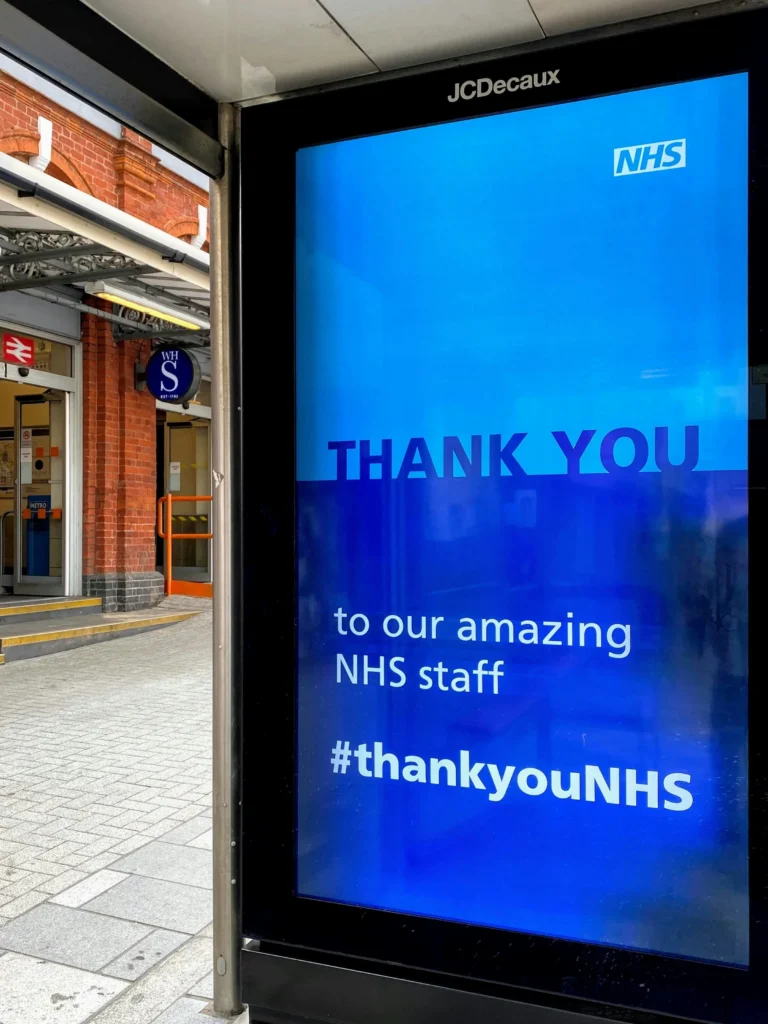
Your brand can operate in exactly the same way. Consistent type choices create a visual signature that audiences begin to recognise instinctively.
That consistency becomes especially important during a rebrand, when audiences are learning to recognise a new visual identity.
A useful exercise is to think about your typography as clothing for your brand.
Would your organisation wear a tailored suit, a practical waterproof jacket, or something more expressive and unconventional? None are starkly right or wrong, but they all say different things.
The same applies to fonts. The best typography choices feel intentional. They support your positioning rather than undermine it.
Typography in context
Fonts rarely work in isolation. A typeface that looks beautiful on a moodboard may feel entirely different once applied across a website, campaign or social platform.
That is why testing matters. We test fonts as part of a new brand identity, rather than quickly select them at the end – they’re the backbone of your look and feel.
When developing brand identities or campaign styles, we regularly explore multiple typographic directions before settling on a final route. The same messaging can take on completely different tones depending on the type choice made.
Testing font choices and text styling in context helps answer important questions:
- Does it feel recognisable across different platforms?
- Is it accessible and legible at different sizes?
- Does it complement the wider visual identity?
- Does it resonate with the intended audience?
- Does it feel ownable and identifiable?
Accessibility and usability matter too
Good typography is not just about aesthetics. It also needs to function effectively across teams, platforms and audiences.
That means considering:
- Accessibility and readability
- Web-safe compatibility
- Licensing and copyright
- Cross-platform consistency
- Ease of use for internal teams and partners
Choosing a font that nobody else in your organisation can access creates unnecessary friction. Equally, selecting typography that is difficult to read weakens communication no matter how visually striking it is.
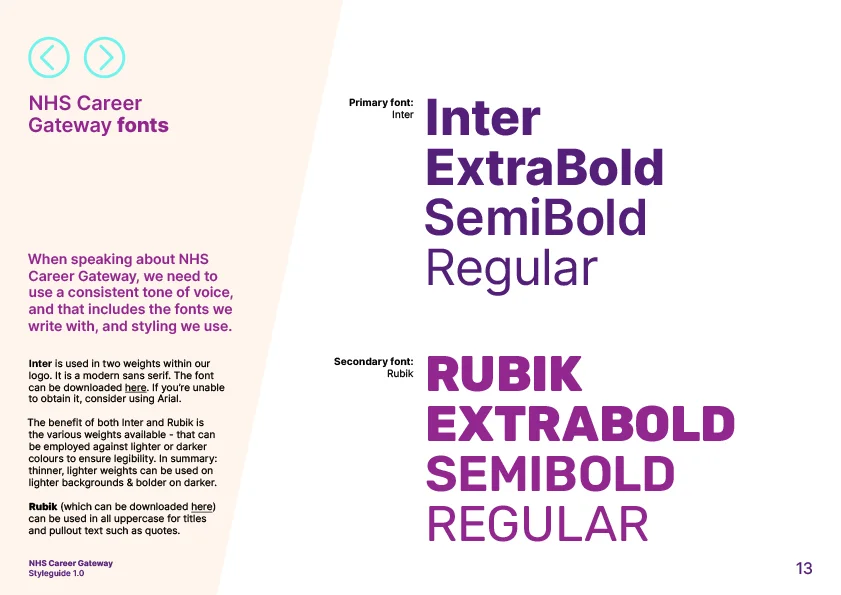
Accessibility should never be treated as separate from creativity. “Don’t confuse legibility for communication” as disruptive designer David Carson once wrote in a way that challenged the phrase’s readability. The best brand systems balance both.
A simple question to ask during a rebrand
If you’re reviewing your organisation’s typography as part of a rebrand, ask yourself:
“What does this font suggest about us before anyone reads the words?”
Does it feel confident? Friendly? Institutional? Progressive? Premium? Dated? Even better, test those perceptions with real audiences. Sometimes associations or interpretations emerge that internal teams have completely missed.
If the perception created by the typography does not align with the brand strategy, the font choice is working against the rebrand rather than supporting it. So look to explore alternatives.
Typography is never just decoration
Your words carry meaning, but typography determines how that meaning shows up. That’s why font choice should never be treated as a finishing touch during a rebrand process. It is one of the core building blocks of your visual identity. At Arke, we treat font options as an integral part of a rebrand, and ensure that they’re suitable. Your rebrand shouldn’t be a series of compromises and near-misses, but instead the most suitable and compelling look to propel your business.
The right typography helps audiences recognise you, trust you and remember you. It creates consistency across every touchpoint and strengthens the emotional impact of your messaging.
In other words, typography is not simply part of your visual identity. It is part of your brand strategy.
How does a rebrand look in practice?
Here’s an example of a complete rebrand project with The Money Charity that included the redesign of their logo, and update of their colour palette, typography, and other core components to communicate to a range of diverse audiences.
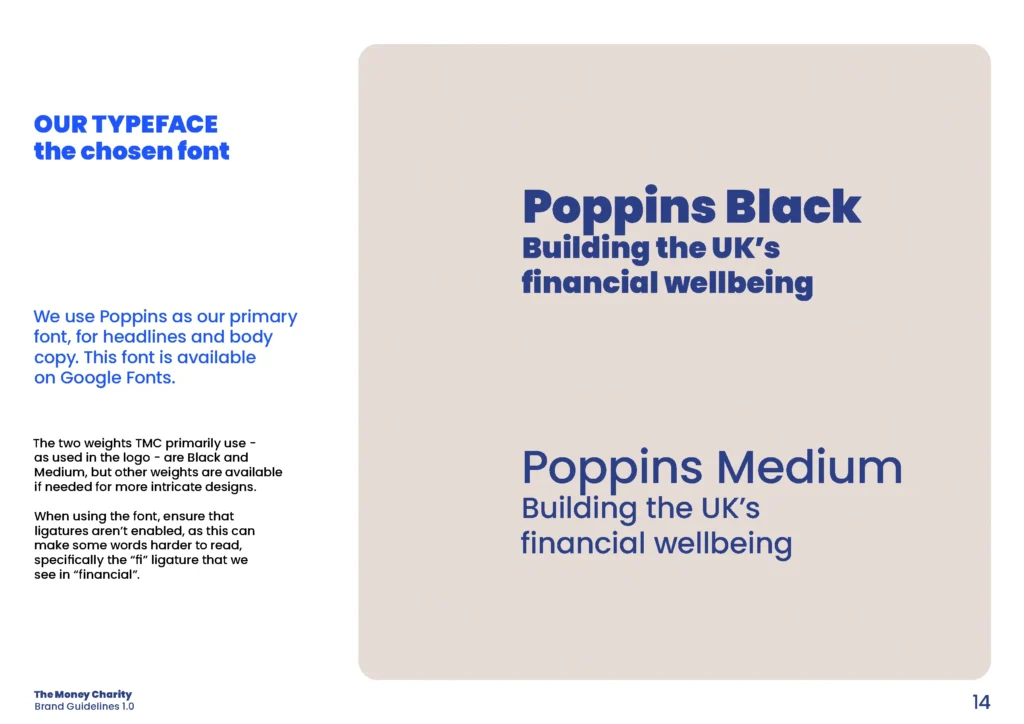
As a specialist branding agency, Arke has experience across a number of market verticals and sectors, which allows us to bring a wide and unique perspective to create the impact your organisation needs.
Choosing the right animation agency is not just about visual style. It is about finding a partner that can translate strategy, messaging and audience needs into animation that works across the right channels.
If you have been tasked with finding an animation agency, here’s a guide and sneak peek at Arke’s playbook for bringing animations to life.
Whether you’re new to representing your brand visually, or considering commissioning an animation project for your next advertising campaign or for internal comms, we hope that this step-by-step run-through showcasing our process helps you envisage how we would go about bringing your thoughts to life.
As always, our projects are as unique as our clients, but here’s how we approach creating animations, adapting as we go.
What to look for when choosing an animation agency
-
Start with strategy, not style
The first thing we do when starting a project with an animation agency is to define the style of the overall piece. Is there going to be voice-over – is there going to be a key character visibly anchoring the narrative?
These conversations normally start as part of a workshop, with prompts used to capture all the information as we talk. They all help inform the management of the project: identifying all the moving parts that need to be budgeted and composited together later on.
This could also include messaging that needs to be animated – making a greater impact than static assets, and explaining why the move to animated assets is justifiable as part of a larger campaign.
-
Visual concept
In some instances, we identify that an overarching key visual might be the most effective to form the core of the animation, whether that’s a flow diagram, a key icon or a hero character that takes the viewer through the information, and getting this firmed up earlier will help shape the action.
As an integrated agency, animation video production involves numerous skills, so approaching it as one team is incredibly efficient. Similarly, we are able to take the learnings from previous advertising campaigns and put them into practice right from the ideation and design stages, ensuring effectiveness right from the start.
-
Possible style routes
As standard, we create routes proposing how we will treat an animation, flexing our creative muscles and thinking about how wild we can go with the concept, but most importantly – thinking about what is suitable.
We explore this through moodboards, finding relevant examples, looking at what contemporary organisations are doing, then refine resulting choices into still images encapsulating the look and style of the animation.
It can even be beneficial to create mini sizzle reels, bringing together examples of our previous work, and well-known current examples, and cutting them together against a relevant music track. These motion moodpieces help define the tone for the project going forward.
Targeting with motion
-
Script and messaging
If there’s an external artist or writer it is always important to discuss the script with them and identify whether there are complex concepts that might require some prior knowledge. If needed, at Arke we offer copywriting, tone of voice and messaging framework development to complement your brand.
We’re often working with an SME (subject matter expert) so collaborating with them to consider the audience and their prior level of knowledge is really helpful at this stage.
Some of the questions that normally arise are:
What do the intended audience know already? Do we have to explain any terms? Does the animation have to work as part of a larger set, and have to align to existing content, for example, or is it a completely stand-alone piece?
-
Length and attention
A lot can go into a 90-second animation. You might have 5 to 10 minutes in mind for the duration of your animation, but that will feel like an eternity when you’re getting into production.
Brevity can be your saviour. People’s attention spans are shorter than… sorry I got distracted.
So making sure that the animation explains its reason to exist in the first few seconds will pay dividends when you start looking at viewing stats.
-
Where will the animation live?
Clarifying where the animation will live is a really important aspect to get nailed down early on, as this can define things like whether you can even have sound, the aspect ratio, whether the inclusion of subtitles might be advantageous.
It could even determine which software is going to be used to create the animation.
We outline the different considerations at an early stage of the project, informing the project plan going forward.
-
Storyboard
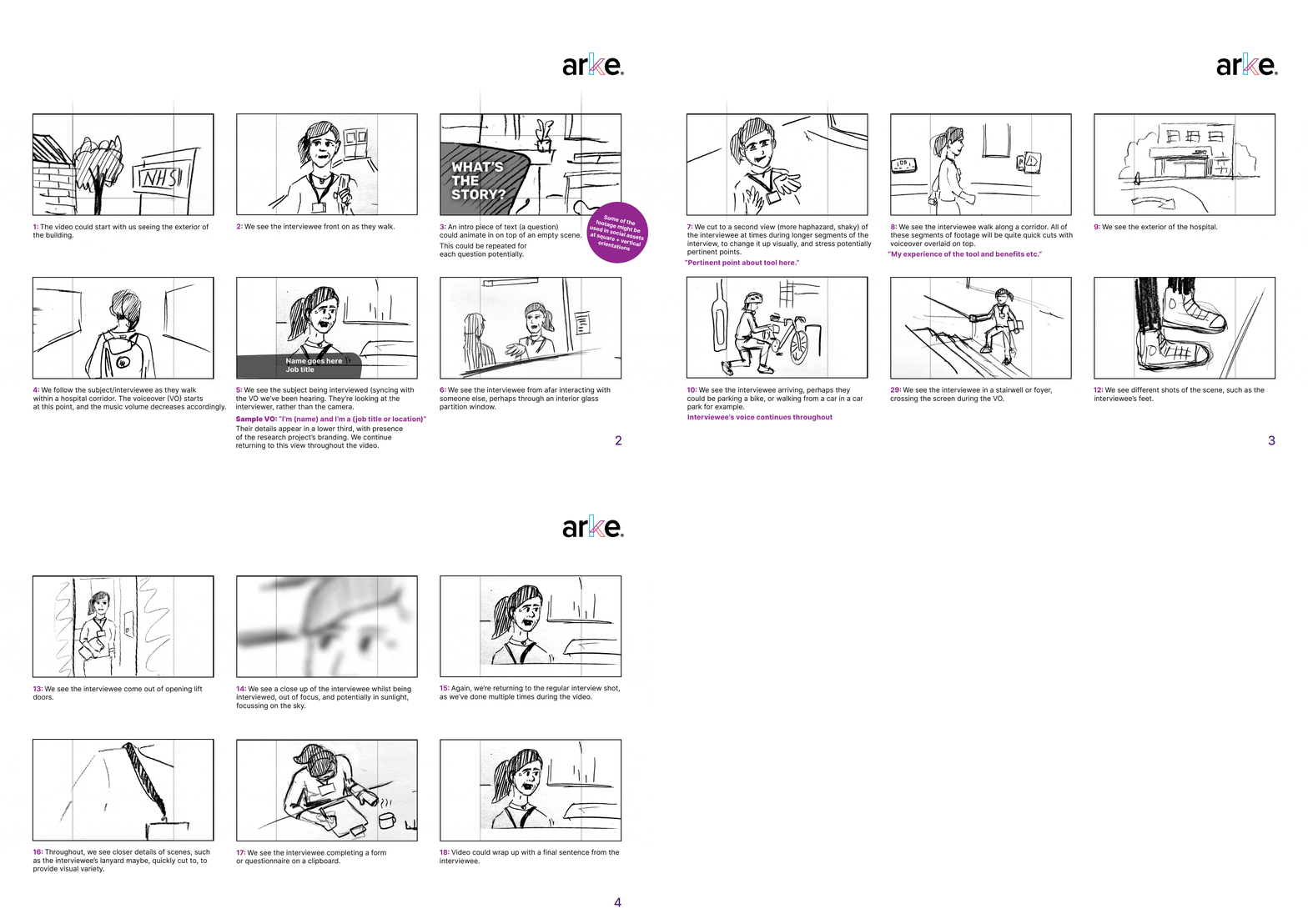
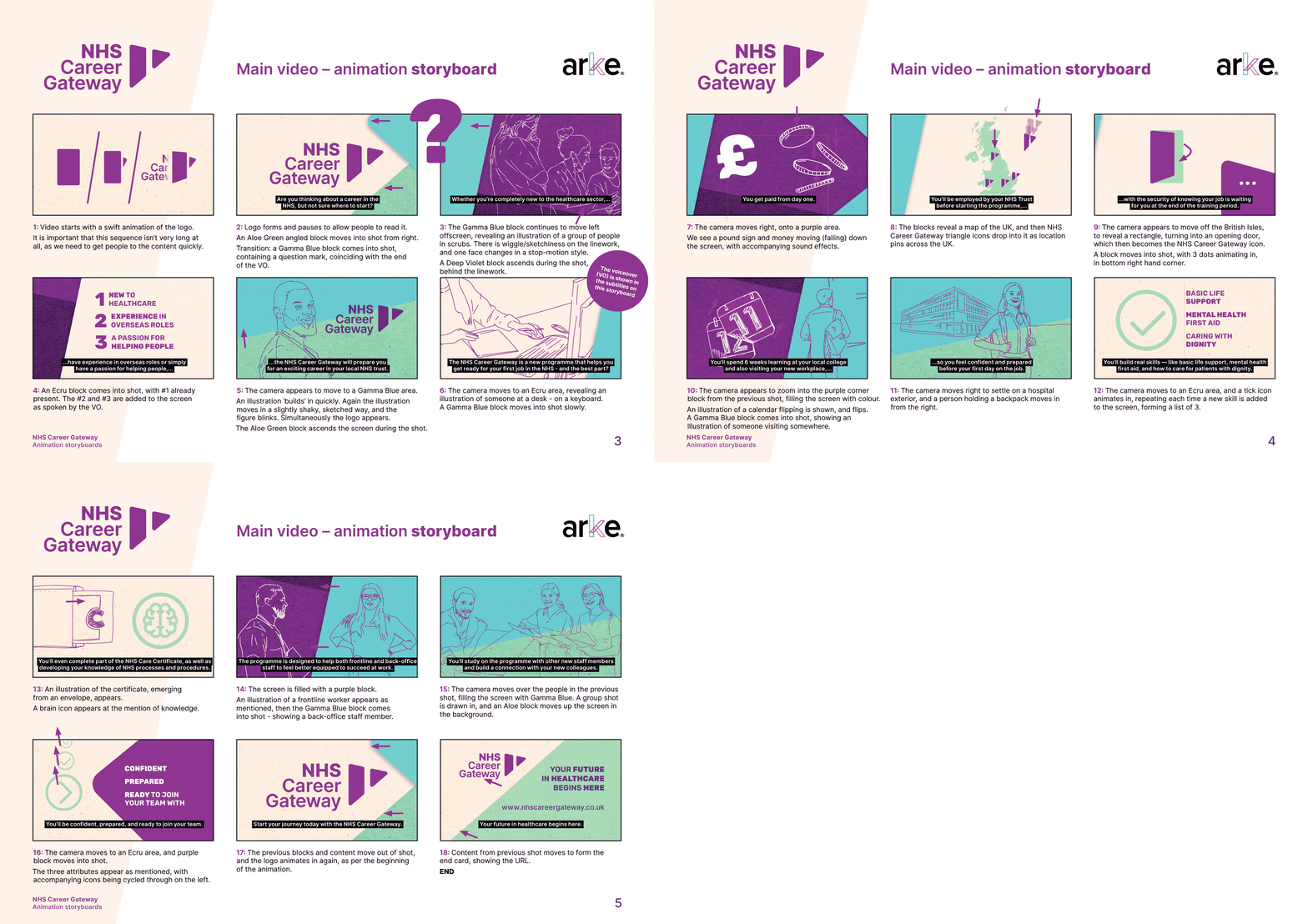
Once all these details are defined, we take the script and move to the storyboard stage. We storyboard the entire animation, so that everyone can review what is going to be produced, and help everyone visualise the final product.
We decide considerations such as: will items drop into shot? Will the camera move to the left? The more detail about what is happening onscreen the better.
Are standalone words being defined going to appear onscreen? If there is going to be a voiceover, then this can be laid out alongside each frame. We also describe transitions – the way one shot becomes the next shot – and how different larger sections will flow into one another on the storyboard too.
Depending on the timescale and requirements of our client, storyboards can be actual pencil drawings in sequence with annotations, or fully worked-up visuals of what will be in each frame.
Taking shape
-
Animatics
For some more complex animations, we create low-fidelity animatics, meaning we take the rough (often pencil visuals) frames from the storyboard, and edit them together with a very rough voiceover recorded on an iPhone, to help bring the storyboard to life, and enable some people to visualise the final product more easily.
This can also help when there’s a complex movement that needs to be shown in sequence.

-
Creating screen-ready artwork
Once the storyboard is signed off, it is time to get to work on moving visuals. The storyboard may have had high-fidelity visuals of each shot, meaning that they simply need to be layered up and taken into the relevant software.
Alternatively, the storyboard may have been rough squiggles and doodles upon doodles, requiring some of the artwork to be brought in line with a visual style for example.
You may have brand guidelines that dictate how illustration and moving image are treated in videos. If you don’t, we’d be happy to help define this.
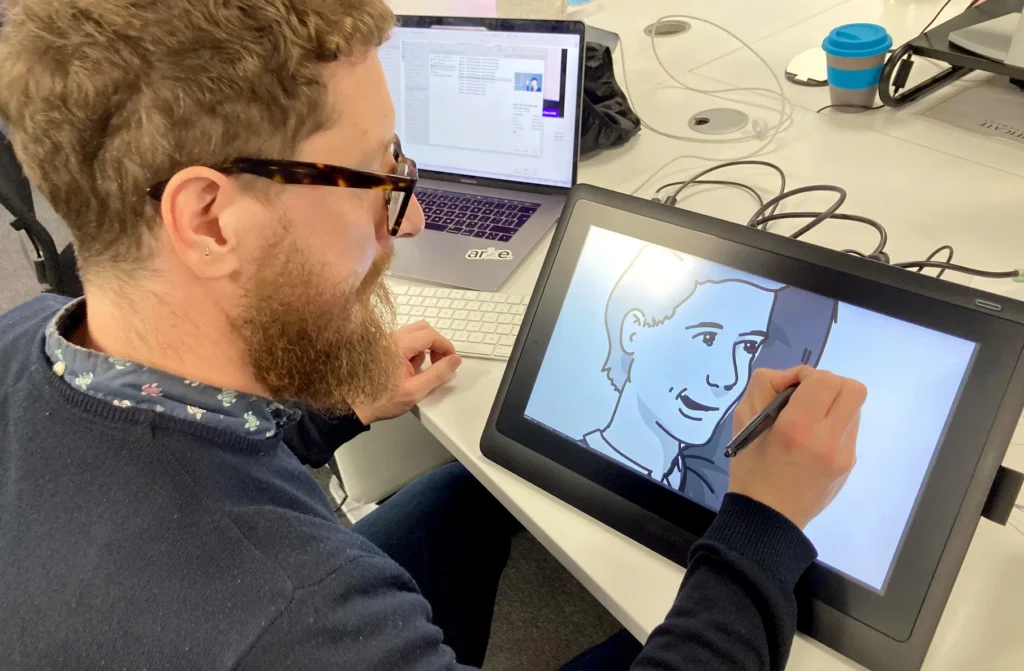
These pieces of artwork may be icons, requiring lots of layers in vector software like Adobe Illustrator, or detailed pencil drawings, requiring lots of iterations. It all depends on the complexity of the animation style.
They could require lots of tweens if it is a stopframe animation for example. It also depends on the software that it is being produced in. Now here is where AI could be capitalised on, as long as you have full control over how you’re going to get your visuals to move.
-
Audio
Before launching into editing and animating, the audio can be brought up to scratch too.
As an integrated marketing agency, we can take care of this for you. This is the point where we replace the rough placeholder voiceovers and sounds with fully-fledged recorded voiceovers.
We typically record several versions, working with a voice artist.
This is also the point we firm up music we’re going to use, as often animation and footage are cut to the beat, so getting approved backing tracks at this stage can save time down the line.
Getting everything in motion
-
Production and animation
Now that we have all the pieces, we put them together in a program like Adobe Premiere Pro or After Effects.
We generally chop up the action into a composition per frame, so that they can be moved around if the order needs to change later in the day.
We use standards such as keyframes and easing and the like to bring static assets to life, and sometimes employ the odd plug-in – all depending on the style of motion required!
-
Review and feedback
When everything’s been put together and rendered out, we share our animation for review, both internally and with our client.
We typically use an online feedback tool, so that people can drop comments in at the relevant part of the animation – this helps avoid generic feedback, and ambiguous comments about things like ‘the bit at the end’.
We action any points that come up and circulate a final version, ready for sign off. Being efficient with how feedback is delivered helps to keep account management time to a minimum.
-
The final edits
Once the animation is all approved, we often create multiple versions of the same animation.
This is often different sizes customised for their end use i.e. the platform that the animation will appear on.
This affects aspect ratios, and details such as where the subtitles go, even the length. Those platforms might be more suited to shorter, abridged edits too.
We can provide guidance on how the animation can be adapted to work best for each platform, liaising with our Paid Media team internally.
-
Accompanying statics
You might think we’re all done by this point, but there’s one more thing to consider: ancillary imagery. By that we mean the static images that accompany your video.
Are there images needed to be visible before it loads, or when it appears on certain platforms?
What will the YouTube thumbnail look like?
If your animation is going to be public-facing, then this will help sell your video, so take some time to come up with some options. You can even test multiple thumbnails on some platforms. How your animation looks before people see it will have a direct effect on play numbers
Final cut
So that’s how we approach animation here at Arke. There’s plenty of moving parts (pun intended) in animation projects, and they can seem overwhelming at the start!
A successful animation project depends on more than visual execution. It requires clear strategy, audience understanding, strong scripting, thoughtful production and careful planning for where the asset will live.
We’re here to consult on project management – to make commissioning us to produce an animation easy. Have a look at our creative services and let us know if you’re cooking up an idea that you’d like us to get in motion!
In this article, Blair, Arke’s Design and Animation Lead dives into how content, simplicity, and detail shape stronger creative strategy and more effective marketing.
I’m a big believer in lateral thinking. When considering what personal principles I use in my daily design practice, I find myself pulling less and less from my uni days for guidance. For me, they actually come from the theatre; specifically from the late, great Stephen Sondheim.
At first glance, musical theatre and digital marketing may seem unrelated. In practice, the connection is surprisingly useful.
What does a guy who wrote songs about people ground up into pies and a presidential assassin review have to do with a digital marketing agency like Arke? The answer is: everything!
Sondheim had three guiding principles for his work. They are deceptively simple, but when you apply them to the chaos of digital marketing, they act as a perfect compass for both strategy and creative, or as Arke likes to call it: our North Star.
Content dictates form
This was Sondheim’s golden rule. He didn’t just write “songs.” He built musical structures that reflected and served the story. Take A Little Night Music for example. The entire show is famously written in waltz time. Every song is a variation of a triple meter (3/4 or 6/4).
Why? Well outside of being period appropriate for turn of the century Sweden, the content of the show is about different love triangles perpetually switching romantic partners. A waltz is a dance set to ¾ time between two people, perpetually switching partners. The “form” of the music is a direct result of the “content” of the plot.
When I sit down at my desk, my first question is never “what looks good?” – It’s “what is the story?”
In my work at Arke, this is the antidote for the “design for design’s sake” trap.
The most effective creative starts with the message, the audience, and the outcome we need to drive. For example, if we are working with a geospatial technology brand such as Envitia, the form needs to feel precise, modern, and credible because the subject matter demands clarity and confidence. In another sector, the creative language may shift, but the principle stays the same: the form should always serve the story.
That is what separates a good agency’s work from middle of the road work. We are translating a brand’s core message into creative that audiences can recognise, trust, and act on.
Less is more
Sondheim was the master of finding the “perfect” word. His lyric writing style was as economical as it was “syllabic” – meaning each of the words sits perfectly on the notes of the music – while also somehow simultaneously adhering to an internal / external rhyming scheme. He would spend weeks agonising over a single syllable to make sure a line hit exactly right – these restrictions often lead to some unexpected creative choices. Rhyming “personable” with “coercin’ a bull” or “While her withers wither with her”. Crazy, I know. This ensured that there was no opportunity for an audience to misunderstand a lyric. He knew that clutter is the enemy of clarity.
As digital marketers, we are constantly fighting for attention in a world that is incredibly loud. If a message is going to hit, it needs to be clear, it needs to be succinct, and it needs to have a personality. The temptation to gush about all of the USPs of a brand or service will inevitably crush your creativity. Conversely, not utilising enough optimised language will affect your SEO rankings. You need to strike a balance, and bring things back to your core message. A “less Is More” approach is where the real power lies.
What is the core message driving the campaign? Is it serving your brand and goals? Is it being communicated in the most effective way possible? It takes a lot of confidence to leave space on a page, but that confidence is exactly what our clients rely on us for. We aren’t just decorators. We are editors!
God is in the detail
This is the one that keeps me up at night. I’m a perpetual tinkerer, I would move elements pixel by pixel for hours if I didn’t have a deadline to work to. For Sondheim, a detail wasn’t just a “nice to have.” It was the anchor of the work.
The show Sunday in the Park with George is all about the struggles of creative work. In the song “Putting It Together,” the character George describes the creative process as an accumulation of tiny, deliberate actions: “Bit by bit, putting it together… Every little detail plays a part.” He understood that the “whole” is just a collection of microscopic choices that either harmonise or clash. This is a concept reflected in the show’s music, story and theme.
In graphic design, this is the difference between a good project and a transformative one. It’s the kerning between two letters that no one else notices. It’s the way a hex code matches up with the CMYK on a style guide. It’s about ensuring that the user journey on a landing page is so seamless that the customer doesn’t even realise they’re being guided.
When we get the details right, we build trust. If a potential lead sees a pixelated logo or a broken link, it can quickly reduce trust in the brand.. But when every single detail is accounted for, it signals that the brand is professional, thoughtful, and authoritative.
Why this matters during the creative process
That’s curtains! I take pride in the work that I do at Arke. Even though the lifespan of the campaigns I build may be finite, they burned bright while they were alive!
Art isn’t easy, as the man himself said. But when you let the content dictate the form, keep things simple, and obsess over the details, you end up with something that doesn’t just look great. It actually is great.
Are you ready to take your creative strategy to the next level? have a look at our creative services and let’s elevate your brand storytelling!
A common issue we see with brands and organisations that come to Arke in search of better results for their marketing campaigns is a disconnect among the touchpoints their audiences have with their brand.
But, what do we mean by that? Read on as Matt, Arke’s Head of Creative, explains how we must consider the entire brand ecosystem and its intention when developing a marketing strategy for each of our clients.
Let’s start with a simple but recurring scenario.
Do your ads match your landing page and overall website UX?
Are they speaking the same language visually? If they don’t, you could be facing some serious trust issues with your audiences. We’re not talking data, URLs, and databases; we’re talking about how things look.
The press is telling us that trust in advertising is high right now, with reports saying that the ‘enjoyment’ of ads is behind it. But, before we even get to the topic of enjoyment in marketing, there’s that key word: trust.
Have you ever clicked on an ad and been taken to somewhere completely different on the internet?
Looks different, feels different… making you wonder what you just clicked on. This is exactly what you want to avoid when promoting your brand.
If we’re putting together a path that you want a potential customer to take, we must consider the user journey. No sudden moves or pesky surprises, please!
Here at Arke, we run paid media ad campaigns on a variety of platforms, and, as with all branded items, consistency is key, and in a time when Gen-AI creatives are popping all over, and we’re all looking for effective ways to adopt it into our workflow, consistency becomes especially crucial.
Our thinking is that AI can help you diversify your creative offering, and it could even allow you to produce assets that otherwise would’ve been out of reach or budget, but having some metaphorical guardrails is of the utmost importance.
We cannot let images and videos get too astray from the look and feel of your landing page, as it’ll erode your hard-earned trust. You also can’t afford to have your brand turning up at different times wearing completely different clothes without an exceptional reason.
Let’s put ourselves in the shoes of your target customer
When people are being served up ads, and being urged to click on them to learn more, book something, or part with their hard-earned cash by purchasing your product, we want to make sure that the place they’re taken to is presentable, and ‘of a piece’ with the ad they’ve just seen.
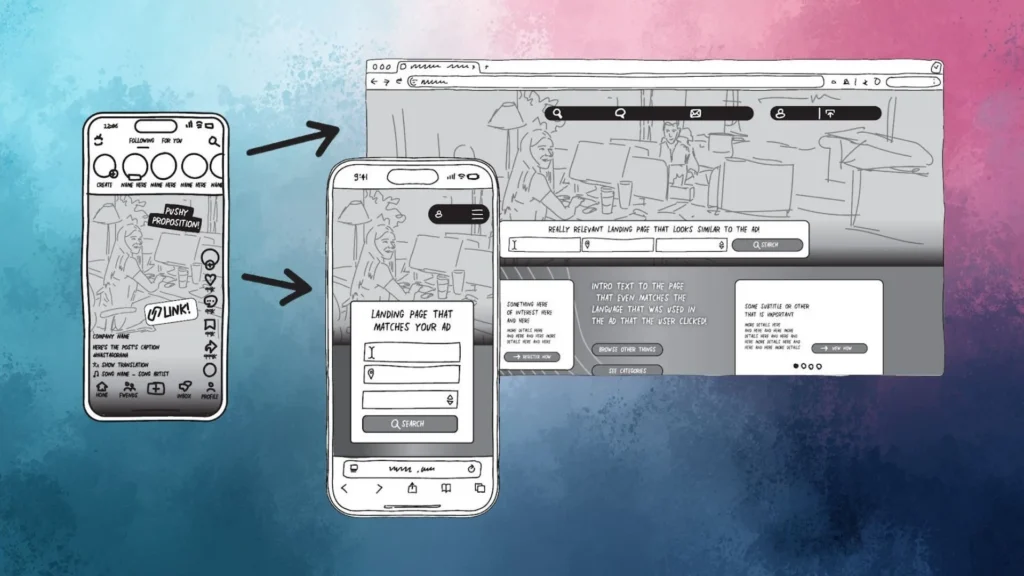
What’s the worst that could happen if this is not the case?
Let me spell out the words that you hear in your nightmares:
Bounce rate: 100% 🙁
Conversion rate: big fat zero 😱
Now your ads might be great: they might be perfectly on brand, have a clear proposition, feature a compelling hook, be ideal for the platform they’re running on, and generate plenty of click-throughs, but still fail to deliver the conversions you want.
That could likely be down to where your ad is taking the user. We always look at your UX with fresh eyes when planning or optimising your marketing strategy by putting your ads and landing page side-by-side to analyse and enhance the user journey based on the available resources.
Considering the landing page you’re directing people to, we check that it complements the ads you’ve created. Your ads have to feel authoritative and confident, never misleading and deceptive. So thinking about what they’re leading to is the key here. Is there a disconnect? Do the visuals align by using similar colours, fonts and photos? And, is the content relevant? There’s nothing worse than being promised one thing and landing on something completely different.
Online marketing has historically been stained with dark patterns, deceptive UIs and brands making it difficult for customers to stop using their services. This is why it’s so essential to have a clear and transparent way for users to understand and feel identified with your brand or organisation.
When the goal is for browsers to become customers, users need to be given the breathing space to make their own decision without feeling pressured, without feeling misled, and the relationship between your ads and the landing page they’re taken to can really affect that.
There are even visual conventions about this requirement for brand coherence, which basically means that if the relationship between elements is closer visually, people will feel more confident dwelling there. A consistent look drives conversion.
Browsers and potential customers are making judgments about your brand subconsciously in seconds, in fact, as little as 50 milliseconds, and the visuals play a huge part in that.
How does Arke integrate the UX for your brand?
We’ve developed integrated marketing campaigns for multiple clients across several market sectors. Aligning creatives, ad targeting and landing pages to break records that have earned us multiple award wins over the years.
A great example of this is the work we have done with the British Film Institute Player, where we achieved a 729% increase in YoY trialists in their peak season and a 52% trial to subscription conversion rate. A key part of our work involved aligning the creatives we devised to better reflect the pages potential subscribers were being taken to by the advertising.
The Key Takeaway
Your brand can be felt on your website, your ads, your social media profiles, everywhere. None of these can be treated in isolation as they’re all part of the same user journey.
The most creative and imaginative ad will not convert if your landing page feels like a separate, non-aligned entity. That’s where the importance of having a team that understands how each touch point contributes to transforming a browser into a customer lies.
Being named the UK’s Most Effective Agency for three years in a row is the best recognition of how our integrated marketing strategies perform for our clients.
Interested in elevating your brand? Let’s have a chat and explore how we can help you achieve your goals.
Here at Arke, as a creative digital marketing agency, we work with clients across a variety of industries – so we end up creating a lot of projects and campaigns with very specific objectives that require unique, effective and bespoke storytelling.
Our clients’ ads are all about getting potential customers to convert – to carry out an action – whether that’s hitting a button, making a purchase, recognising your brand or visiting somewhere in the physical world.
In this article, our Head of Creative, walks us through the way we think at Arke whenever any of our clients need us to bring to life a marketing campaign.
How do we approach each creative project at Arke?
From a discovery and ideation workshop to transforming initial thoughts into visual assets to then develop a story into the final product; there’s never a linear path and each project has its own requirements and complexities.
It all starts with research: understanding your product, your audience, your competitors, your value proposition.
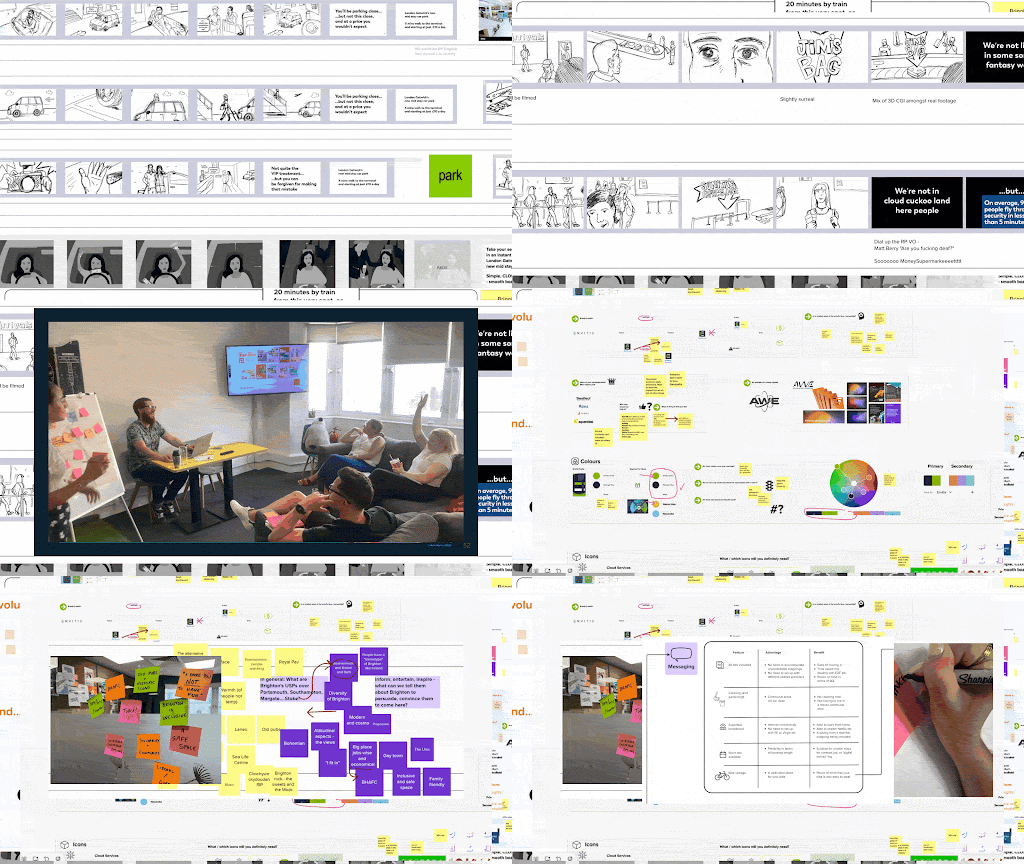
From here, campaigns can take lots of different forms at Arke – IRL or online, for example – and they always have to communicate to our intended audiences. As an integrated agency, our teams work together right from the start to consider any implications for paid advertising, SEO, OOH, etc.
For them to work, we need to strike a balance between an emotional connection and the factual data they need to complete an action. This changes all the time depending on the client and the product or service they’re offering. That’s why the way we work at Arke is always tailored to each of our clients’ unique requirements.

We’re looking at the use of effective narrative and storytelling in marketing.
So when we think about coming up with new campaigns, we need to do more than just having a logo and a headline.
Let’s visualise this first with an example of what this means in practice and then a real-life award winning creative work we did for the British Film Institute.
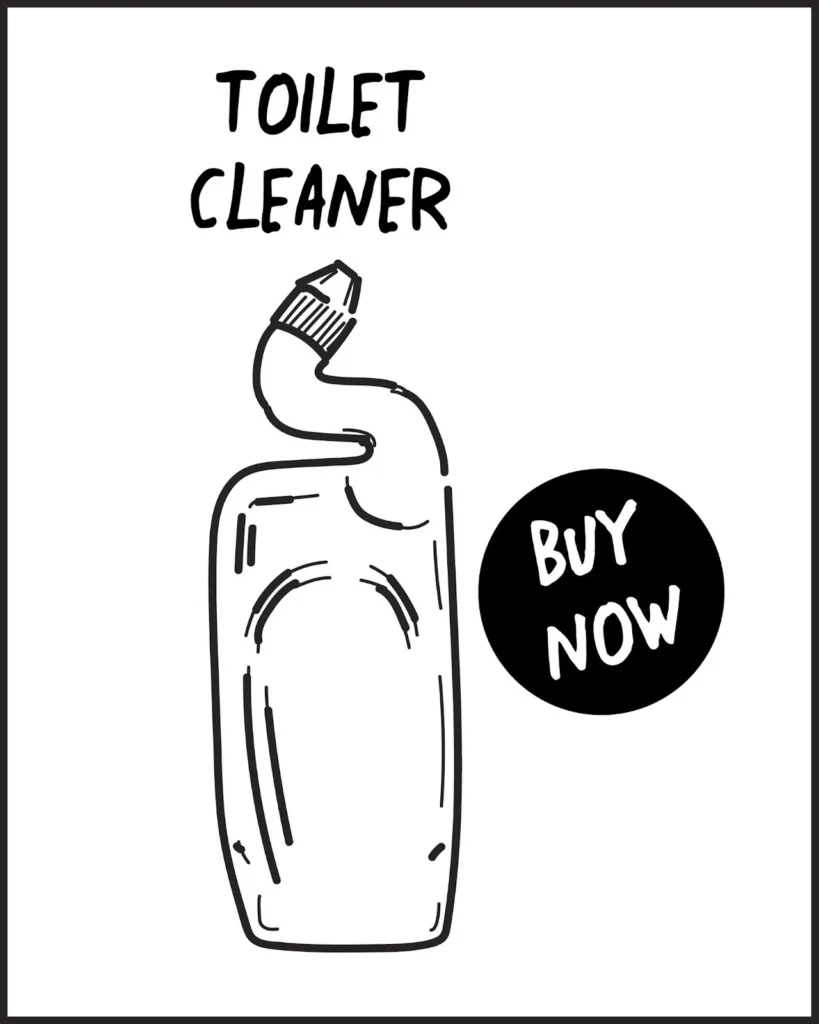
Below we have a scamp with the most basic aspects we know: product & desired intent. We put together these really rough doodles as a starting point, as they’re really useful for getting an idea across quickly.
Then we have to dabble in telling a story – creating a situation.
What do we mean by storytelling?
Essentially – a narrative playing a role in your marketing. Suggestions. Instead of being factual with your ads, we tell a story to show what your offering or product does, or COULD do for your intended customer.
So here’s one iteration of what an ad could be…. This is the bog standard – excuse the pun. This is the Ronseal of ads. The lowest common denominator.

Next: here’s how we could take that storytelling element and apply it to this ad so it goes beyond its features and helps build trust. This headline helps to put the product or service in context, and helps a casual viewer that has come across your ad picture themselves using it.
Who actually enjoys cleaning the toilet? Let’s reference this!
What are some of the features of this product? Is it fast? Is that relevant? Throw it in!
Where can you get it? Is it only available at certain stores? Make it easy for people to find it!
Increase that stickiness factor – as mentioned in Malcolm Gladwell’s The Tipping Point – classic early 2000s popular pseudo science drop there…
And here’s a third option – turned up to 11, telling a story about being a hero cleaning the toilet – framing it as an epic endeavour.

These are just rough ideas – starting points, and they’re a great way to test and pitch how you’re going to advertise something.
When it comes to your next campaign – will you dial up or dial down your storytelling? Scamps help us ideate quickly to start shaping that narrative.
So there’s a scale to storytelling in marketing, ranging from the bare minimum, to secondly giving context, and highlighting features – suggesting some personality. To thirdly: making a whole blockbuster film.
An arguably brilliant example of storytelling in marketing that many of us in the UK can relate to is when the season for John Lewis Christmas ads arrive. I’m sure you’ve all seen ads that you think are over the top! But we can relate to some. And it puts those services and products front of mind!
By ideating quickly, we help you identify just how much storytelling you want to dabble in before committing to artwork or photoshoots! And these rough scamps can be used as prompts when testing with potential audiences – for us, getting something visual in front of people can really help speed up the creative process.
How does this translate into a real-life creative strategy?
Glad you ask! Let’s have a look at an award-winning example of what an integrated marketing campaign looks like when you combine storytelling, branding and a full-funnel digital strategy.
When the British Film Institute approached Arke to help their BFI Player broaden its audience and stand out among streaming giants, our Head of Strategy and myself led a creative workshop to identify the opportunities available to evolve creative assets, whilst aligned with the eventual evolution of the BFI Player brand.
Among all the learnings, this enabled us to create eye-catching graphics with a clear CTA.
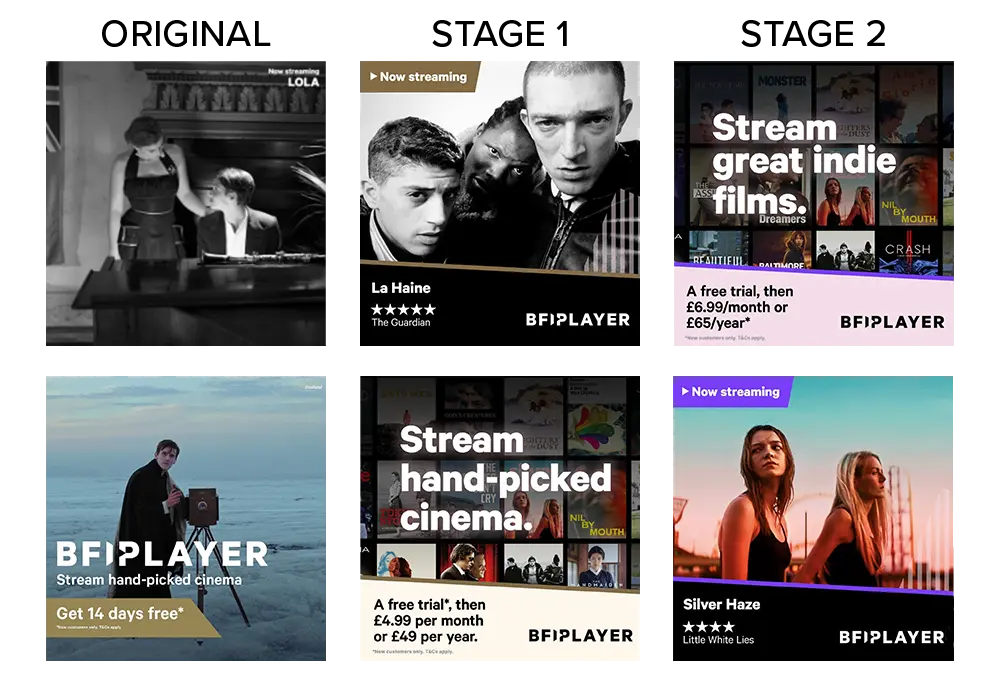
As part of the creative process, we quickly identified how replacing some of BFI’s creatives would also future-proof the BFI by providing them with innovative tools and templates for sustainable, in-house asset production.
Clear branding and consistent creatives enhanced brand recognition, whilst linkable and clickable CTAs allowed for trackable and reportable results for a hyper-targeted campaign looking to expand their audience.
When considering the storytelling narrative, we decided on framing BFI Player as a curator of select film titles, rather than a serve-all streamer as a key differentiating factor against competitors.
The partnership between Arke and BFI has resulted in multi award-winning campaigns, with our results obtaining the Most Effective Campaign at the European Agency Awards, and Best Integrated Campaign for two years in a row at the UK Agency Awards.
Have a read at the case study and learn how we achieved +700% YoY growth on trialists during their peak season.
Why should you work with a creative digital marketing agency?
At Arke we don’t have copy/paste strategies, each of our clients has unique needs and each industry has its own complexities and requirements.
From our Brighton HQ, our teams work closely together so there’s no cannibalisation between paid campaigns, SEO, creative flair and UX.
Contact us below for a no-compromise chat about the current state of your marketing needs and let’s build something great together.
AI for Creatives: Selling the Dream, Not the Machine
On nearly every online platform, discussions about AI are everywhere. It can be a polarising topic, particularly when it comes to its use within the creative process in marketing, but exploring new tools is how our industry evolves. With so much coverage from a wide range of perspectives, it’s easy to get swept up in how everyone else is using AI. However, it’s worth taking a step back to consider where else in our processes we might benefit from a bit of machine assistance. Enter Blair Foley, Arke’s Design & Animation Lead, who shares his experience of pushing past your fears and using AI to help communicate the marketing creative vision early in the process.
The sky is falling. The world is ending. The machines are taking over…
Well, not quite. We’re a long way from Skynet, but since AI tools have become widely accessible, the conversation around them has taken on an alarmist tone. This technology is evolving at a mind-boggling pace, regulations are scrambling to keep up, and for every exciting opportunity, there’s an inevitable counterpoint of concern. Are we all doomed to drown in a sea of Ghibli-generated selfies or action figures? That’s human nature; we react to the unknown with a mix of wonder and fear. I’ve felt both myself during my AI journey.
Within the marketing world right now, particularly when it comes to marketing creatives, I believe there is too much focus on AI-generated assets making their way to market, sparking backlash over authenticity, originality, and ethical concerns. But the real power of AI (at this stage) in marketing isn’t about replacing the final product, it’s about selling the vision. Used well, it’s an incredible tool for ideation, helping clients see the creative direction before production begins. Personally, when developing ideas for speculative work or tenders, AI has proved invaluable, allowing me to visualise concepts in ways I never could have imagined.
In my approach to AI, I follow three principles:
1. Lay a solid foundation
The better your inputs, the better your outputs. If your source imagery and prompts are closely aligned with your final vision, AI becomes easier to direct. While these tools may feel magical, without the correct inputs, you risk deviating from established contexts, styles and imagery, rendering your creative output for the client irrelevant. But if you build strong scaffolding, you’ll be closer to your goals and spend less time fixing all the bad results.



Generator: Midjourney
Prompt: An ornate Victorian-era carved wooden table, with a rose inside of a blue and white bone-china vase, next to a pile of old leather-bound books. The background is a lush red velvet curtain.
2. AI is an idiot savant: work with it, not against it
AI is powerful, but it’s far from perfect. The key is knowing when to refine, when to compromise, and when to embrace the unexpected. It often misfires in ways that open up new creative possibilities, but generating something truly usable still takes hundreds of iterations. Even with Runway’s new continuity-focused tools for video, you might only get a few workable seconds per attempt. And there’s an environmental cost: AI consumes huge amounts of computing power (MIT). It’s a necessary evil for now, but one worth keeping in mind.


Left Image: Generator: Runway / Prompt: A white gloved hand comes into the frame, picks up the rose from the vase and takes it out of the frame. A second blue, latex gloved hand comes into frame and dusts the top of the pile of books. Dynamic movement. Cinematic.)
Here is a text book example of AI going “rogue”. While attempting to bring my still image to life with Runway, the generator misinterpreted my prompt of a “second blue, latex gloved hand comes into frame and dusts the top of the pile of books” as the literal spreading of dust on the books, almost as if it were dusting a cake with icing sugar.
The tool hasn’t really done anything wrong here. It followed my prompt as best it can, based on the reference image and what I asked it to do. The issue is with my wording. My prompt wasn’t specific enough. If I want to see a feather duster actually cleaning the books, I need to say that outright. This highlights my point about AI being an idiot savant: it’s remarkable, but lacks critical thinking or a “common sense” understanding of context. You have to lead the horse to water AND teach it how to drink.
Right Image: Generator: Runway / Prompt (with a further prompt used in ChatGPT to bump up the word count to 1000 characters): A polished wooden table sits under soft, cinematic lighting. A delicate glass vase holding a single red rose stands beside a small stack of old hardcover books. A white-gloved hand enters from the left, moves with elegance, and gently lifts the vase from the table, carrying it out of frame. A beat of stillness. Then, a second hand appears from the right, wearing a bright blue latex glove and holding a pink feather duster. With light, precise strokes, it dusts the top of the books. The scene is shot with a dramatic, filmic style – shallow depth of field, smooth camera movement, rich shadows. Textures feel vivid and tactile: the shine of the wood, the softness of the feather duster, the stiffness of the old book covers. The moment has a theatrical, slightly surreal tone, like a quiet scene in an art film. Each movement is intentional, slow, and graceful, capturing a sense of ceremony and quiet contrast between the two gloved figures.
3. Put your creation in context
AI-generated content feel more convincing when placed in its intended environment. If it’s a social ad, mock it up as an Instagram post. If it’s a billboard, show it in the real-world location. This helps strip away AI’s inherent uncanniness, making it easier for clients to understand how your marketing creative idea would work in the wild and not concentrate on the potential “ick” AI imagery may evoke.
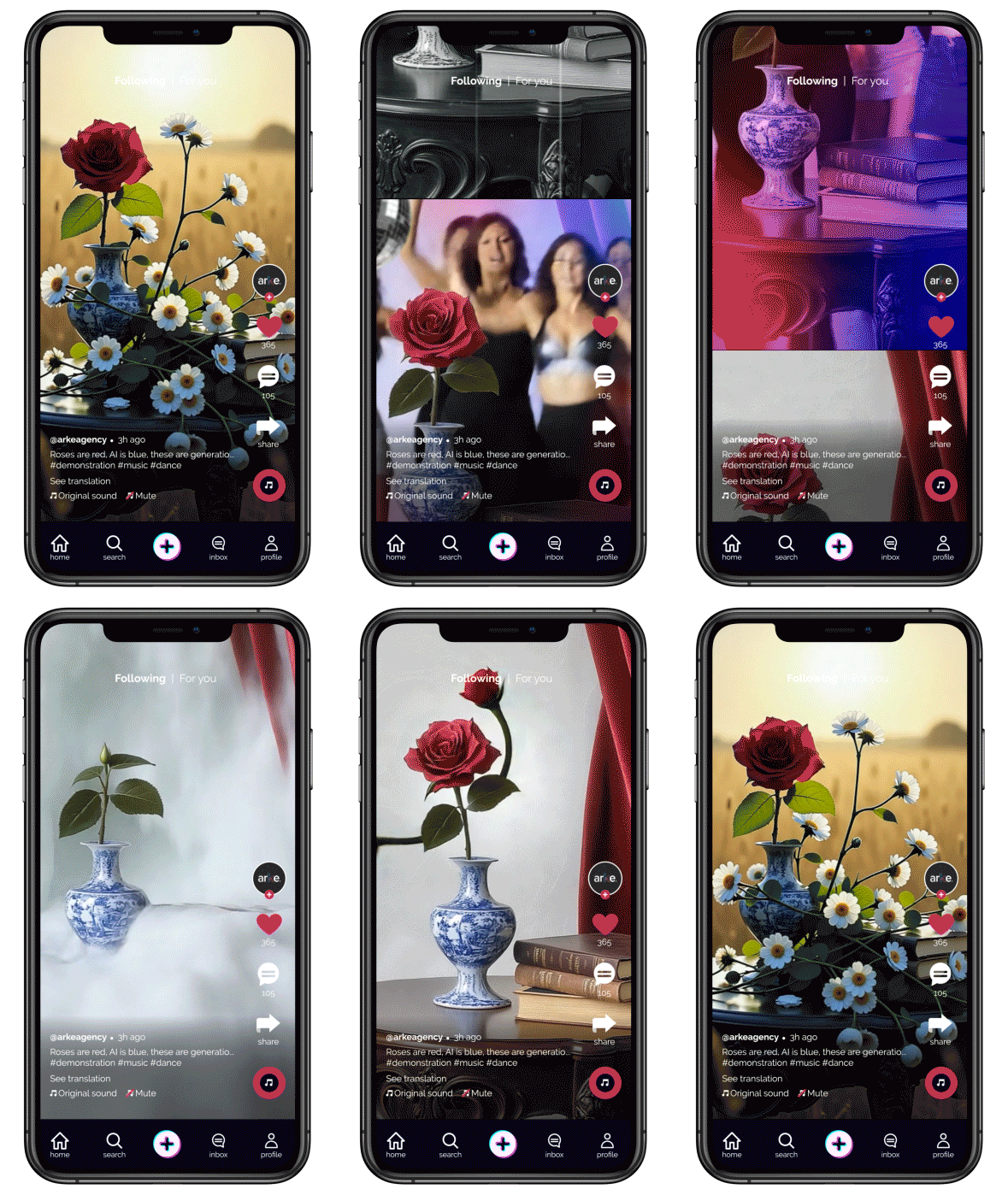
At this stage, I am not a slave to the robots. Instead, we have a healthy collaboration going on. I hope that more designers and creatives in marketing can overcome their AI trepidation and instead see it for its potential good in our work practices. It’s for creative thinking. It accelerates ideation. It helps craft compelling speculative work. It gets clients excited about an idea before production even begins. AI isn’t here to replace human creativity, it’s here to enhance it.
01010100 01101000 01100101 01101110 or, “Teamwork makes the dream work”
Want to see your ideas come to life? Check out our design services and get in touch with us today to start your creative journey with Arke.
So, you’re running some great ads as part of your campaign – text-based search on Google and some visual HTML5 ads on Google Discovery, as well as a few videos on Meta. They might be officially the best ads ever made – but, you’re losing those all-important leads as soon as your audience clicks through to your landing page. So, what’s going on?
Here at Arke, we’re all about our clients getting the best possible bang for their buck when it comes to online advertising. And it doesn’t just stop with said online advertising. Thinking about your potential customers’ journeys leads us to the landing page that you’re directing them toward. How effective is it? Are people abandoning your proposition after excitedly clicking on your ads?
Here are 10 factors to consider when putting your landing page together for your next campaign.
Beginning Your Landing Page:
Ensure that all of the important visuals, copy, forms and buttons appear above the fold (the visible part of the webpage before the user scrolls down), so that people don’t have to scroll down to get to the action. A key part of landing page design is making everything as easy as possible for your potential customers – reducing friction by making it a smooth customer journey. So if you have time-poor customers, keep it short, and have everything important above the fold, reducing the need to scroll down a complex page is one way to make it easier for your potential customers.
Be clear with your message
Your offering should be part of a big headline ideally, so there is no ambiguity about what this page is all about. Whatever you’re hoping your potential customer to do, whether it be to:
-
- download a resource,
-
- enter a competition,
-
- buy a product
-
- sign up for a service
… you need to be clear about what your proposal is. As well as that headline, make sure that all the key information is also present, accompanying your form or call to action button.
Picture this
On the subject of being clear, make sure your landing page includes a visual to entice the audience – what will they get if they click on the button? What are they signing up for if they give their details? You might want to be more literal, rather than conceptual, depending on the nature of your business.
All one big happy family
Your landing page should look in line with your ads – working as part of the same campaign, so that users feel they are in the right, intended place, and importantly don’t feel they’ve been misled, which could cause users to ‘bounce’ straight off the page! The ad that has led the user here will need to match with the landing page – they should be ‘of a piece’. If it were solely text, then the copy should be in the same tone of voice. If it were a visual, then the same brand look-and-feel should be present, so the landing page is a continuation of the same campaign.
No distractions
Keep top navigation and distracting links to a minimum. You probably have a great website, with a huge range of information and offerings, but you want to keep your users captivated with the offering at hand, rather than tempting them to click away to read a funny blog post. You want to be showcasing this one particular aspect of your business – this landing page’s key offering – not leading the potential customer to get lost in other parts of your site.
Small is beautiful
Ensure it is mobile-friendly and will work as well on a mobile device – so that you’re not neglecting a proportion of your audience. Everything needs to work for the visitors using their phones, so test your landing page to check it behaves as expected when using a tablet or smartphone.
4 out of 5 dentists
Numbers are always good 🙂 – do you have a snappy stat that proves how great your service is? Get it up there on the landing page. Furthermore – do you use TrustPilot or something similar? Perhaps include some of the best reviews – make sure you adhere to policies regarding transparency, and linking to ALL reviews for parity!
Testing, testing 1 2 testing
Could you be testing several headlines, or several visuals to see which performs best? There are plenty of services that offer Dynamic optimisation – could you employ something similar, to make sure that the best-performing elements of your landing page are used more frequently?
The devil’s in the details
If you’ve got forms, keep them short, and perhaps user dropdowns rather than free text fields to speed up a potential customer submitting their information. Also, think about what these forms do – if they are to book a call, do users submit and then have to wait for you to get in touch? Why not make this even easier for the user by including a link directly to an online booking system to book the call in at a time and date to suit them best?
Please and thank-yous 🙂
Do you need a page saying thank you to someone having submitted their details, ensuring that the potential customer knows that you’ve got their vital statistics? The message could include the next steps you’ll take, keeping them in the loop. Importantly, this page might be a vital part of you recording your audience’s interactions with your site – affecting your all-important metrics! (Roll on bonus!)
To Summarise:
-
- Make sure your key content is appearing above the fold
-
- Be super clear with your messaging
-
- Back up your messaging with clear imagery of your offering
-
- Ensure your ads and landing page match visually
-
- Keep menus, navigation and links to a minimum to avoid distractions
-
- Keep different screen sizes (like mobiles) in mind when designing (heck – you might even want to design the page mobile first if your audience is likely to all be using smartphones!)
-
- Back up your messaging with stats and reviews if possible
-
- Meaningful testing is only going to help improve your landing page’s performance
-
- Try to keep forms short (a tough balance when everyone wants EVERY crumb of information they can ever get, but use your judgement!)
-
- Let your users know when they’ve completed the intended interaction successfully! And a thank-you doesn’t hurt!
TikTok had a mind-blowing 672 million app downloads in 2022, and it’s only increasing. When you’re representing your company on TikTok, whether through organic posting or paid advertising, Arke can help you devise effective creative to resonate with your audience out of the 900 million active users of the viral app.
However you might be using TikTok – to grow awareness of your company, to engage a specific target audience or drive sales – we have put together our expert guide in order for you to get the best out of your creative for your audiences with your ads.
1. Personalisation
Speaking of audiences, start by considering the personalisation of your ad creatives for your audiences. Make sure that the ad is designed for that audience specifically – that ideal buyer profile for example. If you’re looking to engage students, ensure it looks like something that would appeal to the average age of that group, and not like a retirement ad! The best way to make your TikTok videos feel native to that audience is to get them to create it! User-generated content will make sure you are directly appealing to that group with your ad, whether using brand ambassadors, customers or influencers – content led by the audience will always get better results.
As well as the look and feel of your creative, check out the audience targeting that you’re using. Does your ad match the factors that you’re honing in on?
Visuals aside, consider your messaging, and how these can be adapted for personalisation. That doesn’t mean writing an essay and squeezing it into your video! TikTok themselves say that being consistent and succinct will help your intended audience understand your messaging. And make sure that the most important bit of your whole video isn’t at the very end. Nearly two-thirds of videos with the highest CTR showed their key message or product within the first 3 seconds. So be upfront with your messaging.
And when it comes to running multiple ads – – double-check that the creative and image match that audience. It’s important not to just throw two typical A and B versions out there simply so that you can say you’ve done your experiments!, Go further than that – create specific, bespoke versions of the ad for your different audience segments!
2. Safe zones
Sounds dangerous. And it could be – for the effectiveness of your ads… do you have a lot onscreen? Text, graphics, logos and some key footage? Regardless of whether you’re running video or image ads, make sure that nothing is going to be obscured by the platform’s controls and UI – you don’t want an important call-to-action or logo to be underneath the buttons on the right, or the captiontoward the bottom of the screen.
The latest social media format guides are great, and if you want to double-check that your creative is safer than a Fabergé egg when it comes to safe zones – why not get it straight from the source? TikTok has safe zone files available, containing images outlining the safe zones of vertical, square and horizontal ads. “Elements that appear out of the safe zone might be covered or cropped.” You have been warned! 🙂
3. Go vertical with video
We’ve all seen them: vertical videos in our feed that consist of a tiny widescreen video with massive blocks of colour above and below – they look like a corporation shoehorning an existing video rather than making something specifically for that platform. They can appear haphazard and scream “hasty reuse of someone else’s content in an attempt to get attention”, which isn’t a great look. So you might need to rejig existing files to rectify this! Research found that ads that look and feel like TikTok content “proved to be particularly effective…with potential new customers viewing the ads for 27% longer than average.”
So you’ve got some content from another channel. Instead of simply reposting, consider repurposing your content. Make a vertical version of the video. And if that sort of extreme close-up of a crop isn’t going to work, owing to the action in the video, then add on-brand background patterns, and even consider putting your video into a shape that isn’t a rectangle. Something that is crafted to fit the space will resonate much better, and look less default and spammy, increasing confidence in the ad!
4. Music/sound
So you’ve got a great animated asset. It is perfect for the campaign: on brand, using creative that has a great track record with your audience. All the important action is within the safe zone, but you don’t have a soundtrack.
Before you reach for whatever free, mediocre, generic, stock backing track you can get your hands on, consider using sound native to the app. You could add the music within TikTok and capitalise on popular, trending tracks to help your ads resonate better with the app’s users. You can even see which songs have been popular in the last 7, 30 or 120 days if you don’t want to risk betting on a stinker!
Using TikTok’s own sound library means that the sounds are pre-cleared for commercial use, and make the video feel more on-trend, relevant and native to the platform – encouraging users to watch rather than immediately scrolling past it as an ad.
So the next time TikTok plays a big part in your campaign and you’re coming up with your plan of execution:
-
- consider how your ads are personalised to your audience
-
- check the key content of your ads isn’t out of shot
-
- tailor your content for the platform
-
- and leave the stock muzak at home!
This will all help strengthen your campaign and get you closer to those all-important KPIs!
At Arke, we’re experts in creating award-winning creative, and we can help get your ads back on track to a whirlwind of conversions. Get cracking creating some record-breaking advertising with Arke this new year… is your creative due a refresh?
Getting ads right is hard! We know it, you know it. Not only is there lots at stake, but also pretty often plenty of stakeholders too. Google reported that approximately 70% of success is driven by the creative – so no pressure!
Here at Arke, we’re no strangers to devising a campaign and then working to roll it out to get maximum results. Making sure your ads are as effective as possible so that you’re getting the best ROI you can get is a combination of factors, and unhelpfully, one size definitely does NOT fit all!
We’ve collated THE best practices from a creative perspective to consider the next time you’re planning the ads that make up your campaign. Meta found that better-performing creative can lower overall costs across ad campaigns by approximately 20%, including lower cost per link click and lower cost per website conversion – so there’s lots to play for! Start with these 3 questions:
What’s the aspect ratio of your ad?
Is your content in the right aspect ratio? You might have spent days in After Effects making a great video – but is it designed to suit Meta? Widescreen video ads (we’re talking dimensions like 1920 pixels wide and 1080 pixels high) won’t occupy much of the screen on either mobile nor desktop 🙁 – so consider making a vertical version.
Similarly, a static graphic in the wrong aspect ratio might appear much smaller if it isn’t in the right dimensions, rendering (see what I did there?) – yes rendering your text potentially illegible.
The best way to avoid these issues is to picture your content in situ in an Instagram timeline if that’s where it is going to appear, or throughout people’s stories if that’s where you’re placing it. Context is key. Think specifically about how it is going to be seen – using a preview tool will really help you envision this, helping you catch any potential issues and optimise your content for its proposed end result. The last thing you want is people unable to read anything, or trying to turn their phones around to no avail, or ignoring your ad altogether because it isn’t displaying properly!
Is it moving?
Thinking about the marketing funnel, should your content move? Movement is more suitable for brand awareness – the top of the marketing funnel. If your intention is focused on the top of the marketing funnel use some animation to capture attention.
Video is great for awareness: catching attention and creating a buzz, whereas static ads are more suitable for decision-making! So if your ads are more about decision-based conversions, avoid busy animation that’s less suited to Intention and Decision, where people want to be able to digest information at their own pace.
Think back to the dark patterns employed by fast fashion sites that pressure you into buying something by using micro-interactions and constant movement, leading to a feeling of pressure and FOMO. You don’t want your audience to feel intimidated when they’re making a decision to opt into something on social media.
If you’re using text in your ad – is it too long? When making a campaign, you know the copy. You’re familiar with it. Perhaps you went hard on the benefits and have now seen it a dozen times while working on the layout. Bottom line: you probably don’t read it when composing your ad. Before even getting into the copy itself (watch this space!) – make sure that people have enough time to read it!
What’s your CTA?
What behaviour are you trying to inspire? When considering trying to get a user to actually do something – such as consider your service – is the call-to-action specific to the platform it’s on? Make it easy for your audience.
Be clear about what you’re asking, and where the user is going to be taken to by clicking on your ad… or the button…. Or…. swiping – see? It is hard to be sure. You want your ad to inspire quite literal confidence, rather than looking like a questionable, possibly-scamming, dubious ad with an opaque CTA that just wants clicks and nothing else.
So the next time you’re working through your media plan and coming up with your plan of execution, consider the shape and size of your ads, their use of motion, and the action you’re asking users to take. This will all help strengthen your campaign and tighten up your efforts in getting toward your goals!
At Arke, we’re experts in creating award-winning creative, and we can help get your ads back on track to a whirlwind of conversions.
The past three weeks we’ve been on a mission to find out if AI can be a dependent tool in the marketing world and whether or not it’s really worth utilising.
To do this, we set out with a series of challenges for our in-house creative team and online AI robots. We briefed them on creating logos, writing engaging taglines and illustration. We then showcased the designs to our followers on Linkedin, letting them decide what they thought to be the human approach.
So, is AI worth using in your content strategy? We hope you are ready as the results are in…
Logo Design
Our first challenge for our followers was to recognise which of four logos was created by our Head of Creative at Arke, hidden in a mix of designs generated by AI.
We can now confirm that 55% of our audience voted for the logo made by our Head of Creative with the love reaction, so a close split in opinions.
With sites like Canva and Design.ai offering image generated content through artificial intelligence, the rise of AI content is at an all time high. Now whilst it does speed up the design, it can sometimes take the concept a bit too literally, producing content that may lack creativity.
However, sometimes that could be a great thing for marketers. For example, Google has recently released Product Studio, a system that allows shop owners to easily create unique and tailored product imagery for free.
With products on Google earning a 76% increase in impressions and a 32% increase in clicks when having more than one image, this tool could really help those with small budgets hoping to boost their product image catalogue.
And whilst that is still a pretty cool feature, we know AI can’t always provide the creativity, critical thinking, and problem-solving skills that designers bring to their work. Take for example how we generated a 1009% ROAS for Shay and Blue through pairing custom messaging frameworks with tailored creatives and paid media activity, generating record-breaking revenue during Black Friday.
Copywriting
Next up was our Copy and Content Executive Jacob, alongside AI for the most engaging tagline for Arke.
AI seems to be a well established thinker here, convincing 50% of our audience that it was our in-house Copywriter.
Scheduling platforms have recently launched generative AI to their users. HubSpot’s AI content assistant utilises OpenAI’s GPT model to help anyone on your team ideate, create, and share content in a flash.
Again it’s about being that extra support in the marketing process. Tools like this can help the everyday marketer create content plans, reactive posts and generate ideas for blogs – which lets admit, can be very helpful when you’re on tight deadlines.
However, Sitecare did a similar experiment to us and found that AI underperformed humans in all areas of copywriting. Human-generated content had a lower bounce rate than AI, with Google ranking it higher as readers stayed on the page longer. This is because humans understand the behavioural, unspoken nuances that a machine would have to be told…and if you’re spending so much time briefing this into ChatGPT, its going to be taking you far more time than its worth.
AI can find information on the internet and construct a blog on all it finds, but it tends to lack the creativity and research that goes into making writing that extra bit special – so if you’re writing about a very in depth topic, we recommend sticking to pen and paper for now.
But don’t get us wrong, AI is a very handful tool for all ideation and content planning needs.
Illustration
Lastly, Matt took to the sketchbook to create an illustration which we paired against three AI generated images.
Tasked with finding the illustration representing ‘people using the internet’ that was created by our talented Head of Creative, 71% of our followers got it right and chose the support reaction image.
Now AI may not have you fooled this time, but it is doing some pretty cool things in the Adobe world. With users creating about 200 million AI-generated images using Adobe’s in-house text-to-image model Firefly since it launched in March, the platform is now planning to launch to 12,000 enterprise customers.
With AI now having the ability to action repetitive and mundane tasks, designers can now focus more on creative and strategic aspects of their work. Tasks such as generating design variations, resizing images, or formatting layouts can be accelerated and streamlined using AI algorithms. This efficiency enables designers to work faster and allocate more time to the creative process.
In conclusion, AI is a pretty handy support tool, and offers a realm of opportunities for content creators and designers alike. With the aspect of saving time, helping with ideation and new platforms like Firefly introducing a range of generative tools with endless possibilities, it’s definitely a feature worth utilising. But if you’re looking for something powered with behavioural science, research and audience analysis, it’s a human team of experts you should look to.
Blog written by ChapGPT (only joking).
Did someone say winner, winner?
That’s right! After a successful night at Tuesday’s UK Paid Media Awards 2023 we are over the moon to announce we won ‘Paid Social Media Campaign of the Year’ with our fantastic client Shay and Blue!
Having previously won the European Paid Media Awards, this win adds value to the brilliant results our paid media campaigns can achieve for your business.
The award-winning campaign ‘The Scent of Success’ fed into Shay and Blue’s wider brand strategy, conveying their unique value proposition, ‘Perfume is Personality’, to their rebellious audience. We honed in on data and built up their mailing list to successfully target customers in this campaign, while collecting first-party data for subsequent campaigns.
With a 1009% ROAS, the campaign resulted in a record-breaking period of online trading for Shay & Blue, revenue attributed to Paid Media increased by 244.59%, generating their biggest month in online revenue in a single week – a huge impact for a small, niche brand.
We couldn’t be more proud to win this award with such a fantastic campaign and client! Congratulations to all the other finalists and winners, it was such an amazing night thanks to Don’t Panic Events.
Arke Agency Founder and Managing Director, Steph Noble said: “We loved working so closely with the Shay and Blue team to create such an impactful campaign, delivering target smashing results through a full in-house collaboration. It goes to show the powerful impact social media can have on your brand, and the importance of agility in delivery.
“This award serves as an attribute to the amazing work the team continuously achieves for our clients, something that is evident as we stand strong as a multi-award winning agency. Well done Arkenauts!”
See more of our work with Shay and Blue.
“Storytelling and what it stands for is at the heart of everything your campaign work towards.”
For every campaign, social post or blog, there’s a story to be told. But how can you make sure that story is an absolute page-turner and keeps people hooked?
Okay, so, once upon a time…
What is storytelling?
In general terms, storytelling is the social and universal way we tell stories. In all aspects of life, we share stories, be they funny, sad, weird or wonderful. It’s one of the best ways to engage and converse with others.
In marketing, storytelling follows those same codes; a desire to share and tell. In fact, storytelling is at the heart of inspirational content that consumers can connect with – also known as inbound marketing. With the perfect story, you can engage audiences on an emotional level, creating a valuable, long-lasting bond with your work and your brand.
No matter the content, the story is the thread that holds it all together throughout.
Why is storytelling so important in marketing?
If your story connects with someone, chances are it will with others. And, like any good story, it will be retold, reshared and reposted across platforms, ultimately increasing awareness for your brand and generating new customers.
Besides being an emotive engager, storytelling can explain complex ideas, emotions or values in a simple manner. In turn, you can sell specialities easier, provided you have that persuasive suave in your tone of voice.
You don’t have to go House of The Dragon deep with your story if it doesn’t need to. What’s important is that you’re showing audiences something they can clearly understand… that can be the tricky part.
But don’t worry! We have a few tip-top tips on hand, so you’re not staring blankly at the page for hours on end (don’t worry, that’s going to happen regardless).
Top tips
1. What’s your story?
Before typing away at your heart’s content, stop for a moment and really think about what the story for this specific piece is. Are you selling a product or service and want to show it off? Are you illustrating to audiences what your brand’s value proposition and goals are?
Depending on your purpose, the tone and delivery of your story will change. So, make sure you spend as much time preparing your story as you do writing it.
It’s also important not to edit away at your story whilst you write it down. Don’t waste time making corrections on something that isn’t finished yet. Throw up all you can onto your page, then tinker with its structure and tone later.
2. Who is this story for?
Like with all areas of marketing, you won’t know what to write at all if you don’t know the target audience. Stories tend to come with solutions for issues, so knowing the audience’s pain points and concerns is half the story. It’s now your job to provide the solution.
It’s crucial you specify who your customer personas could be. Knowing audience traits such as age, gender and location could radically change the way you tell your story, especially in its tone and language.
Remember, even if it’s a piece about your brand – write for your audience, never yourself.
3. How are you telling your story?
When the idea of a story pops into mind, we tend to think of books, specifically, words. But there are many ways to tell a gripping story in marketing.
Of course, eye-catching copy can help, but as the old saying goes, a picture is worth a thousand words. Stories can traverse across many mediums; audio, visual, statics, and even social posts.
Some of the greatest campaigns take on a variety of forms. For example, they may have a high-quality advert accompanied by posters and print designs continuing the narrative across digital outlets.
You could also interpret the different stages of the buyer’s journey as different chapters in a campaign’s story, with the motivation and goal for each part of the funnel shifting depending on if the customer is at the awareness or the conversion stage of the journey.
So, it’s not just the structure of your story; it’s also the structure of how you’ll deliver it. The copy length and tone will change depending on the social media platform, and so will any visual designs.
Another consideration; the only limit to story conception is the imagination, which, in reality, can be a burden on budgets. Do you have the right SMART goals in place so that your story is executed and delivered perfectly?
Get to writing!
The world of storytelling is too big to cover in one blog; we’ll be sure to revisit this topic soon and discuss even more ways in which you can perfect your storytelling finesse.
Until then, if you’d like to know more about the creative ways in which you can engage your audience or want further advice spicing up the emotions in your narrative – contact our award-winning team now.
What is a persona in marketing?
A marketing persona is essentially a character that personifies your audience best. The reason brands and marketers spend so long building personas is so that they can understand their audience.
Whether you imagine your target audience as one of the Sanderson Sisters from Hocus Pocus or Ned Schneebly from School of Rock, picking a character to personify your target audience is a quick way to build a marketing persona.
Visualising your customer will help you understand their demographics, behaviours, geographics and psychographics – the basic principles of marketing to audiences. Keeping these at the forefront of your marketing strategy and planning will ensure that your activity aligns with your audience.
How to build a marketing persona in five simple steps
- Do your research
It’s impossible to build up an image of your audience without understanding their motivations, frustrations and who they are exactly. We suggest conducting research under the following categories to accurately understand your audience and build up an image of your audience/s.
Demographics
- Research how old they are; which age group they fall into (boomer, Gen Z, Gen X)
- Which gender do they identify with? Or are they gender fluid?
Behaviours
- Where does your target audience spend their time online?
- Do they tend to buy directly from social media, or do they prefer to purchase on retailers’ websites?
- Who do they rely on for purchasing decisions? Are they influenced by their colleagues, social media influencers or their family and friends?
Geographics
- Where do they live or work?
- Where do they spend their free time?
- Where is their family based?
- Do they work in an office or from home?
Psychographics
- Do you know what your target consumer loves doing in their free time or what they do for work?
- What do they value? Is it sustainability, feminism, their free time?
- What interests and hobbies do they have?
- Define your customer segments
If you’ve got more than one customer, it’s likely they’ll have different traits; it’s not enough to use a one-size-fits-all approach in your marketing.
It’s important to determine early on who your customers are and how you can segment them. Segmenting your audience will help you tailor your marketing and messaging to each group, making your targeting more personal – and more effective. In fact, 72% of customers will only engage with personalised messaging, so it’s key to know who your audience is and talk directly to them.
Once you know your audience segments, put a face to them. Pick a character that best represents their traits (whether it’s Winnie the Pooh or Bridget Jones) and use this character to keep your audience top of mind when producing marketing material.
- Create a messaging framework
Once you’ve created your persona, you’ll want to create a messaging framework to accurately nurture them towards conversion at each step of the funnel.
We’ve created a messaging framework aimed at helping brands craft messaging to nurture their audiences on different platforms and at different stages of the funnel – which you can download here. However, you’ll want to tailor your messaging to your different audience segments, so use the messaging framework as a guideline and tailor it as you see fit.
- Create a buyer journey for your persona
Putting yourself in your customers’ shoes is a great way to understand the experience they receive when interacting with your brand.
Create a road map of the steps you want them to take after seeing your ad, and then map out what their potential frustrations could be at each step.
Next, work out how you can solve those pain points. Design thinking is one way you can improve the user experience; ask yourself if there are any blockers in the conversion journey, then set about designing your landing pages and website to be as user-friendly as possible.
If you’re struggling to put yourself in their shoes, ask a friend or hold a focus group to get a true representation of their thoughts and feelings at each stage of the journey.
- Align your team
Once you’ve defined your personas and your messaging strategies, it’s time to share them with your team to create a foolproof omni-channel marketing strategy
Omni-channel marketing is all about creating a seamless experience for your customers between platforms to build up awareness of your brand.
To ensure your marketing activity is uniform across all channels, you’ll need to align your team with your messaging strategy too. Give them a clear idea of the audience they’re targeting – and use those all-important personas and character traits to reinforce their traits.
Now it’s time to download our free persona-building resource, packed with extra tips and tricks to understanding your audience.
If you would like further help creating personas or a tailored messaging strategy to nurture them to conversion, get in touch with us. Our multi-award-winning expert team can help with everything from copywriting to brand building.
Do you have clear tone of voice guidelines in place for your brand? If you don’t already have a messaging framework in place, you need one, especially amid the cost of living crisis. Knowing how to craft your brand voice, be sensitive and communicate effectively with your audience is more important than ever when consumers are looking to cut costs – don’t let your brand be the corner they cut!
Looking to translate your brand’s voice across platforms to stay top-of-mind? Here is your ultimate guide to building your brand (and gaining more customers as a result).
The proof is in the planning
You can’t build a good brand without taking the time to sculpt it. So, what exactly do you need to consider in order to set the foundations of your brand?
Consider the following:
- What makes your brand unique?
- What’s your mission statement? What is your brand trying to achieve?
- Who is your audience and what problem do you solve for them?
- How can you translate your brand into everything you do? Think about the energy your brand exudes. How does this translate to your colour palette and brand buzz words? How does all of this fit together to create a coherent brand image?
Creating a coherent brand identity across platforms will increase brand recall. Your colours and brand buzz words will further reinforce this.
Engage your audience at every stage of the funnel
Once you’ve nailed your tone of voice, it’s time to put your brand to the test. When creating campaigns, keep tone of voice in mind. Adapt your writing style to successfully nurture your audience to conversion and understand where they are in the funnel.
Speaking of the funnel, let’s look at its specific stages and how your tone of voice will adapt to it.
Awareness
- Do you know your target audience and where they’re active online?
- What sort of content does your target audience resonate with?
At the awareness stage, audiences can be clueless about your brand, products, or services. So, your tone of voice should sound distinctive and intriguing.
Consider how you can get your target audience interested in your brand with whimsical language or by presenting them with a common issue and how your brand can fix it.
Consideration
- What are your competitors doing, and what sets you apart from them?
Setting yourself apart is essential, especially amid the cost of living crisis when competition for customers is fierce.
During the consideration phase, you’ll want to use a more direct tone of voice that guides your target audience towards conversion. Remember, they’re still making their mind up so you’ll still need to convince them that your brand is right for them. They’re also one step closer to conversion than they were, so you’ll want to be even more engaging with your copy, while clearly directing them to your CTA.
Intent
If your audience is still in the decision-making process, give them another reason to choose you. Switch up your copy and convince customers that your brand can solve their current problem. This is your chance to show off your other products, services or offers to paint a picture of your brand.
It’s also time to position yourself as an expert who can solve their problems. Lean on testimonials and customer reviews at this point.
Decision
The decision stage is your chance to convince your audience to convert; impactful messaging is an absolute must at this stage.
Speak directly to your target audience with your copy, tailoring it to them where possible. You can achieve this by segmenting your audience and creating ad sets specifically for each audience. You’ll also want to consider adding some punchy stats to your copy and ad designs to fully convince your audience to opt for you over your competitors.
Our Copywriter’s top tips

- Consider your brand as a person
Create a persona for your brand. Does it sound like a best buddy, a politician, or a kind neighbour? Whatever your brand sounds like in your head is what needs to be portrayed on paper, and thinking of your brand as a character will bring it to life.
- Keep your Tone of Voice consistent
As we said, your brand needs to be portrayed consistently across the platforms it’s present on.
The best way to do this is by writing a Tone of Voice guide so everyone creating content for your brand is on the same page from the get-go. Remember to include key do’s and don’ts, conjuring up a holistic image of what your brand should be and how your team should seek to represent it.
- Your brand is everything, not just your content
While your owned media (what you produce and how you choose to portray your brand on your website, social media etc.) plays a major role in your brand image, you’ve also got to monitor your earned media. Earned media is any content written about your brand, whether good or bad. It can seriously affect your brand’s reputation and image if you’re not on top of it.
Building good relationships with your customers will help to reinforce your brand in a positive light. 86% of people will hesitate to do business with a brand that has negative online reviews. Reviews are a form of earned media, so you’ll need to monitor your online presence carefully to maintain a positive reputation and keep the customers rolling in.
Download our free messaging framework
While these are some of our top tips for creating a bulletproof brand, it doesn’t stop there…
It takes continual refinement to take a brand from good to great. You’ll learn even more brand marketing secrets (including how to alter your tone of voice according to platform and stage) in our downloadable messaging framework template. Plus, it’s free! So why not make the most of the download to boost your brand? Get your copy by clicking here.
Our team of marketing strategists and creative designers have provided rebrands for many of our clients, refreshing their creative, their website and their overall brand strategy. Get in touch if you’d like us to do the same for your business.
Looking to make your business stand out and increase brand engagement in a busy market space? Your brand values are the perfect place to start!
As the cost-of-living crisis continues to rise, the battle for customer attention has never been higher, but so is the desire to save pennies and avoid big spending.
Creative content can come cheaply, but a great (and completely free) way to get audiences interested in your brand is through the values you promote across platforms and campaigns.
So, looking to develop your mission, vision and values to their highest potential? You’ve found the right blog, my friends.
Hang on, what are the mission, vision and values?
Your mission, vision and values are the foundations your brand is built on. Put another way, together – they act as the manifesto informing your customers who you are, what you stand for and what you bring to the table.
Just to be sure, let’s break them down individually:
The Mission: Your mission needs to communicate the purpose of your business. Through your products or services, what is your brand’s objective?
The Vision: Your vision needs to provide audiences with what your business will achieve as a company and what it desires to become as it develops throughout its work.
The Values: Your values should reflect your business’s principles and ethics. As a brand, what are you passionate about? Why is it important customers, workers, and society see a positive impact from your brand?
Taking the time to perfect brand values is an excellent starting point in shaping a distinct brand that stands out from competitors. If your mission, vision and values are detailed and thorough, audiences will relate to your identity.
Anything else my brand values will improve for my business?
Your brand values won’t just attain the customer’s appreciation – but your team’s too. By making sure your values reflect your ethic toward the work environment, your employees will feel a sense of belonging and importance within your company.
And on the topic of teamwork, your brand values will additionally create a focal point team members can refer to that drives the creative identity your brand executes throughout areas such as campaigns and social posts. This is essential if you want to achieve efficient, productive work that feels consistent across platforms.
In a nutshell – strong brand values will shape a recognisable identity, nurture employee motivation and resonate with audiences; overall increasing brand equity and engagement.
But wait one second! Before you head off to snazz up your values, we have a few recommendations that will make sure you’re following best practices in this highly competitive market.
Our top tips to get the ball rolling
- Research, research & research
Every business, big or small, will have brand values. Whether it’s an about page on their website or fused through the copy on CSR-related social posts – every brand wants audiences to know what they’re about.
For inspiration, look into how other brands present themselves and their services to customers. Take it a step further; explore the values of brands similar to yours and mark the similarities and differences in how they portray the brand identity.
Don’t panic if you find a brand that shares the same values you do. Most brands today share similar goals and objectives – from healthy work environments to sustainability and cultural sensitivities.
It’s not about using values nobody else promotes; it’s about making the delivery of those values unique to your brand identity, tone of voice and marketing approach.
- Transparency & authenticity are key
In an always-on marketing environment, audiences are more aware of branding than ever before.
In fact, 88% of consumers say that authenticity is a factor when deciding what brands they engage with and support. Having great values won’t be enough to hook in an audience. What’s important is showing how your work follows through on them.
Basically – teach, don’t preach! Demonstrate to customers the practical strides you make as a business and how you contribute to improved services within your field.
On top of that, 66% of consumers say transparency is one of the most attractive qualities of a brand. Honesty is everything; if you’re not open with your customers, it’s harder for them to see your brand identity as genuine.
To achieve transparency, keep your values realistic. If you tell the world you’re about to solve the cost-of-living crisis, chances are your brand will be bashed when you’re spending time on Twitter talking about unrelated issues.
- Value is also practical
Your brand’s value isn’t based solely on your statements. It’s also about how the customer can interact with you.
73% of consumers cite customer experience as an essential factor in their purchasing decisions. Value comes from the experience audiences have with you, and there are plenty of methods you can integrate to improve that relationship.
Consistency is vital, but creative assets must also be accessible to all audiences. Make sure your branded fonts, colours and imagery can be understood by everyone (it’s only going to increase the number of eyes on your content).
Make the most of technologies such as screen-reader software, voice descriptions, and subtitles. This will emphasise the value you see in your customers and result in better connections. For more insights into brand accessibility – check out our blog covering the topic in detail.
Lastly, did you know it only takes 1/10th of a second for people to form a first impression of someone? Chances are, you’ll want customers heading to your website to check out your products. But if your website is slow or unresponsive, sayonara, website!
Performing a CRM audit of your website and making sure there’s value for customers to keep clicking is just as important as the forward-facing values you set out as a business.
But don’t break a sweat – we can help with all these issues! If a CRM audit tickles your fancy or your business is looking for expert consultancy in brand strategy – contact our team of creative and marketing strategists now.
No matter the area of expertise you work in or manage, creativity will play a major role in keeping audiences engaged with your products or services. But how can you assure your creative content is supercharged to its full potential whilst being cost-efficient?
As the cost-of-living crisis continues to rise, so does the need to budget cautiously. But that doesn’t mean you can’t keep creating content in exciting and snazzy ways.
Want to keep your marketing creative without breaking the piggy bank? Keep reading and dive into our top tips for clever creative!
Get creative with your copywriting
Thankfully, there’s no inflation for words, writing and the effective use of copywriting.
Copy is essential across all business areas – from SEO performance and social media posting to blogs and campaign taglines. The perfect piece of writing can convince your customers to make that final click to purchase a product.
Our copywriter’s top tip: Make sure your copy is personal and persuasive! Calls-to-action (CTAs) that address the customer personally perform 202% better than bog-standard, bland CTAs.
For businesses looking to keep costs low, creative copywriting tends to be the first thing that gets cut. We’d recommend the opposite. Sorry to burst your bubble, but without practice and passion, copy that’s written and quality assured by randomers will be nowhere near as effective for audiences.
People passionate about writing will maintain consistency across your campaigns and uphold best practices throughout your branding.
Want further proof? Check out our blog on how language has helped create some of the greatest campaigns of all time right here.
The pen is mighty, but you can only go so far with words on their own. Let’s explore how you can develop creative content even further without splashing the cash.
Video content doesn’t have to be oscar-worthy
According to Wyzowl’s State of Video Marketing Survey, 86% of businesses use video as a marketing tool, and 87% of marketers say video strategies have increased traffic.
Does that mean you need to bust out the big bucks and create high-production videos to keep audiences engaged? Nope!
Though slick animations, motion graphics, and lens-flaring cinematography will show off your skills as a creative, it’s not entirely needed if you want to catch the audience’s attention in general (though maximum effort is still recommended).
Despite the rise of TikTok and other social media video content, the most common type of video created are explainer videos. Whether it’s a promotional video explaining how your product works or what services your business offer, visually guiding audiences is an effective way to engage and potentially convert users into customers.
There are many creative approaches to how you visually present your brand to audiences, from nicely designed illustrations to more cost-efficient methods like recording an unboxing of your product.
Though many marketing agencies prefer making video content in-house, 32% use a mix of internal creative and outsourcing. If you’ve not got an in-house team you can rely on for awesome content that meets your briefs – get in touch with us. Our creatives love getting stuck into new projects.
Go bananas with unique creative
Thinking outside the box is a great way to be creatively distinct with your campaigns; whilst allowing your team to do something unique through a cost-efficient approach.
Guerilla marketing is defined as an unconventional way of advertising that drives awareness for your brand through emotive and provoking methods.
The biggest purchase you’ll make in guerilla marketing is the creative effort you put into your campaign. Take time to think of something that will really catch the audience’s attention, whether it’s something you do inside, outside or digitally.
Creating one-off events or repurposing older campaigns in new ways can potentially intrigue local news outlets, influencers and audiences. Guerilla marketing is at its best when it breaks away from typical advertising and disrupts the normality of conventional campaigns.
However, to make sure you avoid community backlash, we recommend keeping guerilla campaigns eco-friendly and ethically sound.
For more insights into guerilla marketing – check out our free film & entertainment report covering some outstanding guerilla campaigns.
To take it to the next level, find the perfect balance of creatively engaging and collaborative. Researching geographical trends and events could help shape the creative direction of your campaign, leading to a stronger connection between audience and advert in public spaces.
If you’d like expert advice on effectively advertising whilst keeping costs low or want some inspiration on the creative direction your campaigns could go – contact our professional team of marketing and creatives now. We’re 100% transparent about costs, so you’ll know exactly where your budget’s going if you work with us.
Is your business struggling to find the perfect marketing strategy that assures business is booming? Looking to spend minimal but keep engagement up? High-impact marketing could make all the difference; want to know how?
Today, we’re diving into how high-impact strategies can maximise your marketing efforts whilst keeping costs down, ultimately improving your ROI and brand’s bottom-line.
So, let’s start off with…
What is high-impact marketing?
High-impact marketing is any tactic or method that will have significant, positive effects on your brand’s net income.
Let’s say you write a really informative blog about your services which grabs the attention of thousands of potential customers, resulting in a 10% increase in leads and a 15% increase in website traffic. Jackpot! You’ve successfully found yourself a high-impact marketing strategy.
Notably, this means you can achieve your goals through high-impact marketing without splashing the cash; your methods just have to grab the audience’s attention and lead them through the buyer’s journey effectively.
As the cost-of-living continues to rise, it’s essential that your brand keeps budget considerations a priority, especially if you plan to run multiple campaigns or have a range of goals. High-impact marketing is a great way to avoid big-spend but still deliver creative and persuasive advertising.
Types of high-impact marketing
What types of high-impact marketing could you use?
Your high-impact marketing methods will differ depending on your area of business and the goals your brand wants to achieve. However, it’s a course of action that all businesses should consider.
Let’s say you want to increase awareness for a product your brand offers. A high-impact strategy could be a Youtube series showing off why your product is unique. An in-house, low-budget series will save you money on production whilst driving continued awareness of your brand on a platform rich in SEO opportunities.
On the flip side, high-impact marketing doesn’t have to relate to a specific product; it can be a purely PR-related objective. Perhaps the goal is to increase positive reception regarding your brand online. All you’ll business will need is a LinkedIn profile and a schedule for when posts regarding your brand’s values and positive efforts are released.
These examples show how expansive high-impact marketing can be and how little it can affect your finances. However, with a range of avenues, you’ll need to consider a few things before putting your methods into action…
Effective high-impact marketing
What should I do to make sure I’m using high-impact marketing effectively?
We’ve come up with a few recommendations that make sure you’re making an impact whilst keeping methods intact.
1. Make your goals SMART
Before even coming up with a campaign, make sure your goals are precise and detailed. Saying you’d like to increase online sales is great, but its vagueness could lead your high-impact campaign to splinter and lose focus.
How do you avoid this? Make your goals SMART! Your objectives should always be Specific in what you want to achieve, Measurable in terms of outcome, something you know your brand can Achieve, and ultimately Realistic and doable in a Timely manner.
SMART goals will help your team understand what needs doing, how to do it and when it needs completing in a quick, easy-to-understand objective.
2. Know your audience
It’s all well and good to have objectives set out, but unless you know where your audience is online, it won’t have that spice that gets specific results.
Conducting audience analysis and understanding who they are, what pain points they have, and the platforms they use online to converse with each other is an absolute must if you want to know how to market your product online. It will only make your SMART goals smarter!
3. Retain your current customers
Did you know it can cost 5 to 25 times more to acquire a new customer than retain an existing one?
If you’re objective is to acquire new customers, that’s great, but you also need to consider maintaining and building upon the relationships you have established with your returning audience.
So, a possible SMART goal could be to attract new audiences through a referral programme which offers your existing customers a discount for one week. Once again, this is an effective way to market whilst keeping costs low.
4. Social media is key to keeping costs down
If you’re looking for a crazily cheap way to engage audiences, look no further than social media.
73% of marketers believe their social media marketing has been successful for their businesses. Each platform offers its own audience your brand can target, whether it’s B2B relationships on LinkedIn or unlocking the potential of Gen Z engagement on TikTok.
Organic social posts are a fantastic money-saver that can easily be monitored and optimised through apps like Hootsuite. We’d recommend split-testing your posts to see where you’re getting the most engagement and then cater for those platforms.
For all the latest updates to social media platforms, check out our monthly social blog series covering the latest updates and trends that will keep you in the social loop.
Plenty of methods to pick from!
Whilst high-impact marketing is definitely something your business should consider – there are plenty of other avenues to consider when you want to increase ROI and audience engagement.
From SEO and creative approaches to your brand’s TOV and values – we’ll be back very soon covering a barrel’s worth of methods you could implement – so be sure to keep your eyes posted on our socials.
Until next time, if you’d like more personalised recommendations on how to use high-impact marketing across your online strategies or would like us to conduct research into your social media posting – get in touch with our marketing team now.
Inflation, rising energy bills, petrol prices through the roof… The cost of living increase really does sound like all doom and gloom. But businesses can’t just shut up shop in response to this. What to do?
There are smarter, more strategic ways to deal with the crisis. Reassessing strategy and planning for a post-recession future is key to keeping business afloat. But, with these tips, you’ll keep afloat and thrive!
Here’s everything brands facing the economic crisis need to do to prosper and come out of the crisis stronger. Trust us – we’ve been through it ourselves and helped countless clients push through too.
Audit your outputs
First, breathe. Before you drastically change your business plan, scrap your marketing and cut jobs, take time to audit your current strategy. Find where you can strategically reduce costs and where you can focus your attention to produce the greatest return.
As a digital marketing agency, we’re all about testing and learning for maximum results. Amid the situation, you’ll need full visibility and understanding of what’s having a positive impact on your business and what could be paired back.
Google Analytics 4 is the best way of understanding the conversion funnel and being able to see where your customers are dropping off at a glance. When set up correctly, you’ll be able to create a nurture strategy that aligns with your funnel and respond quickly to any dips in engagement or drop-offs to ensure your customers stay by your side.
If you haven’t got time to do it yourself, get in contact with us. We work with clients across the UK, identifying where they can make a difference on the bottom line and implementing bespoke conversion funnels in line with our clients’ goals. We pride ourselves on transparency; that means no hidden fees or costs, and we won’t suggest anything that won’t contribute to your goals.
Address your customers’ pain points
Don’t forget rule number one of marketing: Keep your audience at the centre of everything you do. Power your business decisions with your audience in mind, and you’ll be able to create an audience-centric approach amid the crisis, encouraging your customers to stay loyal.
Focus your marketing and advertising on growth strategies. Targeting, messaging and positioning is key. How can you address your customers’ pain points? Is it through shouting about your USP or how you’re adapting your strategy in line with your customers’ needs? What are your competitors doing to engage their audience in this trying time.
Honing in on your USP, whether it’s convenience, comfort, or your uncompromised sustainability ethics, will remind your consumers why they love (and need) your brand. In fact, seven in 10 customers are likely to buy more from brands they trust.
We’ve said it before, and we’ll say it again – nurturing your current clients and supporting them through this is key to staying afloat during this challenging time. By being open and honest with your audience, your customers will feel in the loop with changes to your brand, and then you can reward them for their loyalty to keep them around even longer.
Don’t pull the plug on your marketing
Ever wondered why Mcdonald’s, Nike or Netflix continue to advertise when everyone knows their brand? They’re big brands for a reason – they keep their brand top of mind for their consumers with always-on campaigns and… Giant billboards with bites taken out of them?! Regardless, you know who they are and what they’re advertising – they don’t even have to use their logo or their name to get recognition.
Focus on making your brand unique and instantly recognisable, so people are more inclined to purchase your products when they’re available. We’re talking about building brand equity – or the commercial value attached to your brand name. But how can you achieve this without blowing your budget?
Paid media (or paid advertising) doesn’t have to be expensive if you know how to be clever with your budget. Focus on budget-friendly options like social media, where you can reuse a handful of assets and copy across different ad types to reach your audience. If you’re currently advertising on TV, billboards and other OOH (Out-of-Home) platforms, switch to digital avenues where you have full control of your spending and can make data-driven decisions. And of course, always test and optimise your campaigns to produce the greatest ROI possible.
Don’t get disheartened
Wondering ‘will the cost of living go down?’ Eventually, yes. But inflation not set to fall for another two years, so you need to be implementing these tips right away.
While this year may not be your finest in terms of profits – continue pushing forward. Putting in the ground work now will make your brand stronger than ever, so once the recession is over, you’ll be in a position to make major sales.
And finally, don’t panic. As the saying goes, a problem shared is a problem halved, so why not share your challenge with an agency that’s dealt with financial crises before, yet still produced strong ROI for their clients? We are Arke – real, curious and bold. Even in times of economic uncertainty. Tell us about your challenge and we’ll provide free bespoke consultancy to take your brand to the next level.
Roll up, roll up! It’s our sweet selection of the best ads and campaigns out there right now.
We asked our Arkenauts to deep-dive into their favourites from the last few weeks, and they certainly found the cream of the crop!
No time like the present! Let’s get some inspiration for your creative campaigning and explore why these ads tick for our team.
KFC – La Massacre
Is there anything better than pizza and fried chicken? Yes, pizza and fried chicken smushed together!
If the adventures of the Hawkins crew in Stranger Things and the insane rise in Kate Bush mania have taught us anything recently – nostalgia hits big with audiences.
In 2022, we’ve been nostalgic for electronic synths, mullets, mavericks, and, who can forget, over-the-top gore. We also know this collection in its general definition – the 80s. And KFC wants in on the action.
To promote the limited-run item Pollizza, a pizza that swaps out the classic dough for a fried chicken base (yes, you read that right), KFC partnered with PS21 and created the 80s B-movie-inspired short film – La Massacre.
The short features your classic cabin in the woods ensemble of teenagers in grave-y danger; only this time, the killer is a pizza gone rotten. The film relishes the cheesy and saucy-gory style of 80s horror, paying homage to classics like The Evil Dead and Gremlins.
OOH, Horror-styled posters were also designed to promote the film in Madrid, pre-premiere.
NYSU, the director of La Massacre, states:
“We were always clear that we didn’t want to make a parody of the genre, nor make fun of it, but to make an incredible piece that respected the codes and rules of the B series. That’s why the most complicated thing was to escape from the ‘vice’ of advertising, where perfection is sought in every shot.”
That’s some practical advice for all you creatives eager to nostalgia-fy your campaigns. It’s all in respect and presentation. Your campaign doesn’t need high-production values to engage audiences; it needs emotional connection.
The results will speak for themselves. The film has attained over 100,000 views, with a social media reach of 13 million and 1.3 million interactions.
On a bigger scale, Top Gun Maverick is another fantastic example of respecting the source material and winning audiences over. We’re looking forward to a revival in 90s advertising – we want Tamagotchi’s back in the spotlight.
ManyPets – Pet Insurance
Who’s my best friend? You are! Yes, you are!
Since the lockdown, pet ownership in the UK grew immensely, with 27% of adults now owning a dog and 24% having cats.
We’re biased. We see cute animals; we’ll buy whatever you want. ManyPets launched a campaign all dog & cat lovers will bark over.
The simple yet striking ad highlights the well-being benefits animals can have on your lifestyle, placing pure cuteness at the forefront of the campaign.
However, it’s not just the aww-some imagery that connects with audiences; it’s also the direct copy. “90% of people say their pets help them feel calm. “Insure your happiness” highlights why pet ownership can help with mental health, with a CTA that assures your pets are living their best life too.
Created by Uncommon Creative Studios, co-founder Lucy Jameson states:
“We wanted to remind people that they have to insure their pets to ensure their happiness. Plus, this was one more weapon in my war of attrition trying to persuade my husband to let us have a dog….”
The key takeaway here? Simplicity sells, and everything has to work together. You don’t need extravagant copy. In fact, only 20% of people will read beyond the headline – so make sure you pack a punch with your word choice.
But you can’t leave your copy on its lonesome – 94% of content with good imagery receive more views than text-only marketing. A zoomed-in picture of a puppy can make all the difference to your campaign…and your hearts.
The Lost Class
Creative disruption at its boldest and finest.
1.4 billion impressions. 66% increase in background conversations. 12 Pencils received at the 2022 D&AD awards. But, most importantly, reminding the entire world why things need to change…
The Lost Class is a haunting, game-changing campaign. In honour of the 3,044 high school students tragically taken too early from shootings across the US, Leo Burnett Chicago held a graduation ceremony for the students.
The imagery alone packs an emotional punch, visually emphasising the gravity of the situation. However, the wide variety of creative assets and marketing mediums The Lost Class utilised makes its stance on gun control loud, dominant and disruptively engaging across all platforms.
It wasn’t enough for LBC and their client, Change the Ref, to hold an empty ceremony. Two well-known gun advocates then, unknowingly, gave the commencement address to the rows upon rows of empty chairs. In an instant, these men became anti-gun spokesmen.
Since the lunch of the campaign, the petition to pass universal background checks for gun sales has 120,201 signatures.
The boldness of the campaign worked wonders in both ad engagement and deeper discussions regarding gun control. But it does come with its warning for agencies and brands wanting to tackle charged topics.
Guerilla marketing is always a risky investment. There’s a lot to consider – from ethics and well-being to assuring your message comes across clearly to your audience. However, when done right, it can be one of the most effective ways to advertise.
Always look for unconventional ways to market your brand or product. If you’d like thorough insights and recommendations into creative campaigning – contact our creative team now.
The entertainment sector is ever-changing and it can be hard to keep up with the latest developments, especially as we emerge from the other side of the Covid-19 crisis.
With a wave of VOD (Video On Demand) platforms washing over us during lockdowns, and cinemas closed, you might be left wondering what the latest is now that we’re on the other side and cinema doors are flung wide open yet again.
Marketing should never be an afterthought, especially after all the effort you’ve put in to make a show-stopping movie.
Ready to reach your blockbuster potential? It’s showtime and our film and entertainment report has now debuted so you can get your hands on industry insights from our marketing, advertising and movie experts. Plus, it’s totally free to download.
What’s inside?
1. From cinema to VOD and back again
At present, 60% of UK audiences aged 50-64 are paying for streaming subscriptions. Relationships with PVOD and streaming subscriptions have changed over time, so you need to prepare for the future.
Food for thought:
- Are people willing to pay extra to avoid the future of ads on streaming sites?
- Is VOD a competitor to cinema, or an additional revenue stream to market your movie?
2. Creative trends
- 86% of global internet users are gamers – what are they engaging with in games that you can capitalise on?
- We discuss marketing tactics, from guerilla marketing campaigns to live game streaming
3. The metaverse
- 78% of people say that a digital film viewing sounds appealing. How can you prepare for the future of movie consumption and satisfy changing consumer behaviours?
- 63% of people are interested in attending a digital concert in the metaverse. Have you considered digital film festivals and how you can get your movie in front of people and their avatars?
4. Advertising trends
- 43% of cinema-goers have said that they watched a film they typically wouldn’t see because everyone was talking about it.
- Influencers are talking about movies and co-creating content about what they’ve watched all the time on social media. In fact, 50 million people consider themselves ‘content creators’. What platforms will generate the best ROAS (Return on Ad Spend) for you?

Looking for further support? We’ve marketed movies for film houses and film-makers numerous times, including Be The Fox, Modern Films, Curzon and Soho Theatre – and now we’re here to support you.
Let’s make your movie a blockbuster together – get in touch now.
Someone’s settling in well!
We’re absolutely chuffed to announce that we’re beginning a new client relationship with luxury student accommodation provider Big Student House!
As Big Student House expands its rental portfolio across the UK, we’re super excited to be part of their journey, supporting the transformation of their marketing strategy along the way.
As ambassadors of education, we love how the brand puts students at the heart of everything they do, helping them secure accommodation as easily and stress-free as possible, offering no deposit and no guarantor options.
We’ll be working alongside Big Student House to increase applications to their accommodation, optimising their website and implementing an advertising strategy to boost awareness of their offerings.
Manager of The Big Student House, Zoe Masterson commented on the partnership, stating: “Working with Arke Agency was the ideal next step for us as we grow into a national accommodation provider. Arke are one step ahead; they’re always suggesting ways we can take our brand to the next level while being honest with us about what’s achievable. I also love the fact that Arke are at the end of the phone to reassure me every step of the way.”
Arke’s Head of Development, Sam Massink, said:
“We’re delighted to work alongside a brand whose values align with our own. Big Student House takes care of their customers and employees, paying above the living wage while offering a unique customer service experience. Working closely with Big Student House to bounce ideas back and forth is exciting as we reshape their digital shopfront and help them reach even more students with an innovative results-driven approach to advertising. They’re going to LOVE it.’
And we’re confident you’re going to love it too. We can’t wait for you to see the outcome for Big Student House, so keep your eyes peeled for updates!
Pride 2022 is in full swing, bringing communities together through boogie-filled and affectionate events. However, whilst there’s certainly fun to be had, it’s also important to point out the absolute no-no’s from a marketing perspective – such as rainbow washing.
Today, we’re talking to all you advertisers who want to get educated and understand why rainbow washing is something you should absolutely avoid doing through your marketing efforts. Let’s get to it!
What is Rainbow Washing?
Rainbow washing is when businesses present themselves as allies for the LGBTQIA+ community through weak or empty gestures. Want an example?
Have you been on social media recently? Are you scrolling through LinkedIn right now? You’ve probably noticed some companies’ logos have changed in the last few weeks to something more rainbowy. Even stranger, these logos seem to turn back to their classic colours when Pride comes to a close.
Of course, we’re not calling out all companies here, but many think changing brand imagery to Pride colours is enough to proudly state – “look at us, we’re an ally!”.
Rainbow washing can be easy to fall into. Exploiting team members for content, pushing products through rainbow-filled imagery or marching in parades for your own publicity are just a few of the actions considered harmful.
And when you do, the reaction from users can be brand-damaging, but more importantly, it misrepresents and takes away from Pride’s importance and its communities. Let’s look at this in greater detail.
Why does rainbow washing matter?
The LGBTQIA+ community has a gigantic stock in marketing. According to LGBT Capital, the global annual spending power of the pink pound across the communities is a whopping $1.4 trillion – yes, trillion!
But with that comes caution in how you advertise or support these communities. Of course, you can’t please everyone – take M&S’ LGBT Sandwich, for example. But you can account for intention, value and respect.
Unsurprisingly, people within the LGBTQIA+ community like to be represented and supported with consideration. Slapping a rainbow on your brand or overemphasising someone’s identity in your ad to be “inclusive” damages what Pride is continuously working against.
It’s even worse when you realise the financial gain from these watered-down actions is filling the fat pockets of large, uncaring corporations.
So, what can marketers do to ensure they’re contributing to genuine change?
Pride – The full 365
It’s fantastic that the LGBTQIA+ community get a month to celebrate in all its glory. However, once the party (and potential hangover) is gone – support must carry on.
Support takes many forms; it can be the tiniest detail. Respecting people’s pronouns across social media and conversations creates fluid normality for identities. This means a great deal to audiences consistently interacting with your brand.
Innocent drinks are a brilliant example of how brands can use a tone of voice to be respectfully inclusive. The company’s LinkedIn post highlights how the brand now attaches pronouns on Teams, email signatures and social media profiles.
Innocent also invited speakers from the LGBTQIA+ community to share their experiences; so everyone across the business has a chance to hear what life is like for others. That’s how you do it!
Call out crappy content! Highlighting brands doing it wrong within Pride is one thing. Being there for them throughout the year shows you honestly care about better expressions for the communities within advertising.
Make your platform a pedestal. Do you have a large audience or influential presence online? Share the spotlight and highlight the creative work from LGBTQIA+ brands similar to your work – or things you think need preaching!
Rich Ferraro, chief communications officer at GLAAD, states – “If a brand doesn’t have a 365-day-a-year plan for LGBTQ inclusion, they really need to prioritise that over prioritising a one-off Pride campaign.”
Measured Success
So you made your socks for the month rainbow coloured. Well done. Now, what are you going to do? As mentioned earlier, empty gestures won’t help. You have to have a clear objective and outcome for community-supportive branding.
Whether it’s in Pride or a personal campaign throughout the year, ask yourself – “why are we creating this campaign?” Are you supporting a specific cause or charity? Is the product targeted at a niche audience?
These questions will lay the foundations for what social and creative assets need making. But make it unique – don’t dye your product’s colours just because; create a campaign that resonates with the audience.
Check out D&AD’s award-winning LGBTQ+ campaigns celebrating diversity for some snazzy inspiration.
Owning Up
Sometimes, you can get it wrong. It may not be intentional, but slip-ups can happen. What’s necessary is taking responsibility and addressing the situation.
Campaigns are reactionary, and changing with the times keeps you ahead of the game. Engaging with LGBTQIA+ communities and understanding why a campaign doesn’t vibe well with them shows dedication to improvement.
Evaluate your values. If your ideologies are transparent, your mistakes are easier to identify. It also shows that even if you make mistakes, your goals are to improve and learn from them – everyone likes improvement.
If you’d like to know more about supporting the Pride community throughout the month (and across the year) – check out our other blog here.
Welcome back to our hero campaign series, where we ask the question – how can your ad become a classic?
When we talk about ‘hero’ campaigns, we’re referring to those ads that stand the test of time; they just never get old.
But what makes a great campaign? Is it the gorgeous design and art direction? Maybe the catchy jingle that sticks in your brain? Or maybe, it’s a simple word that hooks the audience in?
Today’s topic is language – the lingo you should be using so your ads and campaigns engage and engrain themselves into the audience’s minds in all the right ways.
So, pens at the ready! Let’s look back at how brands have used language to supercharge those ads into legendary status!
A formal request
Finding the right-fitting formality for your ad can be challenging. Do you take the safe route and address your audience politely, or do you risk it all and have fun with the informalities?
Your ad needs a personality, one rich across all aspects of a campaign. In fact, 33% of surveyed audiences say a distinct personality is what makes a brand stand out. So, how can you achieve this through language?
What does your brand seek to achieve; does it aim to inspire, educate, or entertain? Defining your brand’s personality is the first step to curating copy that works.
Well, sometimes, the best way to connect is through sheer silliness – which was the exact tactic for the now-iconic 1999 Budweiser commercial – WHASSUUUUP?
First airing on Monday Night Football (a rather smart placement), the ad encaptures the brand’s tone whilst respectfully embracing their key demographic. The informal catchphrase, though silly, feels genuine and highlights the value of spending time together with friends.
It’s rare to see one exclamatory question make such an influential wave. The catchphrase has become a pop-cultural sensation, appearing in popular media such as The Simpsons, The Office, and Scary Movie.
However, it’s even rarer for an ad to shape the way we converse with each other through our day-to-day. Whassup is not only a catchphrase; it’s now a common way in which we ask the question, “how’s it going?”
There are slogans and catchphrases everywhere you look, and it’s hard to cut through the noise unless you’ve thoroughly thought about your copy. The average consumer see’s up to 10,000 brand messages a day, which can undoubtedly lead to a lack of engagement. So how can you avoid this?
Keeping your language informal, expressive and relatable brings a human element that cuts through and gets straight to the point – like having a bevvy with boys. Don’t be afraid to let out your absurd side (if it fits your brand, of course!)
You talkin’ to me?
I’ve given up on rhetorical questioning; what’s the point, right? I’ll see myself out.
Rhetorical language is a next-level technique when it comes to engaging audiences and tempting them to purchase your products.
When you ask your customer a rhetorical question, it creates a continuous circle inside their mind, a loop that will keep going until that question finds an answer. If you play it right, that answer should be your brand!
In 1984, Wendy’s did that with its famous tagline, “Where’s the Beef?” which cleverly raises the question and immediately answers it.
Sure, the image of 3 grannies confused and screaming at customer services down the phone is funny on its own; but the tagline is what grabs the audience’s attention.
Wendy’s took the bold decision to target other fast-food companies whose beef quality was lacking in quality and size. The question digs into the audience’s brain – “hey, where IS the beef in my burger?” and the answer follows – “I guess Wendy’s has the beef!”
It sounds insanely straightforward, but sometimes a simple question can go a long way. For example, “Got Milk?” (1993) also asks a simple question, yet the campaign became another pop phenomenon whilst milk sales rose across America.
There are a couple of things to take away from this campaign. Firstly, questions don’t need to be long-winded or insanely niche. If they pack a punch or answer themselves, they’ll be an essential tool in the tagline arsenal.
Secondly, corporate research is a fantastic place for inspiration. Wendy’s tagline works because it answers the consumer’s needs at the time. A great rule for language (and campaigns in general) is catering to audience pressure points – be the voice that raises this issue, then solve it!
Verb the right way
What’s a wonderful way to persuade your audience to follow the funnel and answer those calls to action? By using words with actions, of course!
Verbs take on many forms, from linking points to helping a sentence find its structure. However, on the topic of marketing, they spice up your language and add some flavour to your slogan sachet.
I might be cheating a tad here, but it’s impossible to talk about verbs, advertising and the GOATS without referring to the vast and famous taglines that use verb-first techniques.
Take Nike’s “Just Do It”, for example – it doesn’t BS; it jolts the audience to take chances and go the extra mile (quite literally sometimes). Verbs can elicit a strong response when they’re imperatively strong themselves.
Apple’s “Think Different” campaign is another example of how verbs persuasively create a CTA. The slogan challenges the audience to step outside the box and get creative. Again, the verb’s role here is to instruct – it doesn’t ask the audience; it tells them.
Remember, you don’t have to fluff up your copy to make an impact; the boldest word can turn a weak slogan into a strong one.
It’s also important to remember gerunds. Put simply – gerunds are the “ing” at the end of a verb. Imagine these slogans with gerunds, “Just Doing It”… Sounds a bit weird, right?
However, if we look at McDonald’s “I’m Lovin’ It” slogan, the gerund adds something special to the menu. It presents Maccie’s food as continuously good; you don’t just love chicken nuggets – you love endlessly eating them (no judgement, me too).
Verbs can make or break a campaign. They can be short and striking, create a continuous CTA from the consumer, and from time to time, end up as iconic as the product itself.
To be continued…
The world of language and writing can be extremely intimidating at times, with so many rules and grammatical forms to keep up alongside.
However, the best practice is to keep writing! If a slogan isn’t working, play around with its wording. As a good starting point, we recommend reading your content (no matter the length) out loud to get a feel for the issue.
Remember, there’s a reason why pencils come with rubbers – because we need to make changes. Writing and language style are ongoing processes and takes time to perfect, but with each word comes great training.
If these amazing commercials can utilise engaging language – you can do it too! And with social media platforms such as TikTok and Instagram more relevant than ever, your sweet slogans will be trending in no time.
We’ve been very wordy today, so if you’d like a change of topic, then check out our blog on how other A+ campaigns have continued to glitter over the years. Don’t worry – we’ll be returning to the world of language in another copy-related blog soon!
There’s still a lot to cover if you want to be a writer for the ages. Keep up on our LinkedIn page for all our upcoming blogs about creative, copy and world-changing campaigns.
Until next time, if you’d like help supercharging your slogans – contact our creative team now.
What makes an ad great? Even better, what makes an ad stand the test of time?
Is it a tagline? The celebrity cameos? The clean design for your eyes or jingle ringing throughout the ears? Maybe, it’s all the above or purely lightning striking in the bottle? Maybe, we’re asking too many questions…
In our new series of blogs, we want to break down why these ads are now considered hero campaigns – ads that make the biggest splash and engage (almost) all audiences.
The marketing world is exciting because we’re always learning something new, even from the already-analysed oldies and goldies.
Today, we’re going to illustrate why these campaigns are still respected for their unique marketing approaches, highlighting how we can use these techniques in the new era of advertising we’re heading into for more impactful paid media campaigns.
Get ready to take notes on the GOATS!
Diamonds
When we think of the phrase “diamonds are forever”, you’ll likely think of Shirley Bassey singing the Connery-classic James Bond theme. However, these three words can be associated with one of the greatest slogans ever written for a marketing campaign.
Since 1948, De Beers has used “A diamond is forever” to entice audiences with the rarity and sentimental value an engagement ring has for consumers.
When we picture love, we like to think it’s eternal – and there’s no better way to set that in stone (literally) than with a product that lasts forever.
So how was De Beers inspired to create such a catchy tagline? Through extensive audience research, of course. And your marketing approach shouldn’t be any different.
Throughout the late 1930s, research found that many consumers believed diamonds were too expensive, something not worth their hard-earned cash. And so, a campaign was set in place to market diamonds as an essential need for those getting married.
According to the New York Times, the campaign planned to “create a situation where almost every person pledging marriage feels compelled to acquire a diamond engagement ring.”
Though you can argue this persuasive tactic is slightly unethical, you can’t deny the success. Between 1938 and 1941, there was a 55% increase in U.S. diamond sales.
The campaign also shaped itself and catered to the economic changes throughout the decades.
In the 80s, the tagline, “2 months’ salary”, became part of the campaign, emphasising the importance of saving, then spending your money on an engagement ring that stands the test of time.
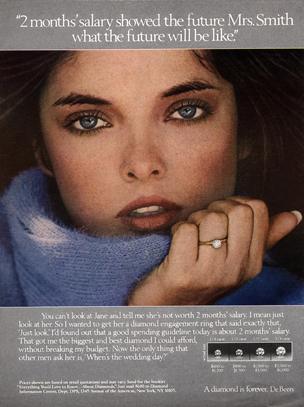
The Key Takeaways
Though we’d never promote manipulating the market, De Beers has shown how marketing can create value for even the tiniest products.
The art of persuasion is a delicate line to walk. Placing value on your product is essential; it highlights why it’s better than the rest. But you also need to make sure you’re not overselling or tricking consumers into thinking it’s absolutely essential.
Value proposition is key. What value are you offering your audience with your product, or what problem do you solve?
The tactics used in this campaign also emphasise how effective audience research can be. The more you understand a consumer’s needs, the more you can cater to them through your marketing.
Got Milk?
On a less sour note (see what I did there?), the other direction in audience engagement is to appreciate the one you already have. Retention is almost more important than acquisition, remember.
In 1993, one particular agency was preparing a pitch for a new client, the California Milk Processor Board, which had tasked them with boosting product sales.
A study before the pitch asked participants to go one week without milk – no Nesquik, no cereal, nothing. The absence of this household essential created an interesting (albeit strange) conversation; can we go without milk?
What followed was an advertising campaign that took the country by pop-cultural storm. “Got Milk?”
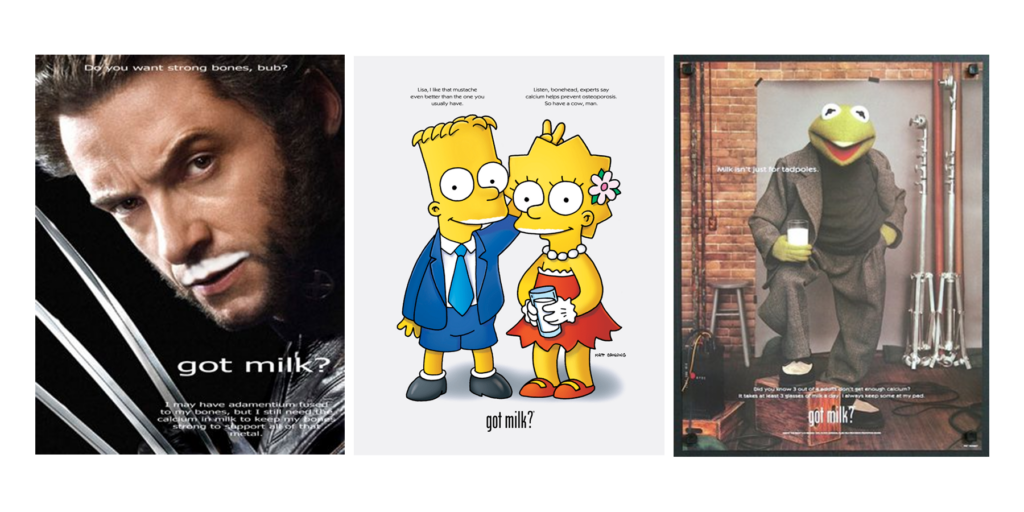
From The Simpsons to Wolverine, you couldn’t go a day without seeing the slogan. An estimated 80% of all U.S. consumers came into contact with the campaign.
The moral of the story? Simplicity sells. Sometimes all you need is a question, and the rest is history. Sure, you can argue that a product like milk is easier to sell than a diamond, but the uncomplicated way the ad presented itself was a stroke of genius.
From print to OOH campaigns, “Got Milk” was so simple you could place it anywhere and everywhere.
In one year, milk sales rose 7% in California alone, and the brand is still milking (sorry) the campaign to this day.
Key Takeaways
The “Got Milk?” campaign came out when active-audience participation was in infancy. Imagine the possibilities now with social media and digital technologies! If you need help in this department, we’re experts, so get in touch.
Keeping your campaign simple can attract a massive reach in audience numbers. Native content (especially on sites such as TikTok) can be a great example of how a simple question can lead to creative, viral content.
The campaign also shows how important it is to keep consumers already using your product happy and in the loop. The campaign didn’t engage people who weren’t drinking milk; it reminded milk-lovers that they needed a new bottle in the fridge.
Old Spice
So, we’ve looked at some campaigns from the past, but how have more recent(ish) campaigns used the digital world to create forever-lasting ads?
In 2010, Old Spice released a TV commercial with Isaiah Amir Mustafa. The ad has been seen over 60 million times on Youtube – whether that’s because of the ad’s quality or because Mustafa is a walking God is still up for discussion.
However, Old Spice took the commercial’s engagement and expanded upon it. Capitalising on the pop-cultural awareness of the “Old Spice Guy”, the campaign took on a new life via social media platforms.
Across Facebook, Twitter, and other social media platforms, Mustafa took on the spicey (sorry, again) persona, replying to fans with personal videos, even chatting to Starbucks about keeping toasty.
In total, the personalised videos reached 11 million views, with the brand gaining 29,000 fans on Facebook and 58,000 new followers on Twitter.
The Key Takeaways
Do everything to keep your audience engaged. A campaign can evolve into whatever you want it to be, and with social media bigger than ever, the options for creative marketing have only increased.
Think about how you can use the star of your ads to engage and communicate with your audience directly.
Celebrity marketing has morphed into influencer collaboration. Sites such as Cameo have found success through personalised celebrity videos – how can you, as a marketer, branch out, partner with celebrities and grab attention through the platform?
Research into who your audience engages with on social media – who are they following, buying products from and engaging with?
We have a whole study on whether influencer marketing can be the right move for your brand, which you can read here.
See you in part two!
Thought that was the end? We’ve still got plenty to discuss!
From the copy to an ad’s design – there’s still a mountain of campaigns to explore when it comes to the greats.
You never know; we might see you on a list of greats one day!
In the next blog in the series, we’re delving deeper into copy and how it can create the perfect ad. So, make sure to check in on our social posts for when the latest blog drops!
Until then, would you like to know more about audience research, its importance, and how it can improve a campaign’s conception? Get in touch with our marketing experts now.
Ever cried at a John Lewis Christmas advert? You’re not alone.
Adverts that incite emotion stick in our minds and create better ties between consumers and brands. Now that virtual and real worlds are colliding with the metaverse making its way centre stage, how can brands engage with the senses and connect with target audiences through virtual reality?
What’s already out there?
Before diving into the wonderfully weird world of the metaverse, pondering what senses brands are trying to utilise in virtual reality – let’s recap what’s already blended into modern technology.
Audio logos
Everyone’s familiar with the ‘dun – dun’ from Netflix or Mcdonald’s whistle. You don’t have to be in the room to know what’s on TV when you hear those ear-catching sounds.
Audio logos help strengthen brand identity and create a memorable ear-perience for the audience.
3D printed food
In a digital-first world, we’re going fully digital with our food. 3D printed food aims to replicate the taste and smell of real food. However, we’re still far off from large-scale production.
But it does make you wonder – are we more hungry for how it looks, smells and tastes rather than what it actually is? Food for thought, for sure.
4D film
The film industry keeps upping its screen game, from 2D to surround-sound IMAX. But I bet you’re wondering, “what if we could smell film?” – no, just me?
The film industry is experimenting with olfactory (smelly) effects – if you’ve been to a 4D movie showing, you’ll have experienced this.
From the basic, DIY aroma-scope scratch and sniff cards to 4D cinemas with moving chairs, water spraying and rushing wind, we’re seeing cinema make waves (sometimes literally) in creating that immersive experience.
These methods spark excitement for the future of 4D adverts. How could additional sensory elements create that emotional connection between audience and brand?
Haptic technology
Haptics refers to touch and motion, and we’ve seen more haptic technology integrate into our daily devices.
For example, mobile phones use haptic feedback when rearranging apps on your home screen or vibrate when someone’s calling.
The latest PS5 controllers now include haptic feedback, which tightens triggers depending on an action such as pulling a bow or breaking in a sports car. Meta is also trialling haptic gloves to add a tactile connection between brands and metaverse goers.
These hands-on approaches (had to be done) to user engagement are still in their early stages. But imagine the possibilities with further experimentation; audiences could interact with brands and products through an infinite toybox of creative.
3D ads
And speaking of early stages, we’re currently on the cusp of experiencing a new era of interactive ads. 3D ads are making their way onto social media in Meta’s latest update. Working with VNTANA, a social augmented reality company, Meta will enable brands to bring their products to life on Facebook and Instagram.
For brands, particularly e-commerce, this presents a major opportunity to showcase products accurately to potential customers, increasing engagement and improving customer satisfaction. This update foreshadows what we can expect advertising in the metaverse to look like, with technology evolving to give users that real-life experience in a virtual setting – browsing a catalogue, for example.
The importance of experience
Experience plays a vital role in advertising. The brand experience revolves around the consumer’s sentiment for a brand and ‘the lasting impression’ they have towards it.
Widen argues that brand experience is more important than user experience as it facilitates deeper connections.
If you’ve ever had a bad experience with a brand, you’ll likely remember that for a lifetime. Emotions and experience can be more important than the product or service itself, influencing decision-making overall.
Consider brand experience carefully. CSR (corporate social responsibility) is a massive factor in consumer perception of a brand.
72% of consumers want brands to be positive contributors to society. Brands that passionately believe in something and shout about it from the rooftops will often connect better with their audience than brands that don’t live, breathe and deliver on their ethos.
Beauty product retailer LUSH pulled out of social media, aligning its online behaviour to its message of rest and relaxation. LUSH created an emotional connection between consumers and the brand as people saw it as a brand sticking to its core values.
Have you ever stopped to wonder why most service businesses (hotels, airlines and restaurants etc.) talk about the experience rather than the end product? According to Gartner, psychology and emotion are arguably the essential elements of a customer’s buying journey, with community also playing a key role.
You could even go as far as to say that customer experience is becoming the new brand identity. A study conducted by PwC found that ‘59% of all consumers feel companies have lost touch with the human element of customer experience.’
Bringing senses and emotion into your marketing strategy allows you to reach your customers efficiently and creates long-lasting connections that promote brand advocacy.
The power of emotion
Speaking of connection, let’s chat about how emotions affect purchasing decisions.
31% of advertisements are emotion-based, not rational, which highlights how emotions have a giant impact on purchasing decisions. In fact, ads with purely emotional content perform twice as well as those with only rational content.
Tingling the senses is a uniquely engaging way of bringing about an emotional response, with sound being particularly effective at sparking emotion. On TikTok, for example, sound-on content is perceived as ‘fun’, a 66% increase in this emotion compared to platforms that don’t use sound.
But how does this translate to connecting to your customers? For example, as with LUSH, being authentic with your brand values is crucial.
Authenticity boosts connection, especially on social media. According to The Drum, ‘being imperfect on TikTok creates intimacy between brands and their audiences, and builds a relationship driven by respect and understanding’.
Why is sense so important in the metaverse?
If the goal is to create immersive experiences, the metaverse needs to look, feel and sound like real life.
Reducing the friction between the real and the virtual helps users interact more authentically, as they would in the real world. This will help brands plan their advertising strategy in the metaverse, as virtual personas should mimic real-life personas.
We all know that sound is paramount when recalling a brand or experiencing the internet. Kantar found that ‘88% of TikTok users said that sound is essential to the TikTok experience’.
But what else is a must in creating a memorable experience? Will smell and taste be the newest features implemented into the metaverse?
How is the metaverse planning on tingling our senses?
Alongside sensory logos, we’re seeing wireless VR headsets throughout the industry, allowing for even more freedom in virtual worlds.
Playstation recently announced VR 2 for PS5, with MetaQuest, Meta’s wireless headset, allowing for even more immersive engagement as users can move freely, mimicking real-life movements.
VR is constantly evolving to give consumers what they want while learning from them. We’re looking at a future of emotion tracking, creating realistic digital avatars through biometric data.
Get involved!
We recommend experimenting with these new technologies as they emerge.
We’re seeing people’s curiosity about the metaverse peak; it’s already big business. VR gear sales are likely to hit $10 billion by the end of 2022, and the expected number of headsets sold could reach 26 million units by 2023!
More and more people are ready to explore the metaverse. And with accessibility in virtual reality improving, there’s a whole new audience awaiting adverts in the metaverse.
What do you need to know?
The metaverse offers an exciting glimpse into the future. How brands begin to advertise in the virtual world is an exciting and slightly daunting prospect for some.
It all comes down to really understanding your audience and the space where they are. What are people doing in that virtual world, what are they interacting with, and how are they communicating with other metaverse goers?
More importantly – how can you form that emotional bond between brand and consumer and connect as you do in the “real” world?
Without a doubt, the metaverse is in its infancy as a marketing and advertising channel, but the potential is huge, with all brands being able to make their mark on the space with the right strategy.
Be sure to watch this space, as we’ll be reporting the latest updates regarding the metaverse over on our blog!
But if you’re rearing to get started on maximising your digital advertising campaigns, contact our paid media experts about your strategy right now.
Just in case you’re no sports fan (or Britishly biassed towards real football), the Super Bowl is the annual playoff championship of the NFL.
However, as important as the big game is, the massive amount of ads playing across the commercial breaks are what we’re placing on the field to compete today.
The average cost for a 30 second Super Bowl commercial for 2022 was a whopping $6.5 million! No doubt the brands advertising have the cash to splash, but are they making sure every second counts?
So who came out creatively on top and who missed the goalpost and flopped? Let’s kick off with the champs to give you some ideas of what you should include in your adverts for jaw-dropping campaigns that convert in an instant!!
Bronze ain’t bad!
Including celebrities in Super Bowl ads is a tried and true method – however, there’s a balancing act between using them efficiently or just “celebrity stuffing” for the sake of it. And we know not everyone has the budget to get Nicholas Braun or Trevor Noah in their ads.
Uber Don’t Eats is a tongue-in-cheek campaign in which celebrities such as Jennifer Coolidge struggle to grasp the delivery services expansion into household shopping.
If the silly “does that mean I can eats it?” line doesn’t make you chuckle, perhaps Gwyneth Paltrow tucking into a vagina-scented candle for dessert will.
Uber’s campaign highlights its new service in such a ridiculous way; it’s hard not to enjoy recognisable faces confused and chomping into lightbulbs.
Uber Don’t Eats has gained a ton of engagement across platforms, with 547,156 views on Youtube and a 19k reach for its hashtag #UberDontEats.
The runner up
Emotionally engaging your audience is no easy task – especially in under a minute. But, it is key to building brand awareness and driving conversions.
Research by Pringle and Field found that emotional campaigns outperformed on almost every metric – including revenue, profit, and share gain.
Toyota’s Brothers campaign places you in the perspective of Winter Paralympian Brian McKeever and the hurdles he and his brother have overcome and dominated throughout their strong bond.
Utilising a point of view (POV) angle throughout its ad, the audience immerses themselves in the cold, uphill challenges the brothers have faced, with their hard work resulting in 13 gold medals throughout the Winter Olympics.
Through a focused, people-first approach rather than product placement, #StartYourImpossible resonates on an emotional level rather than a persuasive one. Clearly, an effective strategy, as the campaign gained a 351.9K reach across social media platforms.
The Gold Star goes to…
Someone give a shiny star to Squarespace for its sweet spot about slippery tongue twisters and shelly services!
Sally’s Seashells encapsulates everything about owning your own business – the struggles, the solutions and the brand expansion, with Squarespace representing itself as the best place to start.
Through whimsical wordplay, alongside electric editing, colouring and direction (from legendary director Edgar Wright), the ad is visually striking for the eyes and audibly engaging on the ears.
Squarespace does what all great ads do and presents itself as a distinctive, timeless classic that will never get old.
Sally’s Seashells washed in over 8,666 tweets and 101,027 engagements for Squarespace.
Having one of the most noticeably talented celebrities in your ad doesn’t hurt either; Zendaya’s inclusion brought in 10,431 tweets and 108,335 engagements. Shucks, that’s a lot!
Sally’s Seashells is a perfect example of how keeping things short, sweet and simple can still make an engaging ad. Playing on familiar themes and concepts can be a great way to attract large audiences; it’s how you creatively separate yourself which is key.
Ads that missed the mark
Not every campaign hit a home-runner (wrong sport, sorry).
The last thing brands want is to waste budget on ads that don’t wow. Researching your audience and what tropes, celebs and ideas they resonate with is key to planning your stellar ad.
It’s worth mentioning that you need to understand what sub-cultures your audience operates in and make sure they’re represented accurately in their advertising.
According to We Are Social, 82% of internet users say they’re not represented in advertising. Although social media ads are better, there’s still a way to go, with only 55% of GenZ saying they feel represented on social media.
Long story short, your ads need to represent both your brand and your audience.
Here are the ads that just missed the mark when it came to their creativity and brand representation.
MetaQuest 2
Meta (known by boomers as Facebook) needed to bring something extra engaging this year to the Super Bowl, following its hot water controversies regarding safety and privacy.
With the release of its new VR headset, MetaQuest 2 (previously known as Oculus) underway, you would imagine the self-proclaimed leader of the internet’s new meta-age would be ready with something awesome. We got this campaign instead.
We were “treated” to animatronic animals (giving off very Five Nights at Freddie’s vibes) that would keep children awake for hours on end.
On top of that, Meta’s message seems muddled – is the world getting you down? Escape reality through our brand new headset! Very dystopian; probably not the wisest statement to make when the world has just come out of a global lockdown.
Unlike Toyota’s brand message of being the best you can be, Meta presents itself as a brand that wants to escape real-life issues. A sentiment augmented reality products might want to avoid.
We’re guessing Meta didn’t consider how their audience would feel about this message when they made this ad. Like we said, understanding your audience and how they behave or represent themselves is key.
Remember The Sopranos? I remember
Nostalgia is like keywords; use it too much, and your content won’t feel genuine.
Chevrolet’s First-Ever Electric Silverado campaign is an almost shot-for-shot remake of The Sopranos classic opening, with the music adding an extra topping of “remember this show?” to the ad.
Creatively, the ad misses the mark in adding something new to the discussion. After watching, I don’t feel like buying a Chevrolet; I want to watch The Sopranos for the 5th time.
Though personally, the campaign’s lack of originality didn’t engage us creatively, the 11,589,824 views on Youtube don’t lie. Nostalgia and pop-cultural references will always strike a chord with audiences.
There were plenty of meh-marketing moments throughout this year’s Super Bowl. Instead of focusing on what went wrong, the key takeaway from these campaigns is making sure your brand’s message is engaging.
No matter how big your brand is (from Taco Bell to Toyota), you have to hook your audience with something they’ll remember.
Squarespace’s tongue-twister and Uber Eats’ silliness; these ads stick out because of their straight-to-the-point originality – not relying on other media or muddled messages.
If you’d like to see how other campaigns kept the engagement levels strong throughout the Super Bowl, check out our blog on last year’s big game here!
Who won the Super Bowl? Crypto!
Though these choices were our personal highlights, the digital currency, crypto, won over the most eyes at this year’s Super Bowl.
Coinbase reportedly paid $14 million for its 30-second ad at the big game. The ad itself was simplistic but super effective – with a multicoloured QR code bouncing around the audience’s TVs like an old-school DVD screensaver.
Simplicity sells, sometimes too well; Coinbase’s website crashed during the broadcast – showing how large the crypto climate is right now.
FTX’s, Don’t Miss Out on Crypto campaign (featuring the king of cringe, Larry David) has gathered an insane 40,342,366 on Youtube too.
Is crypto the new hot-topic marketers should be dipping into? Perhaps people enjoy pretty moving squares and Seinfeld more than anything? Either way, cryptocurrency is booming; we’re spending $6.8 billion annually in digital payments, according to We Are Social.
We’ll be sure to keep you posted on all the news we hear about digital currency developments here.
Key Takeaways
From crypto to Kanye to seashells by the sea, the super bowl commercials this year showed off a variety of distinct creative.
In a world of ongoing social media campaigning being the new norm, it’s crazy that the return on investment (ROI) for televised ads is still going strong.
“According to Kantar research, the 2021 Super Bowl ads delivered an average return on investment (ROI) of $4.60 per dollar spent, with ads for Mountain Dew, Verizon, T-Mobile, and General Motors achieving the best results.”
These ads will only become more effective with the rise of social media – with native content such as memes and TikToks furthering a campaign’s reach through user-generated content.
But the key is understanding your audience and testing your adverts on your users, so you know whether your ad will hit the mark – whether it’s on the big screen, on mobile devices or in a game.
If you’d like help supercharging your campaigns or want further advice on how to make your creative stand out against the rest – contact our team of experts now.
Today, we’re taking a look at some of Reddit’s /r/Movies favourite marketing campaigns!
From Augmented Reality to cryptic puzzles – there’s a lot to take inspiration from here. We’ll be breaking them down, digging into the nitty-gritty and looking at what makes these campaigns tick!
So, get your popcorn, grab your overpriced fizzy drink – the movie is about to begin…
The Matrix
Everyone by now has heard of the Matrix and its mind-bending, thought-provoking sci-fi madness.
However, this wasn’t the case before 1999, and I doubt many could have guessed its incredibly conceptual idea at the time. Its craziness only increased the enticement of the question: ‘What Is The Matrix?’
The trailers consisted of a montage filled with intriguing shots, with exciting action scenes revealing as little as possible. The intense trailers alongside the tagline ‘What is The Matrix?’ was enough to hook viewers.
It’s a clever technique to propel audience participation by asking the simple question, “What Is The Matrix?”. By repeating the question themselves, the watcher creates their own CTA to find the answer.
And as we know, “What Is The Matrix?” created endless discussion and hype around the final release.
As Reddit user JynXten describes it:
“It was very mysterious and secretive, I recall. Everyone wanted to see what it was all about and when we did, our minds were blown.”
Scream
From fake TikTok accounts to a collaboration with Call of Duty, Scream has had some immersive (and spoooooky) marketing campaigns. But let’s look at the OG from 1996 for a moment.
In the 90s (and really all of the time), there was an impressive display of lead roles in massive Hollywood blockbuster films. So Drew Barrymore getting cast as the lead in Scream was no shocker.
Along with an extensive marketing campaign presenting Barrymore as the main character, most moviegoers would believe that by horror film standards, she would have most definitely lived to see the end of the film.
That prediction became swiftly slashed when Drew dropped dead during the first 10 minutes of the film. A great example of subverting expectations.
Reddit user ProphetOfNothing states:
“Killing your leading lady just 10 minutes into it created a brilliantly tense thriller where the characters LITERALLY know the “rules” of horror film logic, yet we are now aware they aren’t going to apply.”
Cloverfield
Going through this list, you’ll quickly notice that either Reddit has a great fondness for monstrous films, or these fear-fanatics really know their stuff!
Cloverfield released no context to the shots of the Statue of Liberty head crashing into the NYC roads, which intrigued audiences all the more.
Cloverfield’s entire digital campaign was shrouded in secrecy, with audiences having to hunt for more information across the web. It’s one of the first examples of an alternate reality game (ARG) making waves across the internet.
As user Alvadeso explains, there wasn’t “even a real title, just a release date. I really thought it was a Lost spinoff or a Godzilla movie.”
Marketers intrigued by experimental campaigns should strive to create interactive narratives for their content. There’s an opening of opportunities right now with AR lenses on TikTok, new text to speech sounds, and cryptic social media easter egg hunts.
Men In Black
The beloved first film in the series was an instant hit (I mean, it’s a Will Smith movie), and the marketing team certainly capitalised on its success.
As user 5N4K3ii says:
“They used a clever nod to in-world tech designed to wipe character’s memories in the film and showed it in ads a few weeks after the film’s successful release” – accompanied by the tagline, “Men in Black: see it again for the first time.”
It’s interesting to think that most of the time, the objective of a film’s campaign is getting audiences to see the movie for the first time in cinemas or on an OTT platform.
However, we can comparably use similar techniques to get users to watch the film in the cinema for the second time; or get fans to watch the movie at home on streaming platforms again.
Jurassic Park
The Steven Spielberg classic could do with a blog of its own for mega-monstrous marketing techniques.
Though many remember Jurassic Park for its brilliant tagline, “65 Million Years in the Making”, there were other ideas the studio tried implementing into the campaign.
One of which was described by Eulielee:
“Around here, there were several billboards that got ripped up pretty bad. I remember thinking, wow, looks like some sort of monster clawed that up.”
The following week, they replaced the billboards with Jurassic Park adverts. Clever girl.
This example is a fantastic insight into how you can use real-world events/placements to drive traffic for your film in imaginative ways.
No matter how far into the future, OOH marketing, much like life… uh… finds a way. Though we may be in trying times, with social media marketing taking the forefront – the possibilities of practical, extravagant advertising will always have a place in our hearts.
Nightcrawler
Using a similar technique that the new Scream movie uses, user Shamgod remembers fake social media accounts created for the sociopathic protagonist of Lou Bloom, detailing his climb up the professional ladder by any means necessary.
These accounts included a video CV posted on Twitter and Linkedin and was great for getting “the audience immersed in the film before it was even released.”
The Ring
This list wouldn’t be complete without one last horror film to top it off. For the US remake of The Ring, the marketing team created both horror and intrigue at the same time, as user EnemySoil says:
“The Ring played parts of the ‘video’ as an ad on TV late at night without any other info.”
I won’t lie to you; that ad still keeps me up at night. It gives the viewer the sense that they’ve discovered something almost they shouldn’t be seeing and would reactively promote word of mouth through friends and family.
Key Takeaways
It’s interesting to think about how new releases can capture the classic methods of old-school movie marketing.
Social media has changed a lot since the days of MySpace and Cloverfield ARGs. But films such as Scream 5 are keeping this experiential marketing alive with their social media narrative campaigns.
A good trailer can be imperative, as evidenced by the success of The Matrix, The Ring, and Men In Black. Remember, keeping the big twists and turns for the theatre is always the right way to get audiences into those cinema seats.
We revel in the opportunity to talk about classic films. Looking through these campaigns can inform new, exciting decisions that inspire our movie campaigns.
Until our sequel, if you’d like advice on how to market your film or are looking to increase campaign engagement – contact our movie marketing experts here.
The creative economy is bursting with opportunity as we dive into 2022. But why is it better than ever?
There’s a lot going on right now – from pandemics to changing privacy regulations. Traditional marketing techniques have never been trickier to implement. Because of this, creative content-makers and marketers have turned elsewhere: social platforms.
Welcome to the new(ish) world of social media and subscription-based marketing – where all your advertising needs are a click away and then some!
Let’s take a look at why 2022 is the year of creative
Who me? I’m a creative
More than 50 million consider themselves content creators now. Though platforms such as TikTok may have started as a fun time-passer in the insanity of isolation, users have found they can maintain a full-time career through it.
That’s no number to scoff at, and clearly, social media platforms are eager to get involved. Investors have poured $1.3 billion into social ad space – TikTok leading the creator fund money flow with $200 million and making waves across the platform as a result. The more empowered content creators feel the more social media channels will flourish.
But what do you really need to know when it comes to the current state of the social media space?
- Snapchat spent a whopping $250 million in 2021 for creators to exclusively use its feature, Spotlight.
- Meta announced an investment of $1 billion for further creative opportunities on its platforms.
- 58% of users say that in the next 12 months, [they] would pay a monthly subscription fee between $1 and $15 to access their favourite creator’s exclusive content.
The key? Not only are brands investing in social media advertising, but they are also eager to splash the cash for your content on their PVOD services. Until that spark dies down (if ever), it’s a vital area you should consider getting your content on.
Right now, the big dogs are barking-mad for your creative. Whether you’re an independent influencer or brand, you should be focusing on making top-quality content that catches the eyes of those looking for exclusivity.
But…
The questions are, how long will these massive platforms keep dishing out the big bucks for content creators? Will we see more creator exclusivity, or are we heading into a free-for-all if creative funds decrease?
No matter the change, what’s vital is you grab a notepad and start taking notes on how influencers interact with audiences.
It’s not enough to throw out the same content again and again; independent influencers strive to create unique and distinct content almost daily, and you should too!
If you’re looking for a good starting place when it comes to making native content that hits big on the top social media channels, you’ll love all our bite-size sessions. They’re filled with tips and tricks on when to post, what to post and how to best engage your audience.
Bring in the brands!
For all you indies out there, big brands are still bursting with advertising potential for you to grasp.
According to Influencer Marketing Factory, 31% of creators cited influencer marketing as their main source of income. We’re seeing even the biggest of brands trying to naturalise native content onto social media.
If Spider-Man can brand itself as a TikToker, why can’t smaller businesses? Marvel’s campaign wasn’t as flashtastic as the movies; it didn’t need to be. What’s essential is that you don’t make ads – make TikToks!
Whether it’s business updates, a funny clip from the office or an impromptu Q&A, keeping the conversation going with your audience will only spark traffic and brand engagement.
Easy-peasy, NFTeasy
We couldn’t talk about creative expansion without mentioning the rise of non-fungible tokens (NFTs).
NFTs are unique, digital purchases – ranging from images, videos or artwork. When you purchase an NFT, it’s yours and yours only.
The newest crypto-craze seems to be popping up everywhere. From TikTok stars like Addison Rae to the real Slim Shady, Eminem, purchasing “Bored Ape #79” for roughly £334,000.
Though it’s yet to be seen if this latest fad will maintain its hype throughout 2022, the ability to sell creative digitally not only makes sense in these socially distancing times, they’re also pretty easy to make and distribute.
The Absolute Essentials
Whether you’re TikTokking, blogging, or NFT logging – strategising your creative is an absolute must! Here are our top tips to try out through 2022:
- Fitting in
Your creative on Instagram isn’t going to be the same as on Reddit. Your content needs to embed itself naturally onto specific platforms. Keep track of video length, tone of voice and assets for each service you’re testing stuff through.
- Keep with the times
Being yourself will always be important, but if yourself is a flat-Earther who hates dogs, memes and everything in between – you might need a brand check-up. Gen Z takes up a massive chunk of social media, with 76% of its audience desiring a brand accepting equality in ideas, cultures and experiences.
- Don’t go OTT with your OTT
Though creativity comes from a mindset with no limitations, the annoying reality is we have to schedule our content. If OTT services such as Youtube have taught us anything, it’s the algorithm that’s in charge. Always research the streaming services you intend to publish content on – whether it’s copyright laws, peak times of engagement or just the latest trends.
Keeping up with the latest platform trends is essential. We can help with that! Click here to see our ongoing updates on all the hot goss across the web.
Stay happy!
Algorithms? OTT? Gen Z? That’s a lot to remember – when can I get back to the creative stuff?
Whether it’s the making or marketing of creative, though rewarding, it can be insanely stressful at times.
In 2021, a Vibley survey found that 90% of creators experienced burnout, and 71% even considered quitting altogether – we don’t like that one bit.
Sometimes, the best thing you can do for yourself (and brand) is stepping away for a moment and enjoy the creative work of others – much like ours right here (wink wink). But more importantly, don’t overload yourself; keep in contact with other creatives and reach out. Now more than ever, keeping together is a must.
Until next time, if you’d like help kicking off a creative campaign or want insights into the social media marketing realm – contact our creative team.
If memory serves me right, I think we’ve briefly touched upon how huge TikTok is right now. Just kidding, we’ve been shouting it from the rooftops! The creative and marketing techniques the platform offers is like none other in the social media sphere, skyrocketing audience awareness regarding brand and product discovery.
But today, we’re taking a different angle and delving into the realm of small and large, the mini and massive. TikTok doesn’t solely catalyse engagement in products; it also heightens the reach of film releases and movie mania. And with the return of cinema right on the doorstep, it’s time you get acquainted with TikTok’s film ad space posthaste!
Looper
TikTok itself puts how the platform works best in its blog:
“TikTok is entertainment that connects. We like to think of this as “community-generated entertainment.”
Content creation on TikTok is unique. It tells a story by putting users at the centre and allowing individual personalities to flow through their videos, especially when it comes to film. From reacting to recreating, theorising and parody – the possibilities users have to preach their passion for film has a potential view reach of 88 billion (but that figure’s probably already started to climb, so don’t be surprised if you’re seeing even better results).
Also, the creative strength of a user’s video alone means that even if audiences are unaware of references related to a film, it can still be successful. For all you movie marketers, the extra step in content creation is making sure the audience knows you’re promoting your film without your video feeling unnatural on the platform.
Like all content on TikTok, community-generated entertainment (CGE) surrounding film loops and loops and loops and – you get it. If it’s a brand new campaign or spliced clips from a trailer, you need to keep it snappy and engaging throughout. Keep your audience on tenterhooks, wondering what’s going to happen.
Luckily for advertisers, TikTok knows all about making it big on the platform and even provides a range of editing tools and techniques to dig through. Short, sweet and on repeat – that’s the motto we keep to on our TikTok page; we recommend you do too!
With 52% of TikTokers discovering something new and 69% co-creating, there’s no doubt TikTok amplifies ideas and stories into an endless loop of virality. So get creating, snipping and hashtagging!

Get me pictures of Spider-Man!
We see the stats; now we need to spice up the stories – but who do we turn to for inspiration? Not all heroes wear capes, some sport spandex. Now being the top sixth highest-grossing movie of all time, Spiderman: No Way Home swung into the TikTok realm to show us how great campaigns can web in a big audience.
Out of all of Spider-Man’s nemeses, The Daily Bugle still stands tall. Once a print-based newspaper, Sony decided to take the Bugle to TikTok with a more recognisable video-based format for its audience.
The Bugle’s TikTok account is set within the Marvel Cinematic Universe, acting as a link between the real and fictional. Its posts vary from interviews with Peter Parker to the legend himself, J. Jonah Jameson, ‘calmy’ calling out Spider-Man.
Though the return of J.K. Simmons was enough to hook us in, the content itself is not only in-line with the franchise’s tone; it also feels naturally integrated into TikTok’s formatting. Additionally, Sony went one step further and provided users with a link to the backdrop used in the videos, allowing the audience to create their own news stories – leading to even more CGE.
The campaign clearly resonated with users, as the page totals 1.4 million followers and is gaining up to 6 million views for some of its content. Though there’s likely a lot of production value behind it (it’s Sony, Disney and Marvel we’re talking about), this campaign highlights how you don’t have to go ‘big’ to bring in an audience.

Boo!
So what tactics can we apply to our TikTok campaigns if we can’t splash the cash and get hold of an Oscar-winning actor? One answer could be through Augmented Reality Games!
ARGs are interactive narratives used across online platforms to create a unique story that ties into the movie’s world. They are a fantastic way to spark discussion around a brand or film whilst also being a distinct piece of content itself.
Creating immersive, online experiences for users is nothing new – 2008’s Cloverfield took the internet by storm with its fake websites and hand-held footage being difficult to debunk back in the old days of web-browsing. However, with the rise of social media in the last few years, you don’t need a domain to create an ARG, just a really engaging story.
Paramount Pictures marketing team got socially spooky as Ghost Face returned for the latest instalment in the Scream franchise. Through TikTok, they created the account (and person) @TooBrAshSarah, who appeared to be an average teenager living in the fictional town of Woodsboro.
However, as the posts continued, things got a bit darker, with ghostly images appearing in the back of her videos; and a final post implying Sarah never made it to her friend’s party…
Though it didn’t bring in those massive Marvel numbers, the account has attained over 30 thousand likes and got both old and new fans of horror excited for the next chapter in the Scream brand.
The key takeaway here is that you don’t need extravagant set pieces or a big budget to engage users – you need to be creatively distinct. It’s not about making ‘ads’; it’s about making a piece of media that holds up on its own. We have a whole blog on how to make TikToks that stand out, which you can read here!

Stay Tuned!
TikTok isn’t going anywhere anytime soon. If anything, it’s shown us time and time again how important it is for the future of paid media and marketing in general. It’s no longer an option but a necessity for entertainment marketers.
We’re firm believers of experimental creative, and as new platforms develop as a space to advertise naturally, our interest to get even weirder with it increases.
We want to see all you filmmakers out there putting passion into your social media campaigns! We’d also like to share with you our Bite-Size session all about triumphantly owning the TikTok realm (popcorn sadly not included) – click here for the tips.
Until our next movie outing, if you’d like advice in giving your creative campaign the spotlight it deserves; or want further advice on social media strategies – get in touch with our team of experts now.
2022 is already shaping itself as an innovation station in the OOH (Out-of-Home) advertising space. Rewinding to 2021, we saw some uber-creative campaigns that stopped people in their tracks.
One stellar example was SONY’s PlayStation 5 campaign, which took home the winning trophy for The Drum Awards Out of Home Award. The campaign took over the London Underground, collaborating with stakeholders to place their recognisable symbols all over London.
We’re expecting to see a lot more creativity shine through in 2022 as consumers return to work, use public transport to commute and generally get back into the swing of things outdoors. So, with that in mind, here’s what we predict will be the top OOH trends this year.
From OOH to DOOH
Before we go any further, what is OOH and DOOH? No, it’s not just something Homer Simpson says. DOOH refers to Digital Out-of-Home advertising, whereas OOH skips the digital. You can think of OOH advertising as your traditional billboard advertising; on bus stops, buses etc.
DOOH, on the other hand, refers to outdoor advertising that can be controlled digitally and powers up through data. It’s also usually more segmented and focused on a particular consumer. For example, if it starts to rain in London, DOOH advertising could incorporate this into its design or messaging, such as an ad for a local cafe suggesting to ‘Not let the rain ruin your lunch – we’ve got warm sofas and even warmer soups’.
Although there’s something charmingly distinct and novel about traditional OOH, DOOH offers vastly improved flexibility, enhanced creativity in advertising (think virtual reality, QR and quizzes), and additional targeting features like geo-targeting. All this makes DOOH a Dooh-brainer (sorry), and we’re sure to see brands utilising it in 2022.
DOOH advertising will be majoritively programmatic
Just as you were beginning to get to grips with the concepts of OOH and DOOH, they lob another spanner in the works – programmatic DOOH.
Programmatic DOOH is similar to how digital media buying works; it refers to the buying and selling of ad space.
We predict programmatic DOOH to become the norm in OOH advertising. The ability to optimise campaigns in real-time and manage ad space budgets provides brands with a real advantage when connecting with their audience, with the bonus of reducing their ROI; it’s the best of both worlds.
Omnichannel approaches will come out on top
You won’t make it far if you’re just advertising through only one medium. It’s vital you use a broad media mix to connect the dots in the user journey and make your brand more memorable for your consumer; that’s the essence of omnichannel marketing.
Due to this blasted pandemic, it’s now more important than ever to adapt your approach at the flick of a switch. One minute, people are out and about, seeing your ad on a billboard; the next, they’re stuck indoors for seven days with nothing but Google and blankets to keep them company.
A flexible omnichannel approach will ensure that you don’t waste your ad spend and that your ads get seen, even when people are back indoors. If your customers experience a seamless interaction with your brand across an array of platforms, they’re more likely to buy into your products. An omnichannel approach is all about boosting brand recall and facilitating the journey to conversion for your target audience.
OOH will branch out
Speaking of being flexible, OOH’s is about to branch out. Historically found in towns and cities, we expect OOH adverts to pack up and follow the consumers – out of the city.
We expect to see DOOH campaigns crop up in smaller towns and villages, especially on the outskirts of cities, as people benefit from the work from home schemes and opt for areas with cheaper living costs. For advertisers, this means rethinking strategy, placement, location and demographics as places start to change.
Just like the entire world, we’re dreaming of going on holiday this year, which means we’re likely to see the OOH market really take flight in airports.
What better way to target your consumers than when they’ve got hours to wait for their flight? If you know enough about your consumer and their destination, you can make big brain moves with your programmatic DOOH strategy. Flight delayed by an hour? Why not send them to the app store to download your latest game or your website to stream the hot new film right now. Know they’re going to arrive just before dinner? Let them know the food will be ready by the time they touchdown; that’s a good enough reason to clap as the plane lands!
The key? The possibilities are endless, but it all boils down to how well you understand your audience and whether you can predict their behaviours in certain situations.
OOH will help to deal with the death of third-party cookies
We’re all dreading the day third-party cookies bid farewell to us. It tugged so hard at the heartstrings that we’ve already written a blog on how you can make the most of your data and mitigate the effects of the cookie crumbling. But now you must be wondering – can OOH whip up something just as delightful in the advertising kitchen to help overcome this challenge?
A study by JCDecaux discovered that OOH priming (exposure to an OOH advert) resulted in the same awareness level as with third-party cookie retargeting. When primed with the OOH ad, brands achieved a CTR (click-through rate) similar to the CTR produced from cookie-based targeting. The study shows how OOH advertising is a powerful tool for boosting brand recall and providing that omnichannel experience.
AR wearables will facilitate interaction with OOH adverts
Whilst we’re on the subject of turning up the dial and zooming into the future of all things digital, we predict augmented reality will take off in the advertising world this year.
AR has increased heaps and bounds in popularity in the last couple of years, and now we’re looking at a future that combines advertising with AR. If you’ve heard of The Zuckerberg’s plans for the Metaverse (who hasn’t?), then you’ll know what we’re discussing here. But while the Metaverse is still yet to launch, our sights are set on highly interactive billboards.
We’ve already seen technology and OOH advertising amalgamate with innovations like QR codes and interactive design, so why not AR? As more and more people immerse themselves within the AR and VR realm, we predict it’ll become more accessible and integrated into everyday advertising.
Why wait around in the mundane real world when there are prototypes for AR wearables right now, such as AR glasses. It might be a long shot, but we’re not ruling out the possibility of clickable links at the blink of an eye and other purchases made through these smart lenses.

The future looks… Digital (Woah, that’s pretty deep). But we’re excited about the innovations that’ll spring up in OOH this year. One thing’s for sure – OOH advertising still has a place in this digital-first world we live in, plus it might even be the solution to a cookie-less future.
However, we don’t suggest you rely solely on OOH. You still need to streamline your ads across platforms to keep your consumers moving through the funnel. If you need help building your omnichannel advertising strategy, get in touch now with our digital advertising experts.
Though life isn’t entirely back to being a box of chocolates just yet, at least we’re on track to good times being spent in the cinema once more. And with that comes the return of advertising on the big screen!
In 2021, marketers expected a Rocky-style comeback for silver-screen advertising, anticipating that cinema viewership will fully recover by 2025. We still have a few hurdles to jump through until we reach those glory days of cinema revenue, but we’re definitely on track.
Though most signs pointed to streaming and PVoD services bringing all the money in (and they definitely do), huge blockbusters screening exclusively in the cinema have made waves for ad revenue in the first quarter alone!
Chief Executive Officer of Digital Cinema Media, Karen Stacey, told The Drum:
“the cinema advertising firm is now on course to reach 95% of its 2019 revenues in Q1 alone.”
The Bondbusters
So, who do we have to thank for getting us back in the lobby? Bond, James Bond. In 2021, 007 brought in £96.5 million in box office revenue, which overall is an increase of 85% compared to 2020.
Our friendly neighborhood Spider-Man has also contributed to the box office comeback. Webbing in an insane £1.25 billion, No Way Home is now the sixth-highest grossing film of all time!
So, why is this? Asides from being exceptional movies (no spoilers!), both Universal Pictures and Disney took a huge risk having these films play exclusively in the cinema with everything going on right now. No Time To Die was the talk of the town across the whole of 2021, delaying its release several times so it could be shown safely on the big screen.
A large portion of this revenue has come from the younger generations. According to Simon Bevan, Chief Investment Officer of media buyer Havas Media Group, “Spiderman alone has already been watched by one-third of all 16-34-year-olds”.
Whether it’s because younger audiences feel safer attending in-person events or the pop-cultural impact these franchises have within the movie universe, the key takeaway here is the cinemas back kicking ass and chewing bubblegum.
With that, our desire to advertise on movie screens is rekindling, but since we’ve been away for so long, is there anything we need to consider before implementing our new advertising methods?
It’s All in the Advertising
The landscape of movie marketing is continuously changing. Take trailers as a prime example – older trailers tended to give away massive spoilers in their films, hoping it would spark interest, now trailers alter specific scenes to keep the big plot twists hidden.
The pandemic has changed the game regarding advertising, leading us to rethink how we present our ads to an audience whose eyes will be engaging with the big screen.
In the same discussion with Bevan, a noticeable prediction he discusses is longer-from ads striking back, with more upfront ads catering toward the younger demo. But with the younger generations being the money-bringer for cinema seats right now, the TikTok approach of engaging the audience fast and efficiently might be the best avenue to consider.
So what should we be showing in our ads? Perhaps we should leave the plot for the film playing after we’ve had our moment in the spotlight. Mark Alhadeff, a senior strategist at AMV BBDO, thinks data-led storytelling leads brands to build dry creative.
Looking at some of the most successful branded advertisements of the past – (meerkats and mustachioed 118 men spring to mind), traditional narrative comes second to the characteristics and overall tone of the ad.
If we’re trying to engage the audience emotionally, experimenting with our ad structure might be the best way forward. According to research conducted by System1, the annual John Lewis Christmas advert wasn’t “sad enough” to rank among its best with audiences – which relied on the classic structure of a short film. I didn’t shed a single tear, just saying.
What to do, what to do?
More than ever, it’s imperative we do all we can to keep the audience in their seats when our ads are playing, rather than making a quick trip to the concession stand or toilet.
After being stuck inside so long, we’re craving cinematic, shared experiences – ones that allow us to escape for a brief moment and immerse us entirely – that’s why cinema still stands strong.
Who better to take notes from than the cinema itself? Odeon Cinemas has recently revamped itself with the help of comms agency Elvis. Their Strategy Director, Camilla Yates, stated: “Communicating the positive effect that a cinema experience can have creates a purposeful lens with which to encourage people back into theatres.”
Perhaps the key takeaway here is to create adverts that emphasize the importance of being where the audience are in that exact moment; relaxed, immersed, and ready for a cinematic experience.
The question is, how are we going to achieve this? There’s no right or wrong answer; keeping to the solidified narrative structure in advertising isn’t necessarily bad – it just depends on your creative execution.
What is important is that you keep your audience engaged throughout. The lines of advertising have blurred since the rise of social media and the Gen Z takeover. However, if TikTok has shown us anything, it’s that people still desire distinct creative.
Go for the experience
The one thing cinema offers better than anywhere else is spectacle. The booming surround sound and crisp imagery, complemented by the total darkness of the room, create the perfect place to catch the audience’s interest.
We’ve seen a lot of changes to the cinema landscape throughout the pandemic (we have a blog covering it all you can read here), and we’re yet to see if these new predicted techniques are the best way forward.
But with the wise words of Arnie in our hearts, we’ll be back and shall keep you posted on all the changes we see to the cinema landscape as it unfolds throughout the year.
For now, if you’d like help supercharging your creative for the big screen or want further insights into the techniques that keep the audience engaged, contact our team of film fanatic experts now.
Ter-wit Ter-woo! Twitter recently published its Birdseye report on industry insights and emerging 2022 trends.
The report reveals all of the trending conversation topics of 2021, so brands can use audience insights to increase their presence, take part in the conversation and build positive brand awareness on the platform. So, what do you need to know?
We’re seeing a massive shift in how we communicate and the topics we talk openly about on social media. Long gone are the days of memes; we’re using social platforms to open up to one another, discussing authentic topics like wellbeing, equality, green initiatives and much more.
There’s real power in generating conversations around these topics on Twitter in 2022. It’s time to delve into it all and see how you can use these insights to inform your marketing strategy and take flight (bird pun) for the new year.
Let’s talk about our feelings
Jonathan Cohen, Content and Communications Director at ListenFirst, a social media analytics agency that researched into one of the Twitter reports, states that “focus on audience affinities, sentiment data, demographic information, and real-time trends” are key in 2022.
Brands need to dig deep into their audience’s interests and discover what they’re engaging with on social media.
Everyone’s chatting about movies
As movies take centre stage yet again with big releases, we’re seeing an increase in Twitter search for all things film and entertainment. There’s been a +301% YoY growth in followers on social media for film brands between 2020 and 2021.
If you’re looking to jump on this trend, you only have to mention film brands to boost your engagement. In fact, you can increase your YoY engagement by +28.4% by doing so.
When we start to analyse tweets about film and entertainment, we’re finding positive reactions. For example, ‘only in theatres’ tweets were trending in 2021, with a decrease in the level of fear between quarter 1 of 2021 and quarter 3 of the same year.
Our attitudes, behaviours and perceptions are clearly shifting as we (hopefully) move out of the pandemic.
We’re getting tech-crazy!
The metaverse is gaining momentum. There was an increase of +19,245% YoY growth of Twitter conversations around the metaverse (given it was a late 2021 phenomenon, this would make sense) and ‘virtual real estate in particular…
Inevitably, advertising space will soon get sucked into the virtual vortex. But with more and more mention of the metaverse comes more concern over digital ethics, with a reported increase of conversation around digital ethics of +32% YoY.
So how can you maximise your virtual advertising while maintaining integrity? What can you, as a brand, do to ensure you’re fulfilling your social responsibility?
The report suggests that ‘direct contact with brands and institutions through social channels helps digital citizens leverage their influence and demand a commitment to societal good’. That means getting your brand ambassadors, customer service team, and wider team on social media – communicating directly with your consumer.
You’ve also got to be transparent. In 2021, we saw brands take a stand for their brand values. Take LUSH and Apple, for example. Apple launched its iOS14 update centred around privacy, and LUSH boycotted social media as a nod to disconnecting from the distracting powers of social media.
Stands like this help brands showcase their values and help to align them with an audience that’s also passionate about the same initiatives. But remember, ensure that whatever you preach is aligned with your brand values and what your customers stand for – you can read more into this topic in our blog here.
We all want a little escape
The report attests that social media users’ behaviour toward ads and brands on social media are changing. People want a sensory experience, something to transport them to their childhood or that creates escapism reflecting visions of their future. Make your ads as engaging as they can possibly be. Make them immersive. Make them fun.
But, as we’ve mentioned with the previous example of Apple and LUSH, you also need to be socially conscious in your ads. As we shift from physical to virtual, it poses challenges to society – and we need to reinforce the importance of a ‘wellness-first transition’ to overcome the health and wellbeing implications of this shift.
Luckily, social media is evolving alongside these changes in user attitudes. With enhanced and ever-evolving targeting options, brands can ramp up their ads with interest-based targeting. Presenting your audience with ads that they want to see and that will interest them is a sure-fire way to boost your conversion rate. And if you’re able to tie in these interests with your brand values, that’s all the sweeter.
But how do people want to experience brands?
With the metaverse making its way into our lives, we’ve seen a greater demand for experiential relationships between brand and audience. We’ve already noticed this shift shape up through social media updates, such as the increased presence of augmented reality in social media advertising so users can experience the product and ‘try before they buy’. The future looks very meta right now.
Most social media platforms have jumped on the immersive advertising interrail, meaning there’s a way to create that interactive experience across your platforms.
Why not try out Snapchat’s AR, the TikTok lenses or Facebook and Instagram’s Instant Experiences feature? These are all designed to immerse your audience in your ads, whether it’s through full-screen takeovers or visual effects that users can add to their own content, boosting collaboration between brand and user.
Advertising creative has become more emotionally driven, impactful, and in line with the customer. By that, we mean brands are tuning into their audience more, understanding what makes them tick and what resonates with them positively and negatively.
Companies then work to tie those messages into their brand – which is what marketing has always been about, right? And using innovative digital technologies like virtual reality to tell stories and captivate in their ads only helps to strengthen the message.
In a nutshell…
In 2021, six key topics stood out:
- Wellbeing
- Creator culture
- Everyday wonder
- One planet
- Technology and life
- My identity
While some of these trending topics won’t come as much of a surprise, we wanted to quickly dive into the ‘everyday wonder’ topic that surged in 2021. Last year saw a +33% growth in conversation around this, particularly focusing on a ‘need for meaning at a time of uncertainty’.
Likely brought on by the pandemic and emergence of the metaverse, we’re seeing a demand for imaginative escapism. Throughout the pandemic, households have flocked to streaming sites. Three in five UK homes signed up for streaming services in 2021, and we’ve written lots of blog articles about this increase in home cinema – (like this one).
We’re now seeing audiences seek out something a little weirder, demanding a mix of augmented reality, real-life and nostalgic experiences. Fingers crossed for smell-o-vision this year.

What do we recommend?
- Continue to listen and adapt according to your audience. Otherwise, you run the risk of tone-deaf marketing that falls flat.
- Conduct deep-dive audience research – so you’re not just reliant on third-party data (although social media reports are a brilliant place to start!)
- Reassure your audience in your messaging. Determine how you can tie in a positive, reassuring tone when marketing your products and be a beacon of positivity in amongst all this uncertainty
- Where entertainment is concerned, position your events as ‘exclusive’ and be bold and adventurous with your creative. Build up excitement around your event, leak footage (where appropriate), and reveal behind-the-scenes footage – people love seeing behind the curtain!
- Get to grips with interest-based targeting features to really get under the skin of your users and target them effectively.
Social media is shifting, and so should your strategy – but it should always be in line with your audience, and that’s why consumer insights reports are more important than ever in 2022.
Now you’re probably wondering, ’what’ll change this year?’ – never fear! We’ll be conducting our own research throughout the year to see how consumers and the social landscape evolves. Watch this space!
If you want to shake up your social media strategy to prepare for the metaverse, contact our team of experts.
Since the beginning of the pandemic, the cinema has taken a hit. We’ve been documenting it all and sharing our predictions along the way. So, as we awake from our lockdown slumber, blurry-eyed from the binging of TV and movies throughout, you would think people were up-and-ready to go back to the big screens and experience films in surround sound technology and the comfort of leathery recliners. But actually, it seems that our sofas and memory foam mattresses are where we really want to be.
Why is it that we’re hesitant to return to the cinema? Have we discovered a comfier, more relaxed viewing method? Is it because we’re scared of venturing into the movie cinema, for fear of sitting next to a symptomless Covid carrier? Or is it because there is simply enough at home to keep us entertained and we’ve all adapted rather well to staying indoors?
Throughout the pandemic, we’ve been covering the rise of PVOD services and the impact they’ve had on audience engagement. Now that we’re heading into more familiar territory, what evidence can we look into that gives us further insight into where the money is regarding movie-making? Let’s take a look at the film landscape as we move into 2022.
How’s it going, Hollywood?
The truth is – not so well. Despite an influx of new films in 2021, the success of these has been scuppered by changes in consumer behaviour. Even for highly-anticipated films that eventually made it to the cinema, like the new Bond film No Time To Die, streaming dominated the share of revenue, and the film is considered to have lost money. And that’s not to mention that it was the highest-grossing Hollywood film of 2021.
What’s going on here?
Throughout lockdown, many studios relied on in-house creativity and marketing. This was a great starting point as lockdown led to an increase in demand, allowing profits to soar. But now consumers have made the switch to streaming services, they’re not in any hurry to switch back to the cinema. In fact, three in five UK homes signed up for streaming services in 2021 and 18-34 spend a whopping nine hours and 13 minutes a week on Netflix alone, not to mention the hours spent on other PVOD services.
Cord-cutting is definitely on the rise; in 2021 27% of US households said they would cancel their pay-TV package and studies show that by 2022, 55.1% of Americans will have ditched them entirely. Dual releases of movies means that the consumers are given options – and they’re opting to stay at home and use streaming services over traditional TV and a trip to the big screen.
As creatures of comfort, we enjoy the freedom of being able to watch shows when it suits us. (Mostly) gone are the days of counting down the hours until our chosen cinema showing or setting a reminder for our favourite TV programme – we want to watch here and now. And the market has had to shift to these changing user trends.
How is the market evolving?
Not only is our way of engaging with film changing, so is the marketing! As Giant Pictures’ director of content distribution Nick Savva states, “previously if you would show up at Cannes without the ability to write a check for an advance or a licence fee, no one would want to deal with you. But that is changing… People are realizing streaming is where the audience is. And they will engage more with these revenue share arrangements.”
Advertising for smaller films has never been so accessible due to the abundance of platforms to create on; TikTok, Youtube Red and Shorts to name a few. Plus, with a wealth of content creators and influencers making their mark on these platforms, there’s more competition than ever before to be seen. But the good news is that over two billion people are on YouTube, opening up the extent that new and upcoming movies can get in front of their audience.

What changed in 2021?
The rise of video on demand (VOD) and premium video on demand (PVOD) means streaming sites like Netflix and Disney+ now own the market. The landscape has changed, and we’re now talking about subscription marketing taking centre stage. But what do people want to see? Let’s take a look at what was popular and what worked in 2021.
Four PVOD films came out on top in 2021. Need we continue? Well, yes. These were Candyman, F9, Black Widow and The Suicide Squad. Available on exclusive platforms, people paid premium prices of $19.99 to watch these flicks, topping most cinema ticket prices.
But what matters most: the audience, or the content?
Well, it’s a bit of both. The Korean series Squid Game took the world by storm and is now the highest-grossing Netflix show of all time. This just goes to show that the right content, even if viewers have to watch it dubbed or with subtitles, always wins.
Can we revive the cinema?
Even after numerous lockdowns, where people are viewing their favourite flicks is still up in the air. Yes, people are streaming more, but people are also determined to get back in the cinema to see the big popcorn experiences (Dune, for example). But will it be enough to revive the cinema? Or will streaming take over for good (or stick around until the next biggest thing)?

Our advice? Determine how big your film is going to be and target your audience in the right place. If you’re working on a tight budget, stick to social media advertising and look into ways to distribute your flick, such as Prime. If you’re in need of tips and tricks on independent film distribution, check out this blog. And you’ll also want to find the right aggregators for your indie film if you want to make it big, which you should read about here.
The TV game has changed; it’s now all about how well you can engage your audience, not just through trailers but UI, algorithms and diverse choices of entertainment. In fact, scrap what we said about streaming sites being king; it’s actually the consumers who have all the control and you need to be listening to them.
If you would like more advice on getting your film out in lights, get in touch with our experts.
The digital world is ever-evolving. From the continuous updates of systems to the level of interaction and opinions users have alongside the changes, finding innovative ways to get your brand out in a fast-paced digital era can be challenging. No need to worry! Arke’s arrived and is here to help simplify the process and help you ensure the best results.
In our recent bite-size learning session, our Paid Media experts Ben and Gemma revealed their top-tip advertising tricks for platforms Facebook and Instagram. Get ready to take notes – these tips will help you achieve your objectives!
Whether you’re looking to improve brand recognition, get more eyeballs glued to your website or increase the number of contact enquiries you receive, you need to be following best practices. So, what works on these platforms, and what did the whizzes highlight in the session? Let’s delve into the key takeaways.
Why should you be advertising on Facebook and Instagram?
Facebook users are highly engaged; in fact, 78% of users log in daily. It’s not just teenagers and young adults on the platform either; those aged 65+ make up 9.5% of Facebook’s active users. Comparatively, Instagram paints a similar picture: users spend an average of 53 minutes per day scrolling the platform, with 130 million tapping on shopping posts per month.
LTA (Let’s talk acronyms)
Facebook’s CPC (cost-per-click) is one of the cheapest. At an average of £0.39, you can convert new customers on a tight budget. However, you need to consider your audience; the way users interact and navigate with the platform to drive your CPC down. There’s more on that in this blog so stay tuned!
CTR (click-through-rate) refers to the percentage of people who saw the ad and clicked the link. Instagram’s rate of 0.40% is one of the lowest, trumping Facebook, TikTok, Snapchat and LinkedIn. If you’re looking to advertise your latest product and encourage your audience to stuff that shopping cart, Instagram is the place to do it.
We know the why, now for the how! Let’s turn our attention to the strategies that advance your advertising on Facebook and Instagram.
Aligning your audience with your ad campaigns
As much as we’d love to, we’ll never be able to sell to everyone. Casting your net wide makes it expansive, yes, but it becomes weaker as a result. Instead, hone in on a specific audience, one you know will resonate with your brand – this will help you maintain your budget and inform the direction your comms and creative take.
When it comes to targeting on social media, lookalike audiences are your best friend. You might not have an impressive customer or client list, but you can expand your reach via lookalike audiences. These are audiences created within the platform and are made to feel and ‘look’ the same as your target customer. By using demographics, geographics and behaviour, you can reach similar audiences on Facebook and Instagram as your current audience. But of course, Meta can’t tell you who your audience is. You’ll still need to create a user profile for your existing customers and those you want to reach. Here are some key questions you need to answer to define your user profile:
- What are their interests, and what intent signals can you use to reach them?
- Who do you want to target? Where do they live? How old are they?
- What channels are they active on?
Which ad format should you choose?
Once you’ve identified the who, it’s time to look at your adoptions. Not all ad formats will work for every audience type; you’ll need to identify which ads your target consumer engages with best. Let’s take a look at your options:
Facebook ad formats:
- Augmented reality ads. These let people interact with your products, experiment with your AR camera effects and then encourage them to purchase with a strong CTA (call to action)
- Carousel ads. These are a series of images showcasing products, services or promotions.
- Lead gen ads. These make it easy for your target audience to get in contact with you. A form will pop up in the advert, and their contact information will be sent directly to you. Qualified lead? Yes, please!
- Instant experience ads. Quick to load, optimised for mobile and designed to capture the user’s attention. These ads are the pinnacle of a great user experience, encouraging users to click tagged products, helping you make a sale.
Instagram ad formats:
- Stories ads. With 500 million people using Stories daily, alongside 58% saying they have become more interested in a brand or product after seeing it in Stories, we see big potential. Plus, they take up the whole screen, making it an immersive experience in an easily-distracting digital age.
- Reels ads. Known as the best place to reach people who don’t already follow you. Plus, they can comment, like, save and share.
- Collection ads. The best format for driving people directly to a product page to discover more. You choose the design – image, carousel or video.
What else would we recommend?
What makes an advertising campaign great? Is it the creative, the messaging, or the out-of-the-box thinking? Surprise, it’s all of the above! With that in mind, here are our top tips when it comes to advertising on Facebook and Instagram:
- Clarify your goals. Choose an objective that drives business value. Without an objective, you won’t be able to measure the success of your campaigns.
- Narrow your audience. Once you know who you’re targeting, get personal through your comms and creative and utilise placement optimisation. This results in you not wasting your ad budget.
- Be visual and be heard. Stand out in a crowded ad space by being bold. Capture the attention of those on the go by including your CTA in the audio. And for the 40% of users who consume content with the volume off, include captions and text overlay.
- Design for mobile-first as 98.8% access social media through their mobile devices.
- Test different ad formats and run with what works.
- Don’t duplicate your ads across platforms; curate and tailor them for each channel.
- Include an enticing value proposition. Why should users click on your ad?
- Include a clear Call To Action. As with any good ad campaign, a short, concise CTA is the final step in converting your audience.
Track, test and trace
It’s okay, we’re not about to bombard you with COVID kerfuffle, but the three Ts do apply to ads. To get a taste of that sweet ad success, you need to be looking at engaging metrics such as; CTR, number of views, impressions and conversions. Keep an eye close to these metrics, as they will only strengthen your choices throughout a campaign.
It’s never too early to prepare for the future!
Everything keeps changing all the time; give us a minute to catch up! In the digital age, flexibility is paramount to optimising your approach, especially when the landscape constantly changes. But what should you be looking out for?
- The conception of the Metaverse. Okay, so Meta hasn’t planned for its launch until at least 2026, but we can’t help but wonder what advertising opportunities the Metaverse will open.
- A lack of trust. How will a lack of trust change how consumers behave on social media? Will social media lose its potency, or will messaging adjust to reassure consumers? Consider how you can adapt your approach and champion transparency and ethics in advertising.
- Detailed targeting options to be removed in 2022. Will the change to targeting options alter the effectiveness of ad campaigns? How can we overcome the challenge of reduced targeting categories?
That’s all the insight we have for now, but keep calm and carry on marketing; we’ll be back very soon with more bite-sized sessions and blogs!
Until then, if you are itching to get started on your Facebook and Instagram advertising campaigns but would like a helping hand from our team of advertising experts, get in touch now.
Making your film is one thing; getting it out there for the world to see is another. In our always-online world, the cinema isn’t the only way to get eyes on your movie.
In a recent survey, 86% of respondents said they’ll pay the same (or more) for subscriptions in the next year. With an almost infinite option of VOD services, people are engaging with cinema on the small screen more than ever.
However, many of these platforms aren’t the cheapest option for filmmakers on a tight budget, and every penny counts. Don’t worry! As the president of uscreen, PJ Taei, puts it, “today, all the tools are available for you to bypass studios, distributors, and even Netflix and get your story out into the world.”
Raindance, one of the largest independent film festivals, has been researching how and why you should be using OTT (over-the-top) websites to distribute your film. So, let’s set our phasers to “note-taking” and explore the world of independent film distribution.
DIY? That’s OTT!
Gone are the days of splashing the cash for coders and developers; web design is a process anyone can pick up. By self-distributing, you cut out the middle-man and gain complete control of your movie’s marketing. This also results in more income for you!
Does ownership of your movie and more money sound good to you? Well, here are four steps to take into account when launching your own OTT website:
- Define your audience. Having an online presence before launching will make all the difference. Before you even begin thinking about launching a site, using social media platforms and engaging audiences interested in film (and its specific niches) should be the priority. Sites such as Reddit and Tumblr are fantastic platforms to hone in on unique interests, and with the ability to repost, gaining lookalike audiences will be a breeze.
- Choose an OTT platform. Finding the perfect OTT service is as vital a decision as casting your actors. Ask yourself, is this website builder easy to understand? Is its video hosting reliable? Is there an opportunity to integrate methods of email marketing onto the site? Here’s a list of the best OTT sites being used right now!
- Choose your monetisation method. Subscriptions, pay-per-view, a one time purchase? How are you going to get the audience to watch your movie? Amazon Prime Video offers both a “rent for a while” feature and exclusive access to films through its subscription model.
- Launch and promote your film. It’s time to get creative! A passionate filmmaker is proud of their work (and so you should be, it’s hard making a film!) It’s time to flaunt your achievements and engage your audience! By utilising your social media presence and offering exclusive content (fan-art, BTS etc.); promoting your film can be just as creatively fulfilling as the filming itself.
Last but not least, maintaining your brand presence online isn’t an overnight objective. There are a few extra things you can do to make sure you’re getting noticed online, such as customised URLs and getting personal with your post. Raindance has an insightful article on this topic which you can view here.
“People don’t change. Times do.”
The internet has changed the way we consume media. More than half of Gen Z in the US and UK started streaming more online content through the pandemic, and that number will only increase with the number of streaming platforms offering unique services by the second.
According to uscreen, when streaming video, 65% of it is done through mobile and TV apps; rather than browsers. Referring back to OTT, this is another factor to consider; you’ll want your site to be accessible on devices such as an Amazon Fire Stick, especially when over 239 billion hours were spent using video streaming apps across the globe last year.
Additionally, Satistia found that, even though advertising generates 51% of the total revenue in the OTT market, subscription customers generate nearly twice as much money per user than users who opt into ad-supported streaming services. So don’t expect a significant ROI if you’re planning on going down the “upload to YouTube” alley.
Don’t Give Up, DIY!
“Distribution is the bottleneck that’s strangling independent film,” says founder of Raindance, Elliot Grove. Getting your film out there is a challenging task, but it’s also never been so easy to act upon.
For those already more established filmmakers out there who want to try their luck gaining the big dog’s attention, Production Base has posted an article on getting your film onto Netflix.
As we stated earlier, self-distributing your film leads to more creative control, something we love to see when it comes to making something unique. Remember, it’s essential to keep track of your budget throughout the process, don’t forget where you’re laying down the movie money! Surrounding yourself with other filmmakers or those knowledgeable about film financing will help bring your movie to life all the more swiftly.
So best of luck, you upcoming Oscar winners! If you’d like more insights into brand-building online, want help in selecting the right OTT website design for your work, or simply want advice on how to promote your film and get eyeballs on your work, contact our team of film marketing experts now.
For over 16 years, David Leopold, the Senior Director of Creative Experience Technologies at ViacomCBS, has worked as an editor, producer, motion graphic designer and almost everything in between. Needless to say, David knows creativity like the back of his hand.
In his Adobe Max presentation, Leopold broke down the creative process and gave wise wisdom for those of us who want things done quickly, efficiently, yet with quality at the forefront.
It’s time to streamline the creative process; and it’s time to learn how…
The 4 Pillars of Creativity
Being creative can be stressful at times, and making sure your workflow doesn’t come with hurdles makes that process all the sweeter.
Leopold highlighted 4 pillars that maintain a creative mindset throughout the production timeline, which are:
- Start your research: Investigate the problems. Are you struggling with something specific, such as software or a muddled mindset? Analyse the issues and explore the existing tools that could help ease the stress.
- Develop: But wait, what if the right tool doesn’t exist? Then make the right tool for you! Adobe software, for example, can be used in all matters, not just the ones they’re advertised for.
- Innovate: Don’t break the rules – ignore them. Your creative process should start with a blue sky of endless possibilities. Avoid limiting yourself to the rules laid down beforehand – pay no interest to them and explore all avenues.
- Educate: To make an impact on the creative world, you can’t keep secrets. Share what you’ve learned with others – they’ll return the favour down the line.
Get in the Zone!
There’s nothing more frustrating than getting stuck into something and then getting distracted. A lot of time can be taken up just getting back into that meditative zone of making magic. Leopold raised this subject and questioned how we get to that mindset faster and stay in it longer.
Firstly, don’t focus on efficiency – strive for productivity. It’s true, sometimes ideas can pop out of thin air, but even so, it’s vital to plan out your time and maximize all the resources at hand. Play around with what you have and steer clear of the creative process becoming repetitive. Use tools that are exciting and invigorate your passion for uniqueness.
Additionally, don’t worry about saving time – center your attention on reallocating it. If you finish a draft earlier than expected, you’re not done! This is an opportunity to polish things up and even look at your work from a different perspective. At Arke, we pride ourselves on sharing our work internally and bringing in eyes, thoughts and ideas from multiple departments. This can generate new ideas and frameworks that you hadn’t thought of that can be integrated into your work.
Last, but certainly not least, get rid of those pesky distractions! Leopold puts it best himself, stating, “creativeness comes from a stream of consciousness”. The more we focus on the product, the better it’s going to be. This is a crucial factor, as if you leave that state of flow, you might never get back to it.
Creating as fast as you can think is one of the best mindsets to be in. With these factors taken into account, your productivity will be at its best and brightest.
The Final Steps
Before we get busy being creative, Leopold’s last words resonated with us and are something we’ll consider before we ever finish making something.
“If it isn’t familiar or magical, put it back on the shelf.”
If the process is uncertain, don’t force it to be finished. Sometimes it’s best to take a step back and analyse where we can improve the process.
If you’d like to view the entire seminar, you can watch it here. And, if you’d like help in streamlining your creative process, let us help you implement the four pillars of creativity smoothly into your current workflow by contacting our creatives today.
Speaking on the first day of the Adobe Max conference, Tasha Lutfi, Principal Design Director at Microsoft and co-founder of Women in Design, discussed how diverse teams can spark creativity in a company, whilst highlighting crucial hurdles that need addressing in the workspace.
Why Diversity Matters
Referring to research Design Senses conducted in 2019, Lutfi addressed that women make up 61% of the design industry. However, only 11% of leadership roles in the design world are occupied by women.
What makes these statistics even more shocking is when you take into account women make $0.80 to the dollar a man does, which means the majority of the design industry is being paid less than the minority…
This is clearly a problem we need to challenge. Lutfi emphasises that efforts towards diversity could net the IT industry revenue that equates to $400 billion a year!
The issue right now is that the door of opportunity is not open for everyone. Those who aren’t represented in the workplace lack role models, mentors, career support or awareness in issues surrounding diversity.
Diversity & Creativity
These statistics make no sense when you look at how diverse and creative communities improve and innovate companies.
Lutfi emphasised that companies with diverse cultures have a 975% appreciation for equality value. On the contrary, institutions with poor diversity experience 18% lower productivity and more errors.
Furthermore, a significant factor for millennials deciding on their career path is an environment with a great culture, including diversity. In fact, it’s their number 1 decision-maker.
The Lifecycle of Diversity
Maintaining a respectful mindset about culture and diversity in the workplace should be at the forefront within the creative industry, but it’s not where it begins.
Nurturing people’s unique independence through education (secondary, further and higher) allows for authenticity in a creative voice; it allows people to express freely and, as a result, opens up new avenues for companies to explore narratively.
Lutfi puts it best, “a product reflects the team that creates it”.
Sparking a Change
Lutfi highlights 3 key points that can elevate diversity within the creative community.
Be aware. Listen and learn; immerse yourself in someone else’s shoes, give them the chance to tell their story.
Be a voice. Speak up when you see something wrong. Saying nothing is part of the problem; if we don’t support those communities who struggle to be heard, there will be no progress.
Be a guide. If you’re in a position of power, use your authority to bring more people to the table. Invite those unheard to the discussion; they could bring something new to the project you never dreamt of.
This is a mindset we should all embrace.
These are just a few of the highlights we took from Tasha’s Adobe Max session. Tasha Lutfi is an exceptional narrator and storyteller, and we’d highly recommend signing up and streaming the seminar (which you can do so by clicking here.)
Be sure to continue checking out the Arke News page throughout the week, as we’ll be posting more insight that we’ve gleaned from Adobe Max week!
Hello readers, we have a surprise for you! Throughout the week, we’ll be posting our insights into the annual Adobe Max creativity conferences.
What’s Adobe Max?
Adobe Max is a virtual event where the most influential minds come together, connect, learn and become inspired by others.
Throughout its week-long runtime, Adobe Max covers a diverse range of topics, including creativity and design in business, social media, education, collaboration and productivity and… well, you get it, there’s a lot!
But wait, there’s more! The conference includes key speakers such as Riz Ahmen, Tilda Swinton, Scott Belsky and Casey Neistat.
Adobe Max is a global event, with seminars streaming from America, Europe, Asia and more. “It’s inspiration time. All the time.”
Stay Tuned!
We’ve got you covered. This week, we’ll be highlighting key sessions that have sparked our attention and bringing them to the news page right here on the Arke website.

So grab some snacks, get cosy and keep your eyes peeled; we’re about to be Adobe Maxed out!
If you have any questions about the conference or the topics we discuss throughout the week, contact our team of marketing experts now.
According to Seth Godin, “a brand is the set of expectations, memories, stories and relationships that, taken together, account for a consumer’s decision to choose one product or service over another.”
In this blog, we’ll explore what comprises a brand, taking a deep dive into these four essentials:
- The USP
- The Target Audience
- The Brand Story
- The Visual Design
The USP
Your USP is a one sentence statement that you own to differentiate your brand from competitors. It sets you apart and clearly communicates a big idea so simply that any manager, executive, intern, CEO – anyone – can repeat it. It’s the core of everything you do at the moment and everything to come from your business in the future.
Car rental company Avis have done this to a tee.
Their USP is that “we’re not the best, but the second best, so we try harder.” A really powerful message and a great example of turning a negative unique point into a positive one, and communicating it to perfection.
How do you go about defining your USP? There are four steps you can take:
- Finding a need and fulfilling it
A good example of this is the lady who invented Spanx – Sara Blakely. She actually invented the first ever pair for herself, before realising that it was something that a lot of women would want access to.
- Specialise in a category
Elon Musk, inventor extraordinaire, specialises in sustainable electric transportation, and other initiatives that will benefit the planet, rather than manufacturing and making anything that moves.
- A non-existing desire or a brand new solution
Usually seen through an innovation in tech, these things literally don’t exist at the moment, so we don’t know what they are. There’s the famous quote by Henry Ford where he talked about his customers and said “If I had asked people what they wanted, they would have said faster horses.” A great example of innovation and how sometimes you know what a customer needs before they know themselves.
- Experience
An example of an experience first company is Nap York, New York City’s first and only 24/7 automated sleep station offering on-demand sleep pods – a business, product and brand that is curated to deliver a unique experience.
PERCEPTUAL MAPPING
Another method of identifying your USP and how you compare to your competitors is through perceptual mapping.
A perceptual map is a visual technique designed to show how the average target market consumer understands the positioning of the competing products in the marketplace. Typically revolving around quality vs price, you can also go a bit deeper than that, and, for example when comparing car manufacturers, position yourselves on an environmentally friendly vs luxury grid.
In a nutshell, a perceptual map basically refers to the consumers’ understanding of the competing products and their associated attributes, and where yours fits in.
TARGET AUDIENCE
Naturally, your target audience comes next. Your product or service is not designed for everyone – hopefully, through the position you take you’ll have a specific audience in mind.
It’s essential that you understand your customers’ needs and wants. That is, after all, what marketing is all about. Understanding your audience is however a journey…a process of constant review, refinement and readjustment. Knowing your target audience helps you gain clarity, create accurate messaging, and will help to define your values and also help to inform your designs. So it’s pretty important!
Understandably given the global pandemic, consumers’ needs, motivations and behaviours have changed over the last 18 months, so you’re going to want to consider these questions at a very minimum:
- Who is your ideal customer?
- What are your customers’ pain points?
- What pain points do you solve?
- Who needs this product or service?
Another way that you can break down your audience and identify your tribe of users is to use this matrix:
THE BRAND STORY
“The King died then the Queen died is a plot… the King died , then the Queen died of grief is a story”
E.M. Forster
A brand story is an emotional narrative that opens up an opportunity for your customer to resonate with your brand. Without a compelling story you are just another nameless company asking for someone’s time or money.
Humans create narrative to give our lives meaning. We are hard wired to attach thoughts and feelings to otherwise arbitrary events. But how can you define your brand story?
- Through a concept
- Through a personal narrative
- Through a manifesto
DESIGN
With the USP defined, the target audience identified and the brand story discovered, we now need to think about how we communicate this visually. Design helps us to communicate intangible ideas in tangible ways. Even something as small as your font can change perception.
Sarah Hyndman, a leading graphic designer, conducted a study on font influence on human perception. People involved in the study were offered the same jelly bean and simply had to eat it whilst looking at one of two fonts. One soft, one jagged.
The results?
- The jagged font saw a 17% increase in reported bitterness of the jelly bean
- The soft font saw an 11% increase in the sweetness of the jelly bean
It’s amazing that something as small and “insignificant” as your font can have a massive influence on how you’re perceived.
Your brand is the most powerful marketing tool you have in your arsenal, with each of the four essentials just as important as the other.
If you’re interested in exploring your brand, undergoing a brand evolution or need help identifying your brand values, get in touch with our creative experts now.
There’s a conspiracy afoot online! Recently, huge brands such as Amazon, Asos, Nike, and Ted Baker have been affected by algorithms allowing their adverts to appear on sites spreading Covid misconceptions.
The Bureau of Investigative Journalism found that these companies were profiting off of adverts linked to sites that were falsely claiming news surrounding the pandemic.
The reliance on algorithmic pairing for ads and site placement is the norm for most brands with an online presence. However, with such a wide web of sites to throw the net over, it’s likely some placings end up on dodgy pages unnoticed.
The buying and selling of ad impressions are instantaneous when using Real-Time Bidding methods, leading to less monitored sites popping up in the auctions from time to time.
For example, adverts for Amazon Pharmacy were popping up on over 30 websites associated with fake news regarding Covid. Additionally, ads for NHS Diabetes appeared on sites promoting anti-vaccine articles.
These issues will only rise higher in concern as more people flock to Google to advertise. Insider Intelligence reported that ad spending increased by 12.7% last year, with an increase of 20.4% this year, most likely due to the “stuck inside all the time” pandemic.
With RTB being the most popular way to advertise online, issues surrounding questionable ad placements will continue until something changes. Such as…
Google & The Ad Algorithm
Google is a pivotal player in the advertising world, so when issues arise concerning its algorithm, everyone will take notice. Not only were a significant number of companies negatively represented online due to the misplacement of their ads, but additionally, ads appeared on more than just one Covid-conspiracy website.
Responding to the previously mentioned investigation, a Ted Baker spokesperson stated: “The location of these adverts is driven by the Google Display Network. We can confirm that we have worked with Google to resolve this issue and that our adverts will not appear on these specific sites in the future.”
That may seem all-well-and-good for a massive institution like Ted Baker, but who’s looking out for the little guys? We can’t all get in touch with Google that easily, so what can we do independently to secure our ads are in all the right places?
Some Tips and Tricks
The online world is riddled with cookie crumbling, privacy policies, and algorithm adjustments. Brand safety has never been more essential for marketers.
It’s time to get read up on ad exclusion placements for your campaign. Google Ads Help has a support page (which you can view here) all about how you can monitor where your ads are ending up, including an automated scheduling system to lessen the workload.
Managing your Google Display Network and excluding certain websites has several additional benefits too. For example, you’ll be saving money on ad spend. Don’t waste money on websites that lack leads and spread negativity; aim for those professionally made pages that are credible, well received, and certified.
Be prepared. Be the best.
Reagan Macdonald, the Director of Public Policy at Mozilla, told The Guardian: “We know the ad ecosystem is incredibly opaque. It’s almost like we’re not supposed to look under the hood. Because if you do, you find this mess. What I really hope is that this will be a sort of last straw for the brands.”
Advertising online can’t be explained in one day (or post), but we can certainly start chipping away at the issues to make sure your brand is protected from pesky problems such as this one.
As marketers, we have a responsibility to make sure our brands are presented positively across the internet.
Need advice for managing your Google Ads? Want to gain insight into excluding certain websites from your RTB strategies? Contact our team of professionals now.
It’s time to get green(er) everyone, get those brand values up-to-date and reviewed as the government is beginning to knuckle down on businesses that mislead falsely implemented green claims.
Wait, what’s going on?
The CMA (The Competition and Markets Authority) have given the red-light warning to companies that claim their products comply with the law should (unsurprisingly) follow the law.
Investigations carried out last year by the CMA found that 40% of green claims made online could be misleading. This evidence implies that businesses could be breaking the law through false representations of their products and brand.
These new rules have been labelled under the “Green Claims Code” and will aim to provide companies with steps into making their credentials as eco-friendly as possible. These laws won’t be mandatory until New Year, so we have plenty of time to improve our values and refine our images so that they’re squeaky-green.
Firstly let’s get to grips with greenwashing…
What’s Greenwashing?
Greenwashing is a marketing term that suggests environmental PR is applied deceptively to persuade the public. These methods include spinning aims and policies to emphasise an environmentally-friendly image for the brand, even if that’s not the case.
In a statement, Andrea Conscelli, Chief Executive of the CMA, said: “More people than ever are considering the environmental impact of a product before parting with their hard-earned money. We’re concerned that too many businesses are falsely taking credit for being green, while genuinely eco-friendly firms don’t get the recognition they deserve.”
Previously, we’ve seen many companies muddying the water when it comes to greenwashing, such as Ryanair Air, who posted statistics based on data from 2011 to keep a specific brand representation.
The Claims
We’ve established when and why the rules are coming, now let’s look at what they are. HM Government has a lovely little video explaining the laws, but we thought we’d post them too and elaborate on what your business can do to keep clean and green.
1: Are your claims truthful and accurate?
2: Are your claims clear and unambiguous?
3: Do your claims omit or hide important information?
4: Do your claims make fair and meaningful comparisons?
5: Have you substantiated your claims?
6: Do your claims consider the full lifecycle of a product?
Not too bad, right? These rules should already be methods you have integrated into your brand values in some shape, way or form. Now it’s a matter of improvement; fine-tweaking those values to make sure your business shines brightly in the eyes of the audience.
How can we make sure of this?
Live up to all the claims you’ve made.
- Don’t be the person who brags about how good they are without clear and detailed examples. Make sure you’re providing credible evidence to back up your claims.
Don’t be vague!
- The classic tale of “customer comes first” never fades. Your statements should be transparent and clear so that everyone can appreciate where you stand and make an informed choice on what they’re purchasing.
Establish your impact!
- Emphasise the effect your product has in the grand scheme of things, from creation to disposal. You should bring your audience on a journey that keeps them fully informed about how passionate you are about making environmental changes.
Additionally, it’s vital to remember supply chains are in constant flux; there will always be a consistent evolution in social and environmental regulation. Rework brand values from time to time ground your business at the forefront of a positive brand reputation – as long as you can live by them!
Anything else, Arke?
Shout your values from the rooftop! Every company is unique and has the right to emphasise its importance in environmental change.
Remember, carrying out your statements is just as important as stating them, so be as eco-active as possible. We have a great blog regarding brand values and how to make an impactful stand, which you can read here.
We live in a very eco-conscious world with sustainable and green credentials becoming more and more the norm. Are you ready?
Would you like advice on how to invigorate your brand values? Perhaps you want to gain insight into maintaining an environmentally-friendly presence online? Contact our expert team now.
TikTok, the most downloaded app of 2020 is having its moment in the spotlight. Now the question is, how can you utilise it to the best of its capabilities?
Before we dive in, maybe you’ve taken a break from the internet for a while and are asking the question…
What’s this TikTok, and why is everyone talking about it?
Created by the Chinese Company, ByteDance, TikTok officially launched worldwide in September 2017. TikTok is a social network platform that focuses on the creation and sharing of short video content, (15 seconds up to 3 minutes) generated by users with an itch to be imaginative.
According to Sensor Tower, TikTok has been downloaded over 2.6 billion times worldwide by December 2020. By the first quarter of 2021, the app had accrued another 315 million downloads, which is the most successful quarter for an app…ever!
The app offers an infinite number of hashtags (#) for users to explore. From the hashtags of film and sports gaining over 50 billion views each, to the downright irreverent, with hashtags like “cats in hats” earning a collosal 2.2 million views.
Additionally, TikTok has begun applying US data privacy law appeasements in line with how other US technology giants publish government demands.
Needless to say, if you’re looking to advertise a product or generate brand awareness, TikTok is where all the eyes are right now.
Welcome to #OlympicTok
Like many social media platforms, TikTok can be all about the now. Eurovision took advantage of the platform this year, reaching over 2 billion views through the app alone.
Now an established brand, this is the first time TikTok was able to get involved with one of the biggest events worldwide; the Olympics.
Though broadcasters may have owned the rights to show the events, #OlympicTok brought us unique insight and entertainment through a social lens, focusing on the athletes as well as their journey and experience throughout one of the most revered sporting events.
For example, a video of Rayssa Leal, a 13-year-old Brazilian skateboarder dancing in front of the arena in which she participated, garnered over 1 million views.
Despite Tokyo opting against in-person attendees, TikTok has allowed the audience to feel closer to the action than ever before. From glimpses of the Athlete’s Village and behind the scenes content, to personal reactions to winning a medal, TikTok has become the forefront app of the Olympics by emotionally engaging with its audience.
Be Real, Be Curious, and Be Bold
Here at Arke, we love seeing platforms like TikTok put the power to create in the hands of its users. Encouraging experimentation and engagement, TikTok is an app that puts people first.
Instead of recommending high-quality “polished” content that you might see on sites such as YouTube, TikTok is all about the rough-and-ready approach. The app isn’t seeking perfection it’s looking for personality.
Additionally, the community is a vital factor for TikTok. It doesn’t judge your content. Instead, it allows you to reach out to others and collaborate (through the feature “duets”) with other users.
TikTok is a vital app for connecting you with your audience. For more on that, explore our previous blog about unlocking TikTok’s content and engagement potential here: https://arkeagency.com/news/tiktok-unlock-its-content-engagement-potential/
How are brands getting involved?
Due to Japan still being in lockdown, many brands reigned in their marketing spend this Olympics, with key sponsors such as Toyota deciding not to air their Olympic-related advertisements on Japanese television.
However, with such a large audience online, there was no question that brands were going to see TikTok as a goldmine opportunity for promotion.
Skims, a shapewear fashion brand owned by Kim Kardashian had a range of marketing tactics ready for the Tokyo games but due to the pandemic had to market elsewhere. That’s where TikTok came in.
Skims partnered with the USA team, outfitting them with pyjamas and loungewear for the event. For athletes such as Katie Nageotte, this brand deal was welcomed with open arms as the Olympic pole-vaulter took to TikTok showing off the clothing and calling them “the comfiest thing I’ve ever worn in my life” whilst gaining 4 million views in the process.
Originally, it might’ve felt like a loss being unable to market on the big screen, the shift to the small screen saw a variety of wins and positive marketing tactics we can take away from advertising on mobile.
The Future of TikTok Marketing
TikTok is still in the infancy of brand marketing compared to its social media competitors. We thought it would be a good idea to highlight some examples of branding techniques so you can score 10’s across the board when it comes to advertising on the platform. Such as…
Sponsored Content / Promotion / Omni-Channel Marketing
Let’s dive a little deeper into the previously mentioned Skims brand for this one. Instead of relying on large high production (and likely expensive) adverts, the clothing brand used TikTok influencers to market its products.
Why is this useful? Well firstly, it’s cheaper! Instead of spending money on media placement, Skims compensated the USA team with their clothing. Of course, there’s the risk of athletes not posting about the brand, but if you give away your product and your ROI is 4 million people seeing your merchandise in the centre of a user’s phone, we’d call that a win.
By using product placement through an influencer, Skims have applied an organic approach and saved a huge amount of money.
Additionally, asking influencers to promote your content can also be a lot cheaper than creating in-house campaigns. This strategy can be seen predominantly on platforms such as YouTube, where creators will take a few moments to thank and advertise a brand due to sponsoring the video.
Partnering with influencers also gives you the opportunity to further build your brand perception. If we look at the Skims TikTok campaign once more, their decision to endorse the USA athletes ensured that their brand was not only getting the limelight but was being promoted by some of the most successful, hard-working and ambitious women around.
By homing in on personalities reflecting your niche, and ensuring their brand is aligned with yours, you double down on the positive impact TikTok can bring to your campaign.
With this micro-influencers present a very viable option, they offer a concentrated network of followers with a dedicated interest, compared to huge influencers whose audiences likely have a variety of interests.
Why not ask a TikTokker to make a whole video promoting your brand? Not only will your brand be at the forefront of the video, but it’s also being projected by a voice the audience is likely familiar with and trusts. A great example of this can be seen through the “Just Dance” campaign, which sponsored TikTok personality, Jelina to mimic the movements of the dance, emphasising the precision of detail the game allows.
These techniques can be categorised under Omni-Channel Marketing, a tactic that integrates and cooperates with the various channels and organisations used to interact with consumers.
Randy Mercer, the VP of global product development at the commerce company, 1WorldSync, (the #1 largest GDSN data pool on the web) said that “We live in an omnichannel world and marketers must embrace not just the platforms they control, like e-commerce product pages or brand websites, but the platforms driven by their target consumers and influencers, as well.”
With TikTok specifically, you’re presenting your brand through influencers who are no different from those watching. It creates a synergy and trust between the brand, the influencer, and the audience.
Asides from the marketing tactics we’ve discussed here, TikTok offers a variety of advertising techniques through its platform. If you’d like to delve deeper into the ad formatting of TikTok click here: https://arkeagency.com/news/tiktok-advertising-formats-explained/
Get TikTokking!
Through TikTok, the audience can become a self-aggregating driving force for brand and product awareness.
We have a great selection of Masterclasses on this very topic created by our expert team on YouTube if you’d like to explore the rich potential the platform has to offer.
- Supercharging your band through TikTok: https://www.youtube.com/watch?v=zYZ_dCIP4IU&t=7s
- TikTok and Virtual Open Days: https://www.youtube.com/watch?v=zYZ_dCIP4IU&t=7s
- TikTok Masterclass Roundup: https://arkeagency.com/news/tiktok-digital-masterclass-roundup/
If you’re interested in exploring marketing through TikTok or want to gain further knowledge into how your brand can use social media platforms to gain more recognition, get in touch now and book a consultation meeting with our team.
It’s always a good place to start with the very rules and fundamentals of something, and that’s where we’ll begin this blog post, with the definition of “brand”. There are numerous definitions that exist, but we’ve tried to boil it down to 5 key points. A brand is…
- More than a colour palette and logo, a brand is a perceived experience
- How all of the parts of a company work together to create an image
- An idea, a gut feeling and a story that lives in your customer’s mind
- An emotional experience that your customer has when they interact with you on any level
- A promise your customer believes in
Our creative manager likes to think that, to quote Ronan Keating, a brand is what your company says when you say nothing at all!
The Experts
Wally Olins, known as the father of territory branding, once said: “If branding can, in its strange, illogical, emotional way, encourage people to develop a close rapport with soft drinks, hamburgers and running shoes, what will it be able to do when its power is released for genuinely significant and worthwhile activities?” Take a look at our blog about brands taking a stand here.
A renowned branding specialist, Marty Neumeier, the author of one of the most famous brand books out there: The Brand Gap: How to Bridge the Distance between Business Strategy and Design, famously said that:
“A brand is not a logo. A brand is not an identity. A brand is not a product. A brand is a person’s gut feeling about a product, service or organisation.”
Science
As Neumeier described, a brand is much more than a logo or colour palette…a brand should be seen as the intersection between art and science.
There is always science, method and purpose behind the design of a logo and colour choice…they aren’t just random decisions. A brand is more than just a visual exploration, it’s a carefully curated identity, and we have to look at science and research to understand how our brand should interact with the wider world.
Wine tasting
You’re probably reading this and wondering how wine tasting connects to branding. Well it’s all to do with perception…
Neuroscientist Liane Schmidt conducted a study on the link between the price of wine and it’s taste. Schmidt recruited more than 50 students, who were given various wines in an MRI machine and asked to grade them on a 9 point scale
Before consuming, volunteers were shown the bottle and the associated price before consuming, with the twist being that all of the wine was exactly the same.
The results?
As would be expected, the more expensive the bottle of wine, the better the score. But this wasn’t just opinion, the more expensive the wine, the more activity was recorded in medial prefrontal cortex and the ventral striatum, proving that our brains actively change perception (taste) when confronted with a stimulus (price). Remember our first point about a brand being a perceived experience?
The Importance of a Brand
So we’ve understood what a brand is, but just how important is it? Take a look at some of these statistics…
- 86% of consumers say that authenticity is a key factor when deciding what brands they like and support
- 81% of consumers said that they need to be able to trust the brand in order to buy from them
- Using a signature colour can increase brand recognition by 80%
- It takes 0.05 seconds for people to form an opinion about your website
- Consistent presentation of a brand has seen to increase revenue by 33%
- 66% of consumers think transparency is the most attractive quality
- 64% of consumers state they would buy from a brand or boycott it solely because of its position on a social or political issue
- 73% of consumers cite customer experience as an important factor in their purchasing decisions
- 77% of consumers buy from brands who share the same values as them
- 79% of people say that user generated content highly impacts their purchasing decisions
Everything is Branded
Last but not least, everything is branded. Everything that you touch, everything that you see, everything that you hear is branded.
Even when you don’t actively contribute towards your brand you are still developing a brand…that pixelated logo on your website and 30-second loading time all contribute psychologically to your audience’s perception of your company. Even by saying nothing, you are saying everything.
Gey in Touch
If you’re interested in speaking to our experienced team to discover how we can help your brand tell your story, align your vision, unearth your values and put what you stand for at the front of everything you say and do, then get in touch today.
On Thursday 3rd June, our expert marketing panel hosted the latest episode in our digital masterclass series: ‘Identifying & communicating your brand values’. The session covered everything you need to know about how to tell your story, align your vision, unearth your values and put what you stand for at the front of everything you say and do.
A brand is much more than just a cool logo or nice colours…in the first of a series of masterclasses, we demonstrated just how important it is. As Jeff Bezos once said, “your brand is what other people say about you when you’re not in the room.”
A huge thank you to everyone who attended and submitted a number of thought-provoking questions…we’ve rounded some of them and our panel’s responses up, so you can digest them at your leisure.
If you want to watch an on-demand recording of the masterclass, we’ve embedded the YouTube video below too.
Q&A
1. What are your favourite brands? And why?
Alfie – one brand that always sticks out to me is Burger King. Earlier this year they had a rebrand but I think the way that they approach as well how they put their brand out there, I think is very clever, and they’re very aware of what they stand for and what they do, and put their message out there with confidence. They’re a great example of not being afraid and being aware of what you are and what you stand for and what your values are…especially when they’re against such large competitors like McDonald’s and others.
Scott – One brand that I look up to is Spotify, who I think have a really strong brand, not just from a visual point of view, which I love, but also from a way that they use the individual user experience to pull out individual narratives to talk about that brand experience.
I’m sure we’ve all seen the billboards in London of “to the person who listened to Justin Bieber’s “Sorry” 8,000 times, what did you do?” I really enjoy the way that they play with the data they have of their customers. I feel that they really bring a strong ethos of “they don’t want you to be anything other than you and to have your experience and enjoy listening to the things that you enjoy listening to”.
2. Can you go through Arke’s brand evolution?
We adapted our brand as we grew, which is fairly common. A big part of Arke and who we are, is our location and we’re very much involved in the community of Brighton.
Visually, we really communicate our roots through the textures that we use. All the textures that you see on the backgrounds of our slides and the colours have all been taken from Brighton. We literally went around Brighton, and were doing some rubbing of textures and taking photographs, before converting those all into brushes that we then used to decorate all the digital and physical assets that we have. But as well as that, again to push past the idea of a brand just being colours, textures and logos, a big part of our brand, and staying within Brighton is that we have a Passion Projects committee. We love our city and our community which is why we work with amazing local charities and not for profits, helping them with their marketing by offering our skills and expertise free of charge.
3. How do I evolve my brand visuals while still being recognisable as the same brand?
A very good question! First of all, you need to understand and identify why you want to evolve. Is it because you’re sick of looking at the same colour or has your business service or products shifted in the past 12 months? If it’s the latter, then you need to strip things back and start looking at that USP. If your services and products are changing, then what you’re delivering is also going to change in terms of an experience. And so I would say it’s about questioning why you need to rebrand. On the other side of the coin, if you want to rebrand because no one is recognising your brand, then I have a question about whether the recognisability is still apparent in that instant.
Brands never have an expiry date, instead things naturally evolve. But at the core of your brand are your values, which stem from your mission, which, coupled with your story, should still be the same. It’s just the occasional update – or evolution! Sometimes if you look at big corporate companies, they make small adjustments which benefit the company, whether it’s presentation templates or small tweaks to a logo.
It’s always important to say why you’re evolving. You typically find that big companies don’t go through drastic changes because their core principles and their values are still lived by.
This is why it’s so important that when we do these sessions with our clients, that discovery phase is to really understand what your brand stands for and what you want to do, and we build from there.
4. How can you avoid making a brand story too cliche?
Cliches are cliches for a reason, and there’s an element of truth in all of them.
If you feel that your brand story is perhaps a bit too cliche, you might be operating in an oversaturated market where the products and services aren’t too dissimilar to what your competitors can offer. So to that point, I would then strip it back so it’s not about the product or service, but instead it’s about the people who are delivering that product or service – what do you do that separates you?
If something feels a bit too cliche, it’s probably a sign that you need to dig a little deeper, to strip things back a bit more. Everyone does operate and do things slightly differently.
5. Do you have any recommended reading to further my understanding of what brand is?
3 of our favourite brand books include:
- The Brand Gap, by Marty Neumeier
- The Brand Handbook, by Wally Olins
- How to Use Graphic Design to Sell Things, Explain Things, Make Things Look Better, Make People Laugh, Make People Cry, and (every Once in a While) Change the World, by Michael Beirut
And an honourable mention for Building a StoryBrand by Donald Miller.
That’s a wrap on our Q&A session! If you have any queries about identifying and communicating your brand values, get in touch with one of our creative experts. As promised the full masterclass is below:
A huge thank you to everyone who attended our recent masterclass “How to use TikTok to supercharge your brand”.
We received a series of insightful and thought-provoking questions from the audience, which we have shared a summary of below.
Oh, and if you missed the workshop and want to get yourself up to speed with the key takeaways, check them out here. You can also actually watch the full workshop on our YouTube channel here.
Starting with TikTok
1. If you’re just getting started with TikTok, what do you suggest as the best first steps?
Start with organic content. Get one person in the office – or at home, normally the one with the best smartphone, and just start putting out content. See what works and what doesn’t. Experiment as much as you can. Make use of some of the advice we gave in the masterclass about quick, snappy clips that contribute to a story. There aren’t any limits in the music you can use or the content you can create. See what works organically and then start to transition this content into your paid content.
You will need to be patient, it’ll require some hard work, but the reward will be worth it! If you want to go down the brand ambassador route, whoever feels most confident in front of the camera, start with them. Then think about whatever makes your brand unique, then explore that in any of the ways we discussed. Have a bit of fun and get the whole team involved – there is nothing wrong in trying something and finding out what works best. Explore what your brand puts out there, what works well for your brand already, then talk about this on TikTok. You could pick an ambassador that’s client facing or has a particular interesting aspect of their role. Talk about your day-to-day work in the office and take the plunge.
Location targeting
2. With regards to advertising, are you able to target by location?
At the moment you can’t boil down to individual cities, or target a radius around a location, or postcodes either. In the UK targeting can only go by nation, so England, Scotland, Wales and Northern Ireland. Nationwide campaigns still get great results within the local area people might want to target. At the moment it isn’t as specific as things like Facebook or Google, but we expect it to be within the next 6-2 months.
Conversation with stakeholders
3. How would you explain to stakeholders that TikTok can help with conversion, or would you say that it is better suited to brand awareness?
Organic content that doesn’t contain a link or CRA is definitely for brand awareness and engagement within communities. The level of reach that you can get on TikTok means that when you do run a campaign you can get high engagement and conversion, for very little money. When this is used in conjunction with retargeting and lookalike audiences, conversion rates are very high.
Brand ambassadors
4. How do you choose a brand ambassador on TikTok?
It can be anyone, but for us, it was someone that is comfortable in front of the camera. There’s a user on TikTok who is a lawyer and they answer questions that people have about their job – it’s almost like they get free service from the lawyer! Any role or company can be interesting, just explore who’s going to be comfortable in front of the camera and then take it from there. It is also helpful if the ambassador is someone with a bit of time to put into this and who is able to bridge across different teams, showing a variety of sides of the business, rather just one department.
Solo TikTok-ing
5. I am a one-man-band, can I still TikTok and garner and sustain interest?
Creative or alternative careers really lend themselves to TikTok as a largely creative audio platform. Start looking at TikTok, the content people make by themselves and the way they interact with their audience. You can set up a tripod, go out into public and engage with suppliers / customers (when allowed!). Just have a look at the platform and see how creative some people on the platform really are.
Ambassador strategy
6. Is it not a risky strategy to use one person as an ambassador, what if they leave?
People switching jobs and careers happens, but rather than it feeling uneasy or a dead-end, you can almost celebrate it – think of it as the passing of a baton or torch and make light of the situation. There can be some funny and genuine content in there. Just like players retire from football, someone sets the precedent and then another person can come in and take things in a new direction. Don’t be fearful that a person might leave, it just means that the next person to come in to take the TikTok ambassadorship role can take the reins and they don’t have to start from scratch.
Product orientated content
7. What do you suggest for product orientated content?
If your content is product orientated, that is absolutely fine and can be a great way of showing it off, but you can take it to the next level by showing someone using them, making it relatable and showing people the benefits of the product. If you can get someone that feels confident in front of the camera, that will give the viewer the chance to associate the brand with that person and will mean that you can show the application of the product, or top tips or recommendations. This has proven very successful before and can take your product orientated TikTok’s to the next level.
If you’re thinking about jumping into the world of TikTok or are after some advice about how to fine tune your creative and boost your reach with advertising, get in touch with one of our experts today.
On Wednesday 18th November, our expert marketing panel hosted the next episode in our digital masterclass series: ‘How to use TikTok to supercharge your brand’.
The masterclass helped attendees to understand TikTok, its audiences, the opportunities it presents to their businesses & how they can take advantage of this early growth phase. We analysed who is using the platform, how they are using it, the content they consume, the advertising opportunity and ultimately how to measure success.
We’ve rounded up some of the key takeaways into this blog. If you want to watch an on-demand recording of the masterclass, we’ve embedded the YouTube video below.
“Engagement” key takeaways
- Of the 8.1 million users in the UK, 76% are under 24 years old
- Users are incredibly engaged, spending 52 minutes a day on the app
- Influencer marketing costs 1,000x less than on Instagram – and influencers get far more engagement too
“Content and creative” key takeaways
- Be real, be you, show the personality of your brand
- Over produced content can be spotted from a mile off and will be scrolled past
- Rough, ready and unrefined content works best
“Advertising” key takeaways
- Depending on the type of content you are producing and what your aims for the campaign are, some ad formats will work better than others
- Opportunity to combine ad formats to encourage engagement and user generated content
- CPCs on TikTok are 83% cheaper and CTRs are 333% higher than on Instagram
“How to supercharge your brand” key takeaways
- Experiment with your content, highlight what makes your brand unique and show your personality
- Post in the evening – this is when TikTok users are most active
- Lookalike audiences present a huge opportunity, but combine them with interest based targeting to really drive conversions
That’s a wrap on our masterclass roundup, as promised the full masterclass is below:
If you’re keen to explore TikTok and the opportunity that it presents, get in touch with one of our experts today.
How are we all doing right now? Are we sitting comfortably, cosy by the fire? Perhaps you’re one of the five UK homes right now tempted to sign up for a streaming service this lockdown and are binging your way through the Netflix catalogue?
As predicted in our previous blog, streaming has soared and is reshaping how audiences engage with content. With a sweet-shops worth of platforms and content to choose from, we’re spoiled for entertainment in these trying times.
Additionally, though stuck at home, we’re certainly not alone. SVoD (subscription video on demand) platforms such as Netflix have added the ability to stream together so we can watch content at the exact time, no matter where we are.
With an almost infinite amount of VoD platforms on our TVs, plus the ability to watch in unison, we ask the question, will we be returning to the cinema when this all blows over? If not, where’s the best place to advertise?
You, Me and VoD
In the three months leading up to April, 21% of British households signed up for an SVoD service. Alongside this, according to cloud video service, Graybo, the monthly spend on streaming has increased to a mountainous £100 million, and it’s still climbing.
Interestingly, 60% of UK audiences aged 50-64 are also paying for streaming subscriptions, which is the closest it’s ever been to the PVoD consumption habits of younger age groups. It looks like everyone is Netflix and chilling right now.
Speaking of Netflix, it could potentially lose its streak as the king of the stream soon. Just as we predicted, Disney+ is ascending through the ranks, making up 52% of all new SVoD subscriptions across February, March and April. What’s more, almost half of all new Disney+ members signed up for an annual subscription which costs £49.99.
As we mentioned in our first VoD blog, the race to win the number one spot will only speed up as more content comes our way. Market-leading analytics firm, Ampere Analysis, states in their UK VoD market report that “competition is growing, with the volume of content on the largest SVoD services tripling in the past three years…Content providers will progressively choose to keep premium content in-house, on their own consumer-facing VoD services.”
In our last blog, we discussed how PVoD also opens up a playground of marketing opportunities. Channel 4 launched “Dynamic TV”, an innovative ad system that allows brands to view first-party data from Channel 4 and create ads based on factors such as location, weather and time of day.
With all these options at hand, it raises the question, will we see a return to the cinema after lockdown?
Let’s All Go to the Lobby!
The truth is, it’s safer to stay inside than go to the cinema. According to research conducted by Deloitte, 51% of millennials with children stated they rented a minimum of one PVoD film whilst in lockdown.
So with cinemas shutdown, how have movie marketers coped with working on the smaller screen? Quite well, actually!
As we mentioned, PVoD allows for exclusivity and content control; if your film is shiny and new, we expect audiences to pay a higher price. That was the case for Dreamworks Animations, “Trolls World Tour”, which Universal released as a 48-hour rental on VoD platforms for $19.99. The film became a homebound blockbuster, earning more in its first three weeks than its 2016 predecessor. Have people made a permanent swap to the home cinema? Not quite. Though VoD does offer a variety of unique opportunities for entertainment to flourish, the cinema still has its perks.
Cinema and blockbusters go together like sweet and salted; they’re an event people want to experience on an IMAX screen with friends and family. Films with large budgets typically take a sizeable cut of box office revenue, with the bonus of an international release. Comparatively, due to global VPN restrictions, PVoD platforms can’t cast as wide a net they’d like for their digital audience.
Not all film distributors are ready to take on the streaming lifestyle. James Bond’s new adventure, “No Time To Die”, has been delayed from April to November due to growing concerns over the pandemic. Though this could be for the safety concerns of movie-goers, it’s more likely due to them missing out on those big blockbuster bucks.
Brand New Avenues
Each avenue has its ups and downs, making it even tougher to decide on a distribution strategy. Will the rise of PVoD encourage studios to reevaluate their plans? We think it will!
We predict to see cinema and streaming services merge. Though the cinema continues to help marketers rake in the international finances – exclusive, higher-priced rentals are too good an opportunity to pass up.
These strategies already look to become a reality. Disney recently announced the live-action remake of Mulan will only be available to stream via Disney+, a movie anticipated to be huge at the cinema.
As always, we’ll keep you posted with any further insights into the movie marketing world. Until then, if you’d like some help increasing film sales or want to get your film screening as a VOD advert, contact our cine-marketers now.
Instagram and Facebook Stories, they’re quick, they’re concise and they’re the perfect place to get your fix of adorable animals. With a combined active audience just shy of 3.5 billion, it’s a powerful marketing tool. But how do you ensure your content, and brand, stands out amongst the sea of selfies and pet pictures? After attending Facebook Groups’ Creative Considerations event we have condensed their insights to provide you with key recommendations, ensuring your next Instagram & Facebook Stories set the digital world on fire.
With over 1 billion stories produced every day on Facebook & Instagram by half a billion people (Facebook Group, 2020), it would take 475 years to view the content created in a single day! So making sure you understand how your stories perform, and how you can optimise your content, is imperative in the modern world of advertising.
In an oversaturated market, the power of creative is of paramount importance. With performance marketing being a critical part of the marketing mix, the stories you tell and how you tell them, have a direct impact on sales volumes and conversion rates. Sounds obvious right?! However, you often see the same recycled assets used across the board, embracing flat broadcast messages and staple imagery. This gives no space for the audience to develop and invest in the story being told. But never fear, Arke is here.
Keeping up with best practice
We’ve broken down these insights into three categories to make your life easy. Look & feel, analyses the creative strategy and elements utilised in your story. Brand & product focuses on how to effectively communicate both (surprise, surprise) your brand and product. Formula & execution discusses how visual style and storytelling can be utilised to enhance your creative.
Look & Feel
- Keep attention with speed, fast cuts and changes will attract the audience’s attention. Leverage speed as a creative element.
- Enhance your story with sound, in split testing 80% of campaigns with sound (music, SFX or narration) outperformed those without.
- 87% of static creative performed better without stickers, however, this was reversed for video content with 83% of creative performing better with stickers.
- Rules surrounding text are still inconclusive, however best practice is to not overwhelm or distract the viewer. Use text to give the viewer additional information or further the narrative of the creative.

Brand & Product
- Best practice is to begin your creative with the brand or product. A vivid background utilising contrast allows your brand to be immediately recognised.
- Place your branding or product front and centre at the beginning of your content to clearly communicate the focal point of your piece.
- 75% of people focused creative drove better brand awareness, however when focusing on lower-funnel conversions, product-centric creative outperformed 73% of the time.
- Animated CTA’s performed extremely well. Emphasising a CTA with animation or focal points increased chance of campaign conversion by 89%.

Format & Execution
- Keeping in theme with the learnings about speed, more scenes in creative encourages higher engagement. A study found that the optimum story should contain roughly 5.3 scenes, each lasting approximately 2.8 seconds.
- Mixed content is the way to go, with a study showing campaigns with mixed formats (video and static) had an 86% chance of outperforming single format content.

Ultimately, what does this all mean?
Stories are a proven, successful and engaging form of creative. The bitesize approach gives you the opportunity to be playful, engage and grab your audience’s attention in an authentic manner. The real-time aspect makes room for bold creative, after all, it’s only live for 24 hours, so they offer their perfect place for you to test your creative waters.
The full-screen aspect of the story allows you to dominate the viewport of the device for a solid period of time – be respectful of that time, you don’t want to disappoint. With Facebook Group reporting that 56% of brand sales lifts being directly attributed to the quality of creative from their stories, the importance of creative execution has never been more prevalent.
Ready to venture into the world of story-based advertising? Or simply want to take the next step in your creative marketing? Get in touch to speak to an Arkenaut & let’s do something awesome together!
I recently went to a local industry event: the Brighton edition of The Curiosity Club. The aim of the evening was to inspire marketers to become more creative, which is something I’m all for. The agenda was certainly a unique one and included a seance of all things! I was sceptical, to say the least…
At the end of the session, the conductors of the seance explained the purpose of the spooky experience. It wasn’t really a seance at all. It was actually a clever demonstration of how to apply the five golden rules of suggestion and persuasion.
Suggestion and Persuasion in Advertising and Marketing
This got me thinking about how the fundamental aim of all advertising and marketing is to persuade. Whether it be to buy a product, fill in a website form, or click on an advert, the goal is always to persuade the target audience to take the desired action. So, as marketers, it’s vital for us to learn how to successfully suggest and persuade.
1. Establish Authority
It’s important to remember that authority doesn’t come only from seniority, and it’s certainly not to do with age. You can also establish authority in terms of knowledge and experience.
The seance conductors, Griffin and Jones, instantly had a level of authority because their names were on the agenda and they’d been booked to run a seance. As a result, the audience automatically presumed they must know a thing or two about seances!
But another way they established authority was by bursting onto the stage very loudly. They exuded confidence. At the end of the session, they referred to the saying: “Where ignorance is mutual, confidence is king”. A good one for reminding you to have conviction in your decisions.
2. Reframe the Situation
Rule number two, reframing the situation, is all about gently shifting your audience’s perception so that they believe it will benefit them. To persuade them to get involved, it’s important that they see the circumstance as worthwhile for them. It’s not going to work if they consider it an annoyance, a challenge or something they have no choice but to do.
Griffin and Jones fostered a sense of excitement straight away. The benefit of participating in the seance was clear; the audience would discover whether there were any creepy goings-on in the historic venue of Proud Cabaret.
3. Condition Desired Behaviour
For those who haven’t heard of Pavlov’s dog, conditioning is the process of causing someone to behave in a certain way through repetition. By repeatedly rewarding the behaviour you do want and chastising that which you don’t, the desired behaviour becomes the natural response.
Griffin and Jones did this gradually through each activity in the seance. There were four activities in total and at the start, every audience member was asked to participate. With each activity, Griffin and Jones eliminated those that didn’t behave in the way they desired.
For example, the first activity was to hold your arms out, shoulder-width apart, with your palms facing. Without forcing your hands to touch, the instructions were to notice how your arms come together slowly on their own as if being pushed by an external force.
For those whose hands didn’t come to touch at all, the instruction was to sit down and watch the rest of the seance without taking part. So, the reward for the correct behaviour was continued participation and the feeling that you had done the activity right. The result on the audience members that “passed” was that they felt motivated to make it through the other activities too.
4. Apply Social Pressure
Humans have an innate desire for self-esteem. In other words, to feel good about themselves. Some of the factors that impact our self-esteem include whether we feel:
- Safe
- Involved
- Liked and approved of
- As if we are providing a valuable contribution to a given situation
Griffin and Jones fostered self-esteem by asking only the members of the audience who behaved in the desired way to continue participating. This also applied social pressure; no one wanted to be told to sit down. All audience members wanted to be chosen to carry on as this validated their contribution to the seance and fuelled their self-esteem.
5. Appeal to Emotions
Griffin and Jones didn’t use the fifth and final rule of successful suggestion and persuasion as heavily as the others. But they did explain it for us at the end of the session; this one’s all about emotions.
Interestingly, if you can make someone feel something strongly enough, you can completely bypass the logical, critical part of their mind.
So, if you want someone to feel a certain feeling, the most effective way is to ask them to either imagine or remember. Their mind will take them back to how they felt at the time and bring that feeling to life again. Think about it: when you reflect on the last time you felt sad, you can’t help but feel a little bit sad again.
Using the 5 Rules of Suggestion and Persuasion in Your Marketing
Let’s take the last rule, appeal to emotions, and apply it to advertising and marketing. It makes a lot of sense. If you want someone to feel a certain way when they see your ad, try asking them to remember or imagine.
In fact, all five of these rules are applicable to marketers. So, the next time you’re sat at your desk and wondering how to get your target audience to do what you want them to, refer back to this list. How can you take inspiration from the 5 golden rules of suggestion and persuasion?
Don’t hesitate to get in touch if you’d like help from our experts to make your advertising and marketing as effective and persuasive as possible. And whilst we’re on the subject of effective marketing, have a read of this blog post about how to measure the ROI from your marketing.
There’s no denying that we are living in a fast-paced digital world. These days, content is everywhere in one form or another, and we’re all vying for each other’s attention. The impact? Modern consumers have short attention spans and lack patience, demanding fresh content here and now. Your audience can be fickle and what they want from you in any one day may not be the same tomorrow.
As the way we consume content is forever changing, the way we produce it has had to adapt too: first moving from text-based to image-focused, before favouring video, to today, where short video clips prove most engaging. Social media giants like Facebook and Instagram have taught us to scroll until we find something that stands out. But we’re often not fully engaged and it’s never long before we’re looking for something else.
Today’s thriving content providers (like TikTok) are well aware of this. In fact, they even take advantage of our diminishing attention spans; users have the ability to create and consume short and snappy, perfectly scrollable content. As marketers, we can certainly learn a thing or two from TikTok!
What is TikTok?
Since 2017, TikTok has been capturing the attention of (predominantly) 16-24-year olds from all over the world. With over 500 million monthly active users, TikTok is fast becoming a social media force to be reckoned with.
Learn more about what TikTok is and why people use it >

How Does TikTok Accommodate Our Short Attention Spans?
The maximum length of each video clip on TikTok is 15 seconds, which makes it perfect for quick consumption.
It’s also because of this content style that TikTok keeps its users in the app; before you even realise it, one video has ended, and another has already started playing. Due to the constant novelty of its content and the continual change of focus, TikTok users tend to spend significant amounts of time on the app – lost in a world of ever-changing content!
Why Does Content Go Viral Regularly?
TikTok features a specific video sharing mechanism; the more users that show interest in a video, the higher the “authority score” of that video. Videos with high authority scores spread easily and quickly across the app, appearing in more users’ recommended content.
While this isn’t unique to TikTok, and other platforms like Instagram and Twitter employ similar algorithms, the difference on TikTok is that your account stats have no bearing on whether your content will go viral. On other platforms, accounts with a high number of followers or a large amount of previous content have a better chance of their new content going viral – but not on TikTok!
So, if your video is creative and stands out from the crowd, there is a chance with each upload that you could get famous within the hour. An undoubtedly great incentive for TikTok users to publish something amazing.

5 Reasons for Brands to Use TikTok
1. It’s Good for Raising Awareness
Since you’re in with a strong chance that your content will go viral on TikTok, it’s a channel using as part of a brand awareness campaign.
2. You Can Target a Specific User Demographic
While it doesn’t purposefully exclude other age groups, TikTok has established itself as a specialist platform with a userbase of predominantly 16-24-year olds. Young people have flocked to the app thanks to TikTok’s targeted customer acquisition campaigns, and they’ve also been drawn in by the Gen Z-friendly design of the app’s interface.
3. Because Content is Cheap and Easy to Create
Another reason why TikTok is so appealing to the youth market is because of the authentic, DIY nature to its content. This is also great news for marketers with limited resources. There’s no need for a production studio or high-level equipment (key to growth on platforms like YouTube). Just use your phone’s front camera and fire up your creativity!
4. The App’s Popularity is Growing
TikTok is growing fast – really fast. It has experienced the fastest growth amongst all social media networks, notably due to the investment from ByteDace and the acquisition of musical.ly in 2017. It has even surpassed Instagram in the total number of app downloads (over 1 billion according to SensorTower).
5. There Are Exciting Advert Formats in the Pipeline
Currently, the only options for advertisers on TikTok are influencer marketing and direct insertion orders (IO). But according to Adweek, TikTok will soon release a biddable advertising option.
TikTok began to test ads in the US earlier this year, pitching four different advert formats:
- In-feed video ads
- Brand takeover ads that appear when a user first opens the app during the takeover period
- Banner ads that encourage TikTok users to participate in brand-designed video challenges
- Branded lenses that work in a similar way to Snapchat filters
So, advertisers – watch this space!
The Darker Side of TikTok
It’s got to be noted that it hasn’t all been plain sailing for TikTok so far. Twice the app has been investigated for taking advantage of its young fans. In fact, in February of this year, TikTok received a $5.7 million (£4.3 million) fine for hosting content from users despite knowing they were under the platform’s minimum age requirement of 16. More recently, the app has been under fire about whether it is doing enough to safeguard its young users and protect them from grooming and financial exploitation – an investigation which is still ongoing.
These issues aside, TikTok has undeniably reinforced the power of bitesize video content in the era of ever-shrinking short attention spans.
… Are you giving your audience what they want?