
Matt Stokes
Head of Creative,
Arke Agency
NEWS
Matt Stokes
Head of Creative,
Arke Agency
Choosing the right animation agency is not just about visual style. It is about finding a partner that can translate strategy, messaging and audience needs into animation that works across the right channels.
If you have been tasked with finding an animation agency, here’s a guide and sneak peek at Arke’s playbook for bringing animations to life.
Whether you’re new to representing your brand visually, or considering commissioning an animation project for your next advertising campaign or for internal comms, we hope that this step-by-step run-through showcasing our process helps you envisage how we would go about bringing your thoughts to life.
As always, our projects are as unique as our clients, but here’s how we approach creating animations, adapting as we go.
The first thing we do when starting a project with an animation agency is to define the style of the overall piece. Is there going to be voice-over – is there going to be a key character visibly anchoring the narrative?
These conversations normally start as part of a workshop, with prompts used to capture all the information as we talk. They all help inform the management of the project: identifying all the moving parts that need to be budgeted and composited together later on.
This could also include messaging that needs to be animated – making a greater impact than static assets, and explaining why the move to animated assets is justifiable as part of a larger campaign.
In some instances, we identify that an overarching key visual might be the most effective to form the core of the animation, whether that’s a flow diagram, a key icon or a hero character that takes the viewer through the information, and getting this firmed up earlier will help shape the action.
As an integrated agency, animation video production involves numerous skills, so approaching it as one team is incredibly efficient. Similarly, we are able to take the learnings from previous advertising campaigns and put them into practice right from the ideation and design stages, ensuring effectiveness right from the start.
As standard, we create routes proposing how we will treat an animation, flexing our creative muscles and thinking about how wild we can go with the concept, but most importantly – thinking about what is suitable.
We explore this through moodboards, finding relevant examples, looking at what contemporary organisations are doing, then refine resulting choices into still images encapsulating the look and style of the animation.
It can even be beneficial to create mini sizzle reels, bringing together examples of our previous work, and well-known current examples, and cutting them together against a relevant music track. These motion moodpieces help define the tone for the project going forward.
If there’s an external artist or writer it is always important to discuss the script with them and identify whether there are complex concepts that might require some prior knowledge. If needed, at Arke we offer copywriting, tone of voice and messaging framework development to complement your brand.
We’re often working with an SME (subject matter expert) so collaborating with them to consider the audience and their prior level of knowledge is really helpful at this stage.
Some of the questions that normally arise are:
What do the intended audience know already? Do we have to explain any terms? Does the animation have to work as part of a larger set, and have to align to existing content, for example, or is it a completely stand-alone piece?
A lot can go into a 90-second animation. You might have 5 to 10 minutes in mind for the duration of your animation, but that will feel like an eternity when you’re getting into production.
Brevity can be your saviour. People’s attention spans are shorter than… sorry I got distracted.
So making sure that the animation explains its reason to exist in the first few seconds will pay dividends when you start looking at viewing stats.
Clarifying where the animation will live is a really important aspect to get nailed down early on, as this can define things like whether you can even have sound, the aspect ratio, whether the inclusion of subtitles might be advantageous.
It could even determine which software is going to be used to create the animation.
We outline the different considerations at an early stage of the project, informing the project plan going forward.
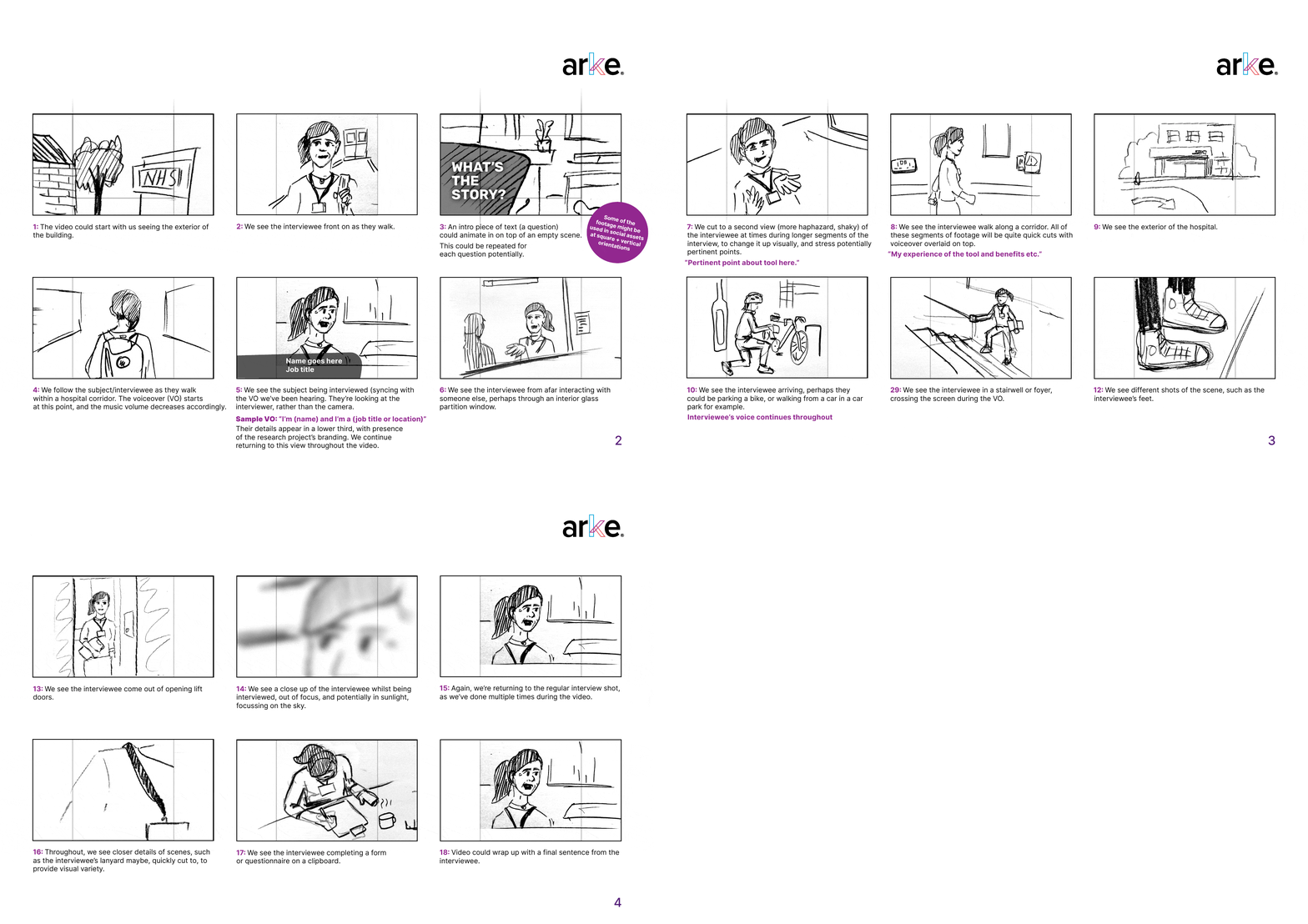
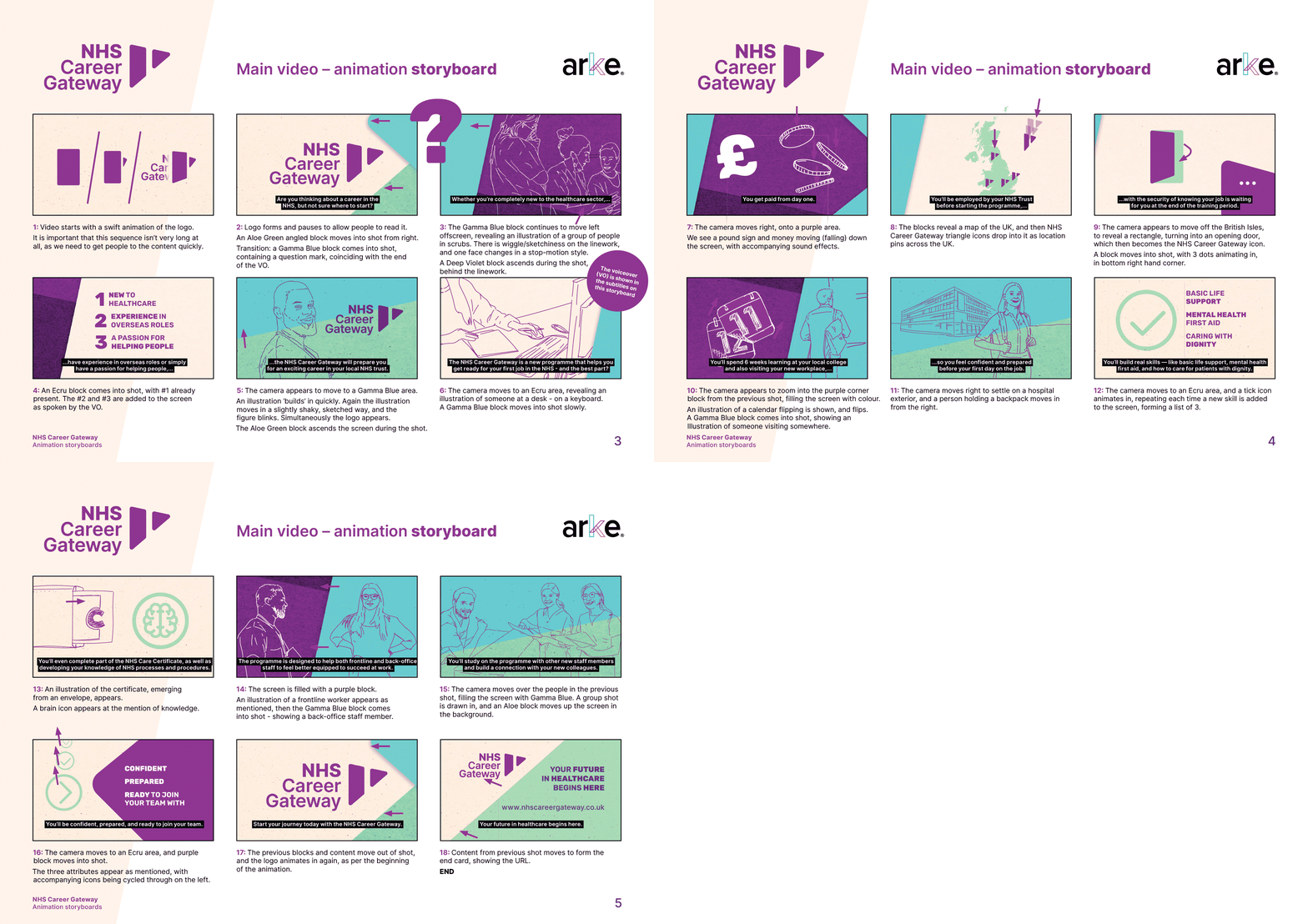
Once all these details are defined, we take the script and move to the storyboard stage. We storyboard the entire animation, so that everyone can review what is going to be produced, and help everyone visualise the final product.
We decide considerations such as: will items drop into shot? Will the camera move to the left? The more detail about what is happening onscreen the better.
Are standalone words being defined going to appear onscreen? If there is going to be a voiceover, then this can be laid out alongside each frame. We also describe transitions – the way one shot becomes the next shot – and how different larger sections will flow into one another on the storyboard too.
Depending on the timescale and requirements of our client, storyboards can be actual pencil drawings in sequence with annotations, or fully worked-up visuals of what will be in each frame.
For some more complex animations, we create low-fidelity animatics, meaning we take the rough (often pencil visuals) frames from the storyboard, and edit them together with a very rough voiceover recorded on an iPhone, to help bring the storyboard to life, and enable some people to visualise the final product more easily.
This can also help when there’s a complex movement that needs to be shown in sequence.

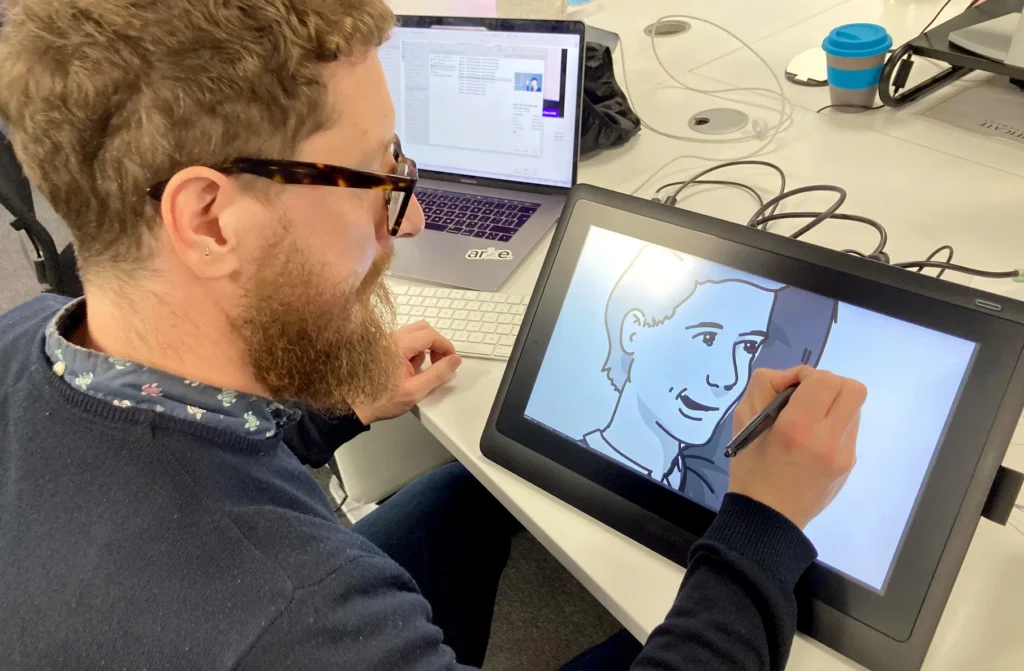
Once the storyboard is signed off, it is time to get to work on moving visuals. The storyboard may have had high-fidelity visuals of each shot, meaning that they simply need to be layered up and taken into the relevant software.
Alternatively, the storyboard may have been rough squiggles and doodles upon doodles, requiring some of the artwork to be brought in line with a visual style for example.
You may have brand guidelines that dictate how illustration and moving image are treated in videos. If you don’t, we’d be happy to help define this.
These pieces of artwork may be icons, requiring lots of layers in vector software like Adobe Illustrator, or detailed pencil drawings, requiring lots of iterations. It all depends on the complexity of the animation style.
They could require lots of tweens if it is a stopframe animation for example. It also depends on the software that it is being produced in. Now here is where AI could be capitalised on, as long as you have full control over how you’re going to get your visuals to move.
Before launching into editing and animating, the audio can be brought up to scratch too.
As an integrated marketing agency, we can take care of this for you. This is the point where we replace the rough placeholder voiceovers and sounds with fully-fledged recorded voiceovers.
We typically record several versions, working with a voice artist.
This is also the point we firm up music we’re going to use, as often animation and footage are cut to the beat, so getting approved backing tracks at this stage can save time down the line.
Now that we have all the pieces, we put them together in a program like Adobe Premiere Pro or After Effects.
We generally chop up the action into a composition per frame, so that they can be moved around if the order needs to change later in the day.
We use standards such as keyframes and easing and the like to bring static assets to life, and sometimes employ the odd plug-in – all depending on the style of motion required!
When everything’s been put together and rendered out, we share our animation for review, both internally and with our client.
We typically use an online feedback tool, so that people can drop comments in at the relevant part of the animation – this helps avoid generic feedback, and ambiguous comments about things like ‘the bit at the end’.
We action any points that come up and circulate a final version, ready for sign off. Being efficient with how feedback is delivered helps to keep account management time to a minimum.
Once the animation is all approved, we often create multiple versions of the same animation.
This is often different sizes customised for their end use i.e. the platform that the animation will appear on.
This affects aspect ratios, and details such as where the subtitles go, even the length. Those platforms might be more suited to shorter, abridged edits too.
We can provide guidance on how the animation can be adapted to work best for each platform, liaising with our Paid Media team internally.
You might think we’re all done by this point, but there’s one more thing to consider: ancillary imagery. By that we mean the static images that accompany your video.
Are there images needed to be visible before it loads, or when it appears on certain platforms?
What will the YouTube thumbnail look like?
If your animation is going to be public-facing, then this will help sell your video, so take some time to come up with some options. You can even test multiple thumbnails on some platforms. How your animation looks before people see it will have a direct effect on play numbers
So that’s how we approach animation here at Arke. There’s plenty of moving parts (pun intended) in animation projects, and they can seem overwhelming at the start!
A successful animation project depends on more than visual execution. It requires clear strategy, audience understanding, strong scripting, thoughtful production and careful planning for where the asset will live.
We’re here to consult on project management – to make commissioning us to produce an animation easy. Have a look at our creative services and let us know if you’re cooking up an idea that you’d like us to get in motion!
Got a mission for us? The Arkenauts are all ears! Book a call, drop your brief or enquiry into our digital portal, and we’ll be in touch straight away!