
Sam Hadley
SEO Specialist,
Arke Agency

NEWS
Sam Hadley
SEO Specialist,
Arke Agency
To answer the question the title poses: yes, but perhaps not in the way we used to.
In this article, Arke’s SEO Specialist, Sam dives into the current state of play for AI Search Optimisation.
Keywords are fragments of intent. Like pottery sherds on an archaeological site, they tell us something real: what people searched, how they phrased it, what language surfaced in the record. But they are not the whole object. A keyword is not demand itself. It is a surviving piece of it.
For years, SEO treated those fragments as the vessel itself. We tracked them, optimised around them, built briefs from them and reported success through them. And, for the most part, it worked. There was a practical neatness to it: find the term, map the page, optimise the title, track the ranking, report the movement.
That was never the whole story, but it was a useful way to make search visible and tangible.
The problem is that search behaviour has become harder to reduce to neat fragments. People still search in short, direct phrases, especially when they know what they want, but they are also searching in longer questions, comparisons, scenarios, follow-ups and half-formed problems.
Google has acknowledged there has been a “profound shift” in how people use Search, with more complex, longer and multimodal questions becoming part of normal search behaviour. AI Mode takes that even further, using query fan-out to explode a single question into multiple subtopics and related searches.
In other words, even Google is no longer treating the typed query as the whole job. The visible query is just the starting point.
That does not mean keywords are dead. It means we need to treat them as what they are: fragments of intent.
It is worth saying this clearly, because otherwise this article risks being mistaken for another lazy “SEO is dead” sandwich-board prophecy, or vapid “rethink your mindset” hustle.
Classic keyword behaviour still exists. It doesn’t matter if you call it SEO, AEO, AIO, GEO or any other acronym.
People still search things like “student accommodation Birmingham”, “best accounting software for small business”, “clearing courses near me”, or “buy waterproof walking boots”. Close to conversion, search behaviour often compresses. The user knows what they want, or at least knows the shape of it, and the query becomes short, commercial and recognisable.
This continuity still matters. In some cases, it matters enormously. If, for example, you are working on ecommerce, higher education, professional services, travel, finance, SaaS or any sector where people compare, choose and buy, you cannot simply float off into “themes” and pretend individual query demand no longer exists. There are still high-value phrases, commercial modifiers, product, location, brand, and comparison terms that deserve close attention.
But this is the distinction: keywords still matter for your AI Search strategy, but they are no longer sufficient. A single keyword can show you a fragment of demand. It cannot reconstruct the whole vessel.
I am slightly wary of saying “people search conversationally now”, because it can become too broad, too easy and too pleased with itself.
People are not all suddenly typing perfect natural-language questions into Google like they are speaking to a patient librarian. Search behaviour is more mixed than that. Old habits remain, and people still use shorthand: they still omit words; they still search in fragments; they still hammer a noun and a couple of adjectives into a box and expect Google to understand.
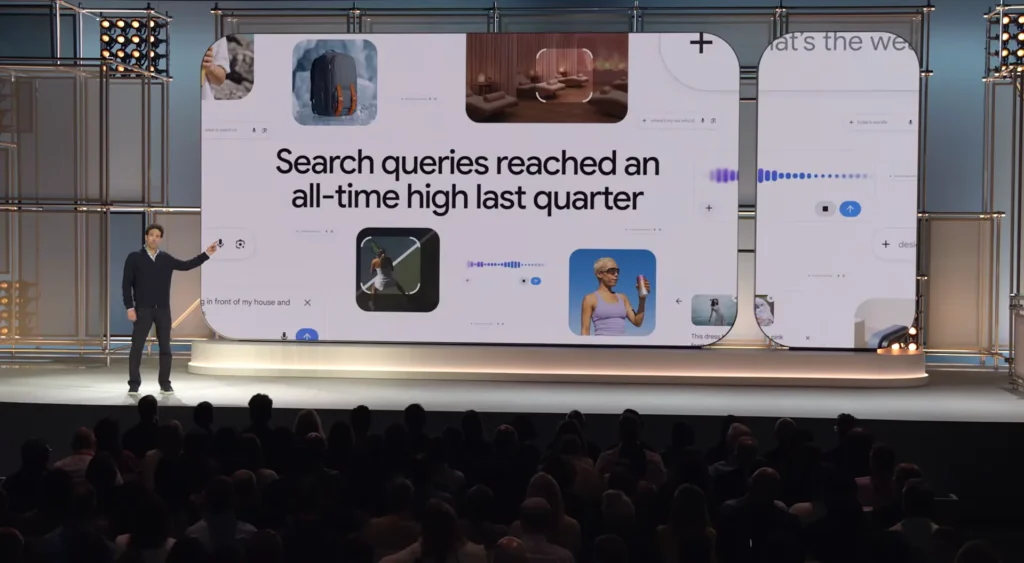
But the important change is that Google is much better at interpreting those fragments, and users are increasingly comfortable giving it more complicated tasks. Philipp Schindler claimed in his opening talk of Google Marketing Live that “search queries are at an all time high”, and that AI Mode searches are 3x longer than traditional queries.
That matters because the strategic unit of SEO starts to change. If a user searches “what can I do with a psychology degree”, “psychology career options after university”, “is psychology a good degree for jobs”, and “psychology degree employability”, those are separate keywords. But strategically, they may belong to the same underlying concern.
In that instance, the searcher is not asking for a keyword. They are asking for reassurance, direction, evidence and possibility.
This is why the old one-keyword, one-page, one-ranking model feels increasingly thin. It is not that the model is useless. It is that it describes only one layer of the search landscape.
One of the clearest signs of this shift is Google Search Console’s Query Groups feature.
Google introduced Query Groups in Search Console Insights to group similar search queries together. The explanation is revealing. Google points out that there are many different ways to write the same query, including misspellings, different phrasing and different languages. It gives the example of multiple queries around making guacamole dip, all phrased differently, but reflecting a similar intent.
Google is not saying individual queries are irrelevant. It is saying that individual queries can become too granular to interpret on their own. The useful view is sometimes the group: the cluster of language that reveals what your audience is trying to understand.
This is very close to how I think SEO needs to evolve. We are moving from isolated keywords to clusters of language, from individual fragments to patterns of intent.
A pottery sherd matters. Its colour, curve, fabric, glaze and markings can tell you a great deal: where it may have been made, how it was fired, roughly when it belongs, and what kind of vessel it once formed part of. But a fragment cannot, on its own, tell you the whole relationship between that vessel and the people who used it. Was it precious or ordinary? Kept or discarded? Used daily, displayed, traded, inherited, broken by accident, or thrown away without much thought? For that, you need context. You need surrounding evidence. You need a reconstruction.
Keywords are the same. They are not meaningless. They are just incomplete.
AI Overviews complicate this further.
Recent 2026 academic research suggests that AI Overviews are not a marginal feature sitting politely above a few informational queries. One large-scale study of 55,393 trending queries found AI Overview activation at 13.7% overall, rising to 64.7% for question-form queries.
Another 2026 study, using a benchmark dataset of 11,500 representative real-user queries, found that AI Overviews were generated for 51.5% of queries and displayed above the organic results.
{Side note: The same study also found low overlap between traditional Google Search results and generative search sources, which suggests that ranking well organically and being surfaced in AI-led results are not necessarily the same thing, but that’s a can of worms for another day.)
You can dispute the exact numbers, because there are so many variables: methodologies, query sets, markets, timing, etc. But the direction is hard to ignore: AI-generated answers are now material enough that SEO measurement cannot pretend they are a side issue.
This matters because AI search changes the visibility question. Historically, we might ask: “Do we rank for this keyword?” Now we also need to ask:
A ranking is still useful evidence. But it is not the whole excavation.
This is where I think the anti-keyword argument often becomes too glib.
It is easy to say keyword tracking is flawed. It is. Any SEO who has spent enough time in Semrush, Ahrefs, Sistrix, Search Console or Data Studio knows that keyword data can be partial, volatile and strangely theatrical. Tiny movements can look dramatic. Important shifts can hide in aggregates. Tracked keyword sets can overrepresent the phrases we already know and underrepresent the messy language users actually use.
But flawed does not mean useless.
Keyword tracking gives us something practical: a consistent sample. It makes the abstract visible. It gives clients, teams and strategists a way to see whether priority areas are moving in the right direction.
For a university, tracking “business management degree”, “nursing degree”, or “clearing courses” will not capture every way a prospective student searches. It will not show every question, comparison, fear, hope or hesitation. But it can still tell you whether the institution is becoming more or less visible across commercially and strategically important territory.
That is useful, it just needs to be treated honestly. The mistake is not in tracking keywords, but is mistaking the tracked keyword set for the whole of search demand.
A fragment is still evidence. You just need to stop calling it the pot.
There is a useful parallel in Google Ads.
Google’s AI Max for Search campaigns is explicitly framed around moving beyond simple query matching and capturing richer intent signals. Google says it uses broad match and keywordless technology to find relevant, high-performing queries advertisers might otherwise miss. Smart Bidding Exploration makes a similar point, with Google saying campaigns using it saw an increase in unique search query categories with conversions.
This is paid search, not SEO, so we can not pretend the two work the same way. But the strategic lesson is still useful: Google is increasingly designing around intent expansion, query variation, and categories of demand; not just exact keyword coverage.
Organic should pay attention to that direction of travel.
Yes. But keywords should no longer be treated as the atomic unit of SEO strategy. They are too small, too tidy and too literal for the way people increasingly search. But they remain useful as measurable indicators of broader visibility.
They are clues. Benchmarks. Fragments. Signals.
The strongest SEO strategies will not ignore keywords. They will use them differently. They will use them to understand themes, not just target phrases. They will measure rankings, but not mistake rankings for the whole picture. They will build content around audience needs, not just query strings. They will report keyword movement, but within a wider model of topical visibility, AI visibility, brand demand and commercial outcomes.
A keyword is a sherd, not the pot.
It can tell you something real. It may even be the first thing you find. But the work of SEO now is not simply to collect fragments. It is to reconstruct the shape of demand they came from.
A modern search strategy should show not just where you rank, but how visible you are across the wider decision journey
For marketing leaders reviewing SEO agency support, the practical implication is clear: SEO strategy can no longer be judged by a rank report alone. The more useful question is whether your brand is visible across the themes, questions and moments that shape a decision; and whether that visibility is turning into qualified traffic, engagement and commercial value.
Are you reviewing your AI SEO Strategy? Let’s have a talk and set a plan of action to increase your AI visibility.
Got a mission for us? The Arkenauts are all ears! Book a call, drop your brief or enquiry into our digital portal, and we’ll be in touch straight away!